Best EHR for Solo Practitioners in 2026: Affordable Options Reviewed
Solo practitioners need affordable, easy-to-use EHR systems with minimal setup. We compared the top options on pricing, ease of use, billing, and time-to-go-live for one-provider practices.
Our Top Picks at a Glance
Tebra
Budget-friendly EHR with patient marketing and easy setup.
DrChrono
iPad-first cloud EHR for tech-forward solo practitioners.
SimplePractice
Beautiful interface with seamless client portal for solo therapists.
TherapyNotes
Structured note templates and reliable billing at an affordable price.
BreezyNotes
Unique pay-per-note model perfect for part-time or low-volume practices.
What Solo Practitioners Should Prioritize in an EHR
Choosing an EHR as a solo practitioner is fundamentally different from selecting one for a group practice or health system. You do not have an IT department, a dedicated billing team, or months of runway to absorb a complex implementation. Every dollar and every hour you spend on your EHR comes directly from your clinical time or your personal budget. That means the criteria that matter most for solo providers are not the same ones that dominate enterprise EHR evaluations.
Affordability is the top priority. Solo practitioners typically generate between $150,000 and $350,000 in annual revenue depending on specialty and payer mix. An EHR that costs $700/month per provider might be reasonable for a large orthopedic group, but it represents a significant percentage of a solo practitioner's overhead. Look for platforms under $100/month if possible, or at minimum under $300/month with billing included. Our complete EHR pricing guide breaks down costs by practice size if you want to benchmark against industry averages.
Ease of use is non-negotiable. You will be the one charting, scheduling, billing, and troubleshooting. There is no support staff to absorb a clunky interface. The EHR should feel intuitive within the first week, not the first quarter. During your demo, pay attention to how many clicks it takes to complete a note, schedule an appointment, and submit a claim. If the vendor needs more than 30 minutes to show you the basics, the product is probably too complex for a one-person operation.
Fast setup matters. Enterprise EHR implementations take 6-18 months. As a solo practitioner, you should be live within 1-3 weeks. Any vendor that quotes you a multi-month implementation timeline is selling you a product built for organizations, not individuals. Look for self-service onboarding with pre-built templates, and confirm that billing/clearinghouse setup is included — not a separate project.
Built-in billing or tight billing integration is essential. If your EHR does not include claims submission, you will need a separate billing platform or a third-party biller, both of which add cost and complexity. The best solo-practitioner EHRs include integrated clearinghouse access, eligibility verification, ERA/EOB posting, and basic denial tracking within the subscription price.
Medical vs. Behavioral Health Solo Practice Needs
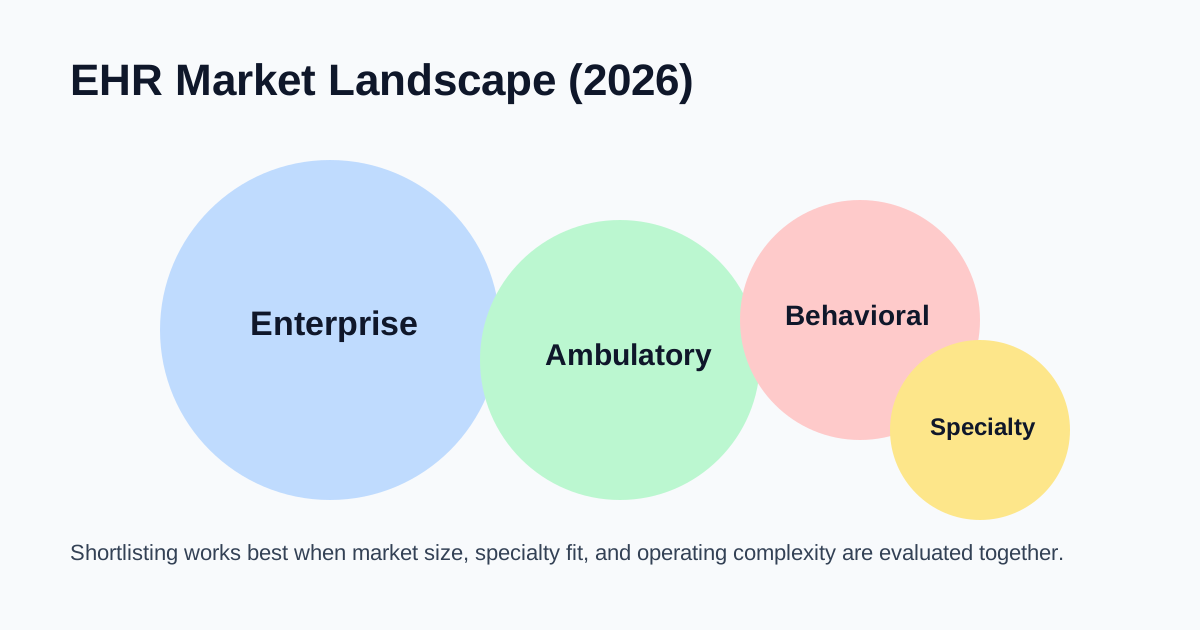
The solo practitioner market splits into two broad camps, and the right EHR depends heavily on which side you fall on. Medical solo practitioners — family medicine, internal medicine, pediatrics, dermatology, urgent care — need a fundamentally different feature set than behavioral health solo providers like therapists, counselors, psychologists, and psychiatrists.
Medical solo practitioners need e-prescribing (EPCS for controlled substances), lab order interfaces, CPOE (computerized provider order entry), problem-oriented charting with ICD-10 and CPT code integration, and immunization registry connections. They also need referral management and the ability to send and receive CCD/CCDA documents for care coordination. Platforms like Tebra and DrChrono serve this market well because they were designed around medical workflows from the start.
Behavioral health solo practitioners need therapy-specific note templates (progress notes, intake assessments, treatment plans, discharge summaries), a client portal for intake paperwork and consent forms, integrated telehealth, and appointment reminders with low no-show management. They typically do not need lab integrations or e-prescribing (unless they are a psychiatrist or prescribing APRN). Platforms like SimplePractice, TherapyNotes, and BreezyNotes are purpose-built for these workflows and are almost always more affordable than general medical EHRs.
Choosing a general medical EHR for a therapy practice (or vice versa) creates daily friction. You will spend time working around templates that do not match your documentation style and navigating features you do not need. Our EHR selection process guide walks through how to evaluate specialty fit during your search.
Detailed Vendor Reviews
Tebra — Most Affordable
Tebra (formerly Kareo) has been a go-to recommendation for budget-conscious solo medical providers for over a decade. The platform combines EHR charting, practice management, billing, and patient marketing tools in a single cloud-based system. For solo practitioners, the biggest draw is the price: you can start with standalone billing for as little as $10/month, and the full EHR plus practice management suite scales up from there depending on the modules you select.
The clinical charting is functional but basic. Tebra includes pre-built note templates, e-prescribing, a patient portal, and online scheduling. Where it shines for solo providers is the integrated clearinghouse — claims submission, eligibility checks, and ERA posting are all built in, which eliminates the need for a separate billing vendor. The patient marketing tools (website builder, online reputation management, SEO) are a unique bonus that no other EHR in this list offers, which can help solo practitioners grow their patient panel without hiring a marketing agency.
The tradeoffs are real, though. Since Kareo merged with PatientPop to form Tebra in 2022, some users report that the platform feels disjointed — the clinical side and the marketing side do not always integrate seamlessly. Customer support quality has been inconsistent post-merger, and the reporting capabilities are limited compared to more expensive platforms. If your priority is the lowest possible cost with adequate (not exceptional) clinical tools, Tebra delivers. If you need deep charting customization or robust analytics, look at DrChrono instead.
DrChrono — Best Mobile EHR
DrChrono was one of the first EHR platforms designed for the iPad, and it remains the strongest mobile-native option for solo medical practitioners. If you run a practice where you move between exam rooms, make house calls, or simply prefer charting on a tablet rather than a desktop, DrChrono delivers a genuinely mobile-first experience rather than a desktop product crammed into a mobile form factor.
The feature set is comprehensive for a solo practitioner: customizable clinical forms, e-prescribing with EPCS, medical billing with an integrated clearinghouse, appointment scheduling, patient portal, and a solid API for third-party integrations. The form builder is particularly strong — you can design note templates from scratch using drag-and-drop fields, which means you can tailor your documentation to your exact workflow rather than conforming to a vendor's idea of how you should chart. DrChrono also supports medical speech-to-text dictation on iPad, which can significantly speed up documentation for solo providers who chart during or between visits.
The downside is price. At $299+/provider/month (with higher tiers available), DrChrono is the most expensive option on this list. That price is competitive for a full-featured medical EHR, but it is a significant jump from Tebra's entry point. DrChrono is best suited for solo medical providers who value charting flexibility and mobile access and are willing to pay more for those capabilities. It is generally overkill for behavioral health practices, which are better served by the BH-specific platforms below.
SimplePractice — Best for Solo Therapists
SimplePractice has earned its dominant position in the solo behavioral health market through relentless focus on user experience. The interface is clean, modern, and genuinely pleasant to use — a quality that matters more than you might think when you will be spending 2-3 hours per day in the system. For solo therapists, counselors, and psychologists, SimplePractice is the benchmark that other BH EHRs are measured against.
The client-facing experience is where SimplePractice truly separates itself. The client portal allows new clients to complete intake paperwork, sign consent forms, provide insurance information, and even make payments — all before their first appointment. Automated appointment reminders reduce no-shows, and the integrated telehealth platform is included in all plans. For solo therapists who want their practice to feel professional and polished from the client's first interaction, SimplePractice delivers that out of the box without any technical setup.
Clinically, SimplePractice includes progress note templates, treatment plan builders, diagnosis tracking, and Wiley Treatment Planner integration. Billing features include insurance claims submission, superbill generation, and credit card processing through Stripe. The main limitation is that SimplePractice is designed for individual and small-group therapy — it does not handle complex medical workflows, lab orders, or e-prescribing. The Starter plan ($49/month) limits you to basic features; most solo therapists will want the Essential plan ($69/month) for insurance billing and telehealth. At that price point, it competes directly with TherapyNotes.
TherapyNotes — Best Documentation
TherapyNotes takes a different approach than SimplePractice: rather than leading with design, it leads with clinical documentation quality. The note templates in TherapyNotes are more structured and clinically rigorous than most competitors, with built-in prompts that guide you through documentation best practices for different session types. For solo practitioners who prioritize thorough, audit-ready notes — or who have been burned by a previous EHR's loose documentation standards — TherapyNotes is a strong choice.
The platform covers the essentials well: scheduling with automated reminders, a patient portal, integrated billing with clearinghouse access, credit card processing, and telehealth. TherapyNotes' billing module is widely regarded as one of the most reliable in the BH EHR space, with clean claim rates that reduce denials and speed up reimbursement. At $69/month for a solo practitioner, the price is competitive and predictable — no tiered plans to navigate or surprise upsells.
The tradeoff versus SimplePractice is primarily in the user interface and client experience. TherapyNotes' interface is functional but less visually polished. The patient portal, while adequate, does not match SimplePractice's seamless onboarding flow. If you are choosing between these two, the decision often comes down to what you value more: a beautiful client-facing experience (SimplePractice) or more rigorous clinical documentation support (TherapyNotes). Both are excellent for solo behavioral health practices.
BreezyNotes — Best Per-Note Pricing
BreezyNotes stands out in this list for its unique pricing model: rather than charging a flat monthly fee regardless of how much you use the system, BreezyNotes offers a pay-per-note structure that scales with your actual caseload. Plans range from $19/month (for very low volume) to $189/month, depending on how many notes you create. For solo practitioners who work part-time, maintain a small caseload, or are building their practice and cannot justify a fixed $69-$100/month fee, this model can represent meaningful savings.
The platform includes treatment planning, progress notes, intake assessments, scheduling, and billing. BreezyNotes is built specifically for behavioral health, so the clinical templates are therapy-oriented out of the box. The interface is straightforward without being spartan — it gets the job done without unnecessary complexity. Billing includes claims submission and basic revenue tracking, covering the essentials a solo BH provider needs.
BreezyNotes is best suited for solo behavioral health providers who see fewer than 20-25 clients per week. At higher volumes, the per-note cost can approach or exceed what you would pay for a flat-rate platform like TherapyNotes or SimplePractice. It is also a strong option for practitioners who are just starting out and want to keep fixed costs minimal until their caseload stabilizes. If you are a full-time solo therapist with a full caseload, compare the per-note cost at your expected volume against the flat rates of the other options before committing.
Pricing Comparison
The table below compares monthly pricing, billing inclusion, and key features across all five recommendations. All prices reflect published or commonly quoted rates as of February 2026 and may vary based on contract terms.
| EHR | Monthly Cost | Billing Included? | Telehealth | Best For |
|---|---|---|---|---|
| Tebra | $10-$100+ | Yes (integrated clearinghouse) | Add-on | Budget-conscious medical solo |
| DrChrono | $299+/provider | Yes (integrated clearinghouse) | Included | Mobile-first medical solo |
| SimplePractice | $49-$99 | Yes (from Essential plan) | Included | Solo therapists/counselors |
| TherapyNotes | $69 | Yes (integrated clearinghouse) | Included | Documentation-focused BH solo |
| BreezyNotes | $19-$189 | Yes | Included | Part-time/low-volume BH solo |
For a deeper dive into EHR pricing models, including how to evaluate percentage-of-collections vs. flat-rate subscriptions and how to calculate your true total cost of ownership, see our complete EHR cost guide.
Free and Low-Cost EHR Options for Solo Practitioners
If budget is the single most important factor, there are a few options below the price points listed above — though each comes with significant tradeoffs.
OpenEMR is an open-source, ONC-certified EHR that is free to download and use. It includes charting, scheduling, billing, e-prescribing, and a patient portal. The catch is that you need technical skills (or a paid hosting provider) to install, configure, and maintain it. Hosted OpenEMR services typically run $50-$150/month, which puts the total cost in the same range as the paid options above but with a less polished interface and slower support. OpenEMR is best for solo practitioners who have IT skills and want maximum customization control.
Practice Fusion was once the dominant free EHR but shifted to a paid model. It now offers a low-cost cloud EHR suitable for small medical practices. Pricing is competitive, though the platform has lost some market share as users migrated to alternatives with better support and fewer ads.
Tebra's billing-only plan at $10/month is the lowest-cost commercial option, but it does not include EHR charting — only practice management and billing. If you are a solo practitioner who primarily needs claims submission and scheduling (for example, a cash-pay practice that only bills a few insurance patients), this stripped-down plan can work. However, it does not satisfy Meaningful Use or MIPS requirements since it lacks the clinical EHR component.
Our general recommendation: unless you have strong technical skills and want to self-host OpenEMR, the paid options between $49-$100/month offer dramatically better user experience, support, and time savings. For a solo practitioner billing even 10-15 insurance claims per month, the time saved by an integrated billing EHR easily justifies the subscription cost.
Setup Time Comparison
One of the advantages of being a solo practitioner is that EHR implementation is far simpler than it is for larger organizations. You do not need to coordinate across departments, train multiple staff members, or run complex data migrations. Still, setup time varies meaningfully between platforms.
| EHR | Typical Setup Time | Self-Service? | Data Migration Help | Notes |
|---|---|---|---|---|
| SimplePractice | 2-5 days | Yes | CSV import | Fastest setup; pre-built templates ready immediately |
| BreezyNotes | 3-7 days | Yes | Manual entry or CSV | Simple onboarding; minimal configuration needed |
| TherapyNotes | 1-2 weeks | Yes | CSV import | Billing/clearinghouse credential setup adds a few days |
| Tebra | 1-2 weeks | Guided | Vendor-assisted | Marketing module setup is separate and takes longer |
| DrChrono | 2-4 weeks | Guided | Vendor-assisted | Custom form builder adds setup time but pays off long-term |
The biggest variable in setup time is not the software itself — it is your clearinghouse and payer enrollment. If you are switching from another EHR and already have active payer credentials, you can often migrate those credentials to your new platform within a few days. If you are starting a new practice and need to enroll with payers from scratch, add 2-6 weeks to any of the timelines above for credentialing, which is independent of the EHR setup.
For a complete implementation checklist including data migration, staff training, and go-live planning, see our EHR selection process guide.
Frequently Asked Questions
What is the cheapest EHR for a solo doctor?
Tebra is one of the cheapest commercial EHR options for solo medical doctors, with plans starting around $10/month for billing-only and scaling up from there for the full EHR suite. For behavioral health solo practitioners, BreezyNotes starts at $19/month with its pay-per-note model, and SimplePractice starts at $49/month. If you want a free option, OpenEMR is an open-source EHR with no license fee, though it requires technical skills or a paid hosting provider to set up and maintain.
Do solo practitioners need a full EHR system?
Yes. Any provider who bills insurance or participates in Medicare/Medicaid quality programs needs an ONC-certified EHR. Even cash-pay solo practitioners benefit from an EHR for structured documentation, e-prescribing, and liability protection. However, solo practitioners do not need enterprise-grade features like multi-location scheduling, complex role-based permissions, or departmental reporting. A lightweight, affordable EHR with solid charting, billing, and scheduling is sufficient.
How long does it take a solo practitioner to set up an EHR?
Most cloud-based EHRs designed for small practices can be fully operational in 1-3 weeks for a solo practitioner. SimplePractice and BreezyNotes typically take under one week. Tebra and TherapyNotes average 1-2 weeks. DrChrono may take 2-4 weeks due to its deeper customization options. The main time investment is configuring note templates, importing your patient list, and setting up billing credentials with payers.
Should a solo practitioner choose a medical EHR or a behavioral health EHR?
Choose an EHR built for your specialty. Solo therapists, counselors, psychologists, and psychiatrists should use a behavioral health EHR like SimplePractice, TherapyNotes, or BreezyNotes. Solo medical providers should use a medical EHR like Tebra or DrChrono. Using a general-purpose EHR for behavioral health (or vice versa) creates daily documentation friction and potential compliance gaps.
Can I switch EHR systems easily as a solo practitioner?
Solo practitioners have the easiest time switching EHR systems compared to any other practice size. With only one provider and typically fewer than 500 active patients, data migration is straightforward. Most cloud EHR vendors offer data export in CSV or CCD/CCDA format. Plan for 2-4 weeks total: export your data, verify the new system can import it, run both systems in parallel for 1-2 weeks, and complete the cutover. See our EHR selection guide for the full switching process.
The Bottom Line
The best EHR for a solo practitioner depends on two factors: your specialty and your budget. For solo medical providers who want the lowest cost, Tebra is hard to beat. If you want the best mobile experience and are willing to pay for it, DrChrono is the clear choice. For solo behavioral health providers, SimplePractice offers the best overall experience, TherapyNotes has the strongest documentation, and BreezyNotes is ideal if you need flexible, volume-based pricing.
All five platforms can be set up in under a month, include integrated billing, and are priced for one-provider practices. The risk of choosing wrong is low — as a solo practitioner, switching EHRs is a matter of weeks, not months. Start with a free trial or demo from your top two choices, chart a few sample notes, submit a test claim, and go with the platform that feels most natural for your workflow.
For help structuring your evaluation process, read our step-by-step EHR selection guide. For a full breakdown of what you should expect to pay, see our EHR pricing guide. And if you want to compare any of these vendors head-to-head, visit our vendor directory for detailed profiles, feature breakdowns, and user review summaries.