Best EHR for MAT Programs in 2026
Best EHR platforms for medication-assisted treatment (MAT) programs, evaluated on EPCS workflows, compliance controls, SUD documentation depth, and revenue-cycle reliability.
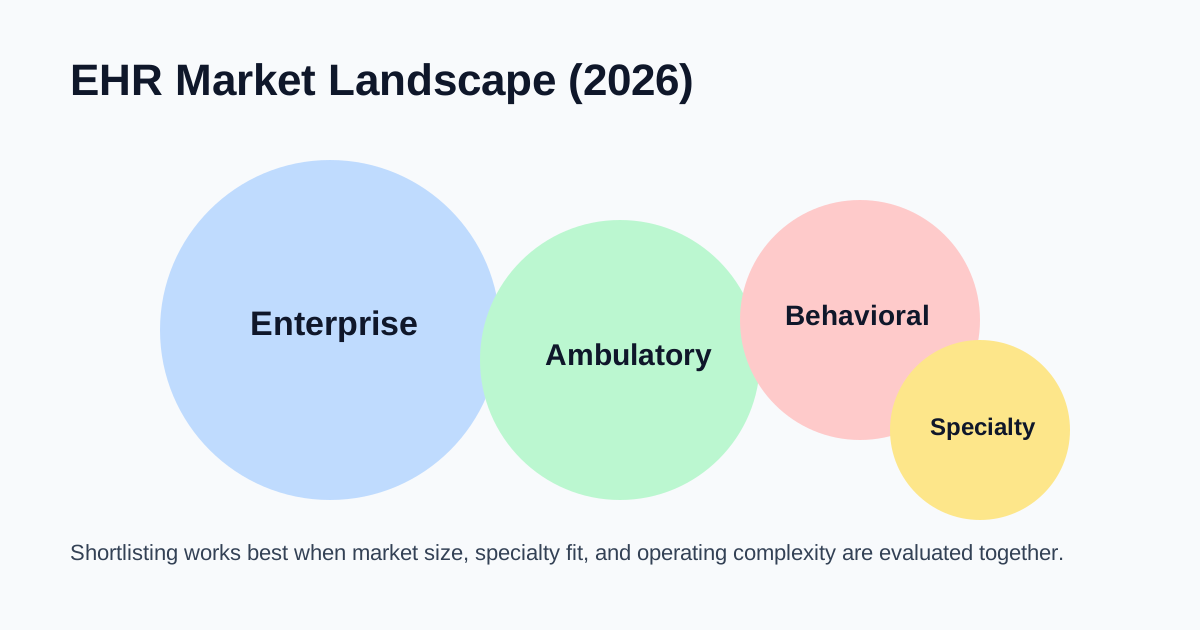
Our Top Picks at a Glance
Ease
AI-native BH platform with EPCS support, integrated operations tooling, and strong clinician-productivity workflows.
AZZLY Rize
Purpose-built SUD platform with ASAM-oriented workflows, compliance controls, and integrated RCM.
Valant
Strong psychiatry-first prescribing experience with EPCS and medication-management depth.
Netsmart (myAvatar)
Enterprise behavioral-health platform for large organizations with complex reporting and multi-site operations.
PIMSY
Balanced clinical and business tooling for mid-size organizations blending MAT with broader behavioral health services.
Key Takeaways
- MAT programs operate at the intersection of controlled-substance prescribing, behavioral health documentation, 42 CFR Part 2 compliance, and complex payer operations -- requiring EHR capabilities that general-purpose and even standard BH platforms do not provide.
- EPCS-certified e-prescribing with integrated PDMP lookups is non-negotiable for any program dispensing or prescribing buprenorphine, naltrexone, or methadone.
- Ease and AZZLY Rize are the strongest purpose-built options, combining MAT medication tracking, ASAM criteria integration, 42 CFR Part 2-oriented controls, and integrated RCM in a single platform.
- OTP (Opioid Treatment Program) compliance, urine drug screen tracking, and state reporting requirements add layers of documentation that the EHR must handle natively to avoid audit exposure.
- Prior authorization for MAT medications is a revenue-critical workflow -- programs that automate auth tracking through their EHR recover significantly more revenue than those managing authorizations manually.
What MAT Programs Should Look For in an EHR
Medication-assisted treatment programs face a unique operational reality. You are prescribing controlled substances -- buprenorphine, methadone, naltrexone -- to a patient population under intense regulatory scrutiny, while simultaneously managing behavioral health documentation, coordinating care with primary care and mental health providers, navigating prior authorization requirements that vary by payer and state, and maintaining compliance with federal substance use disorder privacy laws that go well beyond HIPAA. A general-purpose EHR, or even a standard behavioral health platform, was not built for this level of clinical and administrative complexity. The result of using the wrong system is predictable: manual workarounds, compliance gaps, denied claims, and clinician burnout from documentation overhead that the EHR should be absorbing.
The right EHR for a MAT program must function as an integrated clinical, compliance, and revenue-cycle platform. It needs to handle controlled-substance prescribing workflows with the same fluency that a cardiology EHR handles order sets, and it needs to embed regulatory controls -- 42 CFR Part 2 consent tracking, PDMP integration, OTP reporting, urine drug screen management -- into the daily clinical workflow rather than leaving them as afterthoughts. Programs that get this choice right see measurable improvements in authorization turnaround, claim acceptance rates, and clinician productivity. Programs that get it wrong spend their first year building workarounds and their second year shopping for a replacement. Here is what to evaluate.
- EPCS and controlled-substance prescribing quality: The EHR must be Surescripts-certified for Electronic Prescribing of Controlled Substances (EPCS) across all DEA schedule classes. For MAT programs, this means reliable buprenorphine prescribing (Schedule III), support for methadone documentation in OTP settings, and naltrexone (Vivitrol) injection tracking. Look for platforms that embed PDMP lookups directly into the prescribing workflow rather than requiring a separate browser tab -- this saves 3-5 minutes per patient encounter and ensures you are meeting state-mandated PDMP query requirements.
- 42 CFR Part 2 compliance controls: Substance use disorder records carry federal privacy protections that exceed HIPAA. Your EHR must provide granular consent management, segmented record access, disclosure audit trails, and re-disclosure prohibition notices. Programs that manage Part 2 compliance through paper forms and manual tracking routinely receive audit findings during state surveys and accreditation reviews. The EHR is the compliance backbone -- purpose-built SUD platforms embed these controls natively rather than requiring bolt-on modules.
- Urine drug screen (UDS) management and result tracking: MAT programs conduct frequent toxicology screens to monitor treatment adherence and detect relapse. The EHR should support lab order entry, electronic result ingestion, panel-specific result interpretation (distinguishing between prescribed medications and illicit substances), and longitudinal tracking of UDS results across the episode of care. Results should auto-populate the clinical chart and flag abnormal findings for prescriber review.
- ASAM criteria integration and treatment plan documentation: ASAM (American Society of Addiction Medicine) criteria are the national standard for assessing SUD patients and determining the appropriate level of care. Your EHR should provide structured ASAM assessment templates that guide clinicians through all six dimensions, generate level-of-care recommendations, and produce documentation that satisfies payer authorization requirements. Treatment plans built on ASAM-informed goals create a defensible clinical narrative that reduces concurrent review friction and denial rates. See our EHR selection process guide for how to evaluate this during vendor demos.
- Prior authorization and revenue-cycle integration: Prior authorization for MAT medications -- particularly branded buprenorphine formulations and injectable naltrexone -- is among the most time-consuming administrative tasks in SUD treatment. The EHR should provide authorization tracking with status visibility, denial management workflows, and integration with payer portals or clearinghouses that reduce manual phone and fax cycles. Programs that automate auth workflows through their EHR report 20-40% reductions in authorization turnaround time. For a deeper look at cost structures, see our comprehensive EHR pricing guide.
- State reporting and OTP compliance: Opioid Treatment Programs certified by SAMHSA face additional reporting requirements, including the Treatment Episode Data Set (TEDS), state-mandated outcomes reporting, and OTP-specific documentation standards for methadone dispensing. Many states also require reporting to prescription drug monitoring programs for dispensed methadone. The EHR must support structured data capture that maps to these reporting requirements rather than forcing manual data extraction from free-text notes.
Detailed Reviews
Ease -- Best Overall MAT Platform
Ease brings an AI-native operating model to MAT program management that fundamentally changes how clinicians interact with documentation and administrative tasks. The platform's Voice AI capabilities allow prescribers to dictate encounter notes during patient visits and receive structured, coded documentation in return -- a meaningful productivity gain when you are seeing 25-35 MAT patients per day and each encounter requires medication reconciliation notes, UDS result review documentation, PDMP query records, and treatment plan updates. Ease handles EPCS-compliant prescribing for buprenorphine and other controlled substances, and its integrated operational tooling connects the clinical encounter directly to authorization tracking, billing, and program-level reporting without manual handoffs.
What differentiates Ease from other MAT-capable platforms is the depth of its operational integration. The platform combines EHR, CRM, and RCM functionality in a single system, which means admissions workflows, prior authorization tracking, and claims management all operate from the same data layer as the clinical chart. For MAT programs dealing with complex payer mixes -- Medicaid managed care, commercial insurance with varying formulary restrictions, and grant-funded patients -- this integration eliminates the reconciliation gaps that arise when clinical and billing systems are disconnected. Ease also provides program-level dashboards that give leadership visibility into census, retention rates, authorization status, and revenue per encounter, which is critical for programs managing to narrow margins.
The trade-off is that Ease uses quote-based pricing, which means smaller programs need to evaluate whether the platform's full capabilities justify the investment relative to simpler alternatives. Ease is best suited for MAT programs that are scaling, operating multiple sites, or looking to reduce administrative overhead through AI-driven automation. Solo prescribers running a small buprenorphine panel within a general psychiatry practice may find the platform more comprehensive than they need. But for dedicated MAT clinics, OTPs, and multi-service SUD organizations, Ease belongs at the top of the evaluation list. For California-specific compliance considerations, see our EHR for MAT programs in California guide.
AZZLY Rize -- Best Dedicated SUD/MAT Platform
AZZLY Rize was built from the ground up for substance use disorder treatment, and that specialization pays dividends in MAT program operations. The platform provides ASAM-aligned assessment workflows that walk clinicians through all six dimensions and generate level-of-care documentation formatted for payer authorization submissions. For MAT specifically, Rize supports medication administration records (MAR) for observed dosing in OTP settings, controlled-substance tracking integrated with the treatment plan, and UDS result management with longitudinal trending. The 42 CFR Part 2 compliance infrastructure is among the most mature in the SUD EHR market, with granular consent management, segmented record access, and comprehensive disclosure audit trails built into the system's core architecture.
AZZLY Rize's differentiator is its all-in-one approach. The platform bundles clinical EHR, practice management, billing/RCM, and compliance tooling in a single system, which eliminates the integration overhead that MAT programs face when they piece together separate systems for prescribing, documentation, authorization management, and claims submission. For programs running multiple levels of care -- combining outpatient MAT with IOP, PHP, or residential treatment -- Rize provides census management, group therapy documentation, and discharge planning workflows alongside the MAT-specific tooling. This breadth makes it particularly well-suited for organizations where MAT is one service line within a larger SUD or behavioral health operation.
The drawbacks are primarily around modernization and AI capabilities. AZZLY Rize does not offer the AI-driven documentation and workflow automation that Ease provides, which means clinicians are doing more manual documentation work per encounter. The user interface, while functional and improving, is not as visually polished as newer platforms. And like Ease, pricing is quote-based and tailored to program size and module selection. For programs where SUD-specific compliance depth and all-in-one operational coverage are the primary evaluation criteria -- and where AI-powered documentation is less of a priority -- AZZLY Rize is the strongest purpose-built option available. See our best EHR for addiction treatment page for a broader comparison of SUD platforms.
Valant -- Best Prescriber Workflow
Valant was designed for behavioral health prescribers, and its medication management workflow is the tightest in the space for psychiatrists and nurse practitioners running outpatient MAT panels. The platform provides Surescripts-certified e-prescribing with native EPCS support across all DEA schedule classes, in-workflow PDMP integration that auto-queries state databases when you open a prescribing screen, and Surescripts medication history that pulls a patient's fill records automatically. For a prescriber writing 20+ buprenorphine prescriptions per day, this level of integration saves meaningful time and reduces the risk of missed PDMP queries that create compliance exposure.
Valant also provides structured psychiatric documentation templates that work well for MAT medication management visits -- 15-20 minute encounters focused on symptom review, side effect assessment, UDS result discussion, and prescription renewal. The platform supports measurement-based care with PHQ-9, GAD-7, and other standardized instruments that patients can complete through the portal before appointments, which is valuable for tracking co-occurring depression and anxiety in MAT patients. Valant's patient portal enables secure messaging, refill requests, and appointment scheduling, all of which reduce phone call volume for front desk staff.
The limitation for MAT programs is scope. Valant does not provide residential census management, its group therapy documentation is basic, and its 42 CFR Part 2 compliance tooling is less comprehensive than what AZZLY Rize or Ease offer. Valant also lacks ASAM criteria assessment templates and does not include the revenue-cycle management depth that dedicated SUD platforms provide. For outpatient-only MAT programs where the primary workflow is prescriber-patient medication management -- and where group therapy, residential services, and complex payer authorization are not significant parts of the operation -- Valant is an excellent fit. If your program operates across multiple levels of care or needs deep SUD compliance infrastructure, Ease or AZZLY Rize will serve you better.
Netsmart (myAvatar) -- Best Enterprise MAT Programs
Netsmart myAvatar is the dominant enterprise behavioral health EHR, deployed across thousands of organizations and serving over 750,000 users. For large MAT operations -- multi-site OTPs, statewide treatment networks, and organizations managing hundreds of concurrent MAT patients -- myAvatar provides the scalability, state reporting integration, and enterprise analytics that smaller platforms cannot match. The platform supports ASAM-based assessments, 42 CFR Part 2 compliance controls, controlled-substance documentation, and the complex reporting requirements that come with state contracts and Medicaid managed care agreements.
Where Netsmart separates itself is in data infrastructure and interoperability. Large MAT organizations need to exchange data with state prescription drug monitoring programs, report to TEDS and state outcomes systems, integrate with health information exchanges for care coordination with primary care providers, and produce aggregate analytics for contract compliance and grant reporting. Netsmart's CareFabric platform and interoperability layer are built for this level of data exchange. The platform also supports multi-site configuration with centralized administration, which matters for organizations operating 10+ MAT clinic locations under a single governance structure.
The trade-offs are cost, implementation complexity, and user experience. Netsmart implementations for enterprise clients typically take 12-18 months and cost six figures for implementation alone, before recurring subscription fees. The user interface, while functional, requires significant training and is not as intuitive as newer platforms. For organizations with fewer than 50 staff or a single MAT clinic location, Netsmart is overkill -- the implementation investment and ongoing complexity are disproportionate to the program's needs. But for large behavioral health organizations where MAT is one component of a multi-service operation, myAvatar remains the enterprise standard.
PIMSY -- Best Mid-Market MAT/BH Mix
PIMSY (Practice Information Management System) occupies a practical middle ground for mid-size organizations that blend MAT services with broader behavioral health programming. The platform provides ASAM assessment support, treatment planning with the Wiley Treatment Planner integration, group therapy documentation, and billing with claims management. For MAT workflows specifically, PIMSY supports e-prescribing, medication tracking, and basic controlled-substance documentation. Its strength is breadth: PIMSY covers clinical documentation, billing, scheduling, HR management, payroll, staff credentialing, and practice reporting in a single platform.
For organizations where MAT is one of several service lines -- a community mental health center that offers outpatient therapy, psychiatric services, IOP, and a MAT clinic -- PIMSY's ability to manage all of these programs within one system reduces the vendor sprawl and integration complexity that mid-size organizations struggle with. The Wiley Treatment Planner integration provides evidence-based treatment goals and objectives that clinicians can customize for SUD and co-occurring disorder patients, which accelerates treatment plan creation and improves documentation consistency across the organization.
The trade-off is MAT-specific depth. PIMSY's controlled-substance workflow and 42 CFR Part 2 compliance tooling are not as mature as what AZZLY Rize or Ease provide. Organizations whose primary identity is a dedicated MAT clinic or OTP will find the SUD-specific capabilities thinner than purpose-built alternatives. However, for a 15-50 person organization that needs a cost-effective all-in-one platform at $99+/user/month and treats MAT patients alongside a broader behavioral health caseload, PIMSY delivers strong value. The built-in HR and payroll functionality alone can eliminate $200-$500/month in separate software costs.
Pricing Comparison
MAT program EHR pricing is more variable than general outpatient behavioral health because of the additional compliance modules, prescribing infrastructure, and operational tooling these programs require. The table below summarizes pricing across our recommended platforms. For a full analysis of EHR cost structures including hidden fees, see our EHR cost guide.
| Vendor | Monthly Cost | Pricing Model | Implementation Fee | Key Included Feature |
|---|---|---|---|---|
| Ease | Quote-based | Facility/program | Included in contract | AI documentation + integrated RCM |
| AZZLY Rize | Quote-based | Facility/module | $5,000-$25,000+ | All-in-one SUD EHR + RCM + billing |
| Valant | $100-$300/provider | Per provider/month | $1,000-$5,000 | EPCS + in-workflow PDMP |
| Netsmart (myAvatar) | Quote-based | Enterprise contract | $50,000-$200,000+ | Enterprise scale + state reporting |
| PIMSY | $99+/user/mo | Per user/month | $2,000-$8,000 | EHR + HR + payroll in one |
Quote-based vendors (Ease, AZZLY Rize, Netsmart) typically factor in facility size, number of active patients, module selection, and program type when generating pricing. For a mid-size MAT clinic with 10-20 clinical staff, expect first-year total costs (subscription + implementation + training + data migration) in the range of $30,000-$90,000 for purpose-built SUD platforms, and $15,000-$45,000 for per-provider platforms like Valant. Enterprise deployments with Netsmart routinely exceed $200,000 in the first year. EPCS typically adds a one-time hardware token cost of $25-$75 per prescriber or a recurring soft-token fee, regardless of vendor.
MAT-Specific Workflows Your EHR Must Support
Buprenorphine and Methadone Dispensing Documentation
The documentation requirements for buprenorphine prescribing and methadone dispensing are substantively different, and your EHR must handle both correctly. For outpatient buprenorphine programs, the EHR needs to support EPCS-compliant prescribing for Schedule III medications, induction protocol documentation (including observed induction notes when applicable), dosing titration records, and take-home prescription tracking. Each encounter should capture the prescriber's clinical rationale for the current dose, any dose adjustments, patient-reported symptoms, and UDS results that informed the prescribing decision.
Methadone dispensing in OTP settings requires a different workflow. Because methadone for opioid use disorder is dispensed on-site rather than prescribed to a pharmacy, the EHR must function as a medication administration record (MAR) that logs each dispensing event with the dose, time, dispensing clinician, and patient identification verification. OTPs are required to document take-home eligibility criteria, phase advancement decisions, and guest dosing arrangements when patients receive methadone at a different OTP location. An EHR that treats buprenorphine and methadone identically misses the operational differences between office-based prescribing and OTP-based dispensing.
PDMP Integration and Controlled Substance Tracking
Every state now operates a Prescription Drug Monitoring Program (PDMP), and the majority require prescribers to query the PDMP before prescribing or dispensing controlled substances. For MAT programs, this is not an occasional check -- it happens at every encounter. The EHR should integrate directly with the state PDMP so that prescribers can query patient records without leaving the clinical chart. The best implementations auto-query the PDMP when a controlled substance prescription is initiated and display results inline with the prescribing workflow. Programs operating in multiple states need an EHR that supports PDMP integration across all relevant jurisdictions, which typically means integration through a PDMP aggregator like Appriss PMP Gateway or Bamboo Health.
Beyond PDMP queries, the EHR should maintain a comprehensive controlled substance log that tracks every prescription written or medication dispensed, including the drug, dose, quantity, refills authorized, prescriber, and date. This log serves as the program's internal audit trail and is routinely reviewed during DEA inspections and state licensing surveys. Programs that rely on manual logs or separate spreadsheets for controlled substance tracking are introducing unnecessary compliance risk.
Urine Drug Screen Management
Urine drug screens are a core clinical tool in MAT programs, used to verify treatment adherence, detect unauthorized substance use, and inform prescribing decisions. A MAT-focused EHR should support the full UDS lifecycle: ordering panels (standard immunoassay and confirmatory testing), tracking specimen collection with chain-of-custody documentation when required, receiving electronic results from the lab, presenting results in a clinician-friendly format that distinguishes between expected positives (prescribed medications) and unexpected findings, and maintaining a longitudinal view of results over time. Abnormal results should generate clinical alerts that prompt prescriber review before the next prescription is issued.
The documentation of how UDS results are interpreted and acted upon is equally important. When a patient's screen shows an unexpected substance, the clinical note should capture the prescriber's assessment of the finding, any clinical conversation with the patient, and the treatment decision (dose adjustment, increased monitoring frequency, referral to a higher level of care, or no change with documented rationale). EHRs that treat UDS results as simple pass/fail entries miss the clinical nuance that auditors and payers expect.
Group Therapy Documentation
Many MAT programs incorporate group counseling, psychoeducation, and peer support sessions alongside medication management. Programs offering IOP or PHP levels of care may run 10-20 groups per week. The EHR must support group session creation with attendance tracking, a shared group note with individualized clinical annotations for each participant, proper billing code assignment (group therapy codes differ from individual session codes), and mapping of group attendance to treatment plan goals. Without structured group documentation, clinicians either skip individualization -- creating audit exposure -- or spend hours duplicating documentation across individual charts.
Care Coordination with Primary Care and Behavioral Health
MAT patients frequently have co-occurring medical and behavioral health conditions that require coordination with external providers. The EHR should support care coordination workflows including referral tracking, secure messaging or document exchange with referring providers, shared care plan documentation, and -- critically for SUD programs -- the ability to share clinical information while maintaining 42 CFR Part 2 consent requirements. This means the EHR must allow authorized record sharing with specific providers while excluding SUD-specific information from general health information exchange transmissions unless the patient has explicitly consented. Programs that cannot manage this segmentation risk either inadvertently disclosing protected SUD records or failing to coordinate care because the consent process is too cumbersome.
Medication Reconciliation
MAT patients are often on multiple medications -- buprenorphine or methadone for opioid use disorder, psychiatric medications for co-occurring depression or anxiety, and medications for chronic medical conditions. Medication reconciliation at every encounter is both a clinical safety requirement and a documentation standard. The EHR should pull real-time medication history from Surescripts, flag potential drug interactions (particularly with benzodiazepines, which carry heightened overdose risk when combined with opioid agonists), and produce a current medication list that is reviewed and signed off by the prescriber at each visit.
42 CFR Part 2 and OTP Compliance
42 CFR Part 2 is the federal regulation that separates SUD treatment documentation from every other healthcare specialty. Updated most recently in 2024, Part 2 requires explicit patient consent before substance use disorder treatment records can be disclosed to any outside entity -- including other healthcare providers, insurance companies, employers, or law enforcement. For MAT programs, this means every disclosure of treatment records must be individually authorized, tracked, and auditable. The EHR must support consent form management that documents which entities are authorized to receive records, what information is covered, the purpose of disclosure, the authorization timeframe, and the patient's right to revoke consent at any time.
Beyond consent management, the EHR must enforce record segmentation so that SUD-specific information is not included in standard health information exchange transmissions, referral documents, or records shared with providers who have not received patient authorization. Every disclosure must be logged with a timestamp, recipient identification, scope of information shared, and a re-disclosure prohibition notice attached to the shared records. For MAT programs specifically, this is complicated by the need to coordinate care with primary care providers and mental health professionals -- you need to share enough information for safe clinical coordination while respecting Part 2's consent requirements.
Opioid Treatment Programs (OTPs) face additional compliance requirements. SAMHSA-certified OTPs must maintain documentation of patient eligibility for take-home medication, phase advancement criteria, counseling attendance records, and annual physical examination results. OTPs must also report to state regulatory bodies and SAMHSA, which typically requires structured data exports that map to specific reporting schemas. The EHR should capture this data through normal clinical workflows rather than requiring separate data entry for regulatory reporting. Programs that fail to produce clean audit documentation during SAMHSA or state licensing surveys risk corrective action plans, increased oversight, or in severe cases, loss of OTP certification.
State Reporting and Prior Authorization for MAT Medications
State reporting requirements for MAT programs vary significantly by jurisdiction, but most states require some combination of TEDS (Treatment Episode Data Set) submissions, state outcomes reporting, PDMP data contributions for dispensed medications, and Medicaid-specific reporting for publicly funded programs. The EHR should capture the data elements required for these reports through normal clinical documentation -- patient demographics, diagnosis codes, treatment modality, medication type and dose, UDS results, treatment episode dates, and discharge disposition -- and produce structured exports that align with state reporting formats. Programs that rely on manual data extraction from clinical notes for state reporting are wasting significant staff time and introducing data quality issues.
Prior authorization for MAT medications remains one of the most frustrating administrative burdens in SUD treatment. While federal and state parity laws prohibit more restrictive prior authorization for SUD medications than for other chronic conditions, in practice many payers still require prior authorization for branded buprenorphine formulations (Suboxone film, Sublocade injectable), injectable naltrexone (Vivitrol), and sometimes even generic buprenorphine-naloxone. The EHR should provide authorization tracking that shows the current status of every pending authorization, alerts staff when authorizations are approaching expiration, and integrates with payer portals or electronic prior authorization (ePA) networks to reduce the phone-and-fax cycle.
Programs that automate prior authorization tracking through their EHR see fewer gaps in medication coverage, fewer patient disruptions from authorization lapses, and faster time-to-medication for new patients. The financial impact is also significant: a denied or expired authorization on a Sublocade injection ($1,800+ per month) results in either an uncompensated administration or a delayed treatment -- both of which are bad outcomes for the patient and the program.
Implementation Considerations
Implementing an EHR in a MAT program requires more configuration and workflow design than a typical outpatient behavioral health deployment. The controlled-substance prescribing infrastructure alone requires DEA identity-proofing for each prescriber (a prerequisite for EPCS activation), PDMP integration configuration for every state in which the program operates, and testing of the prescribing workflow end-to-end with the clearinghouse and receiving pharmacies. OTP programs need methadone dispensing workflows configured with their specific dosing protocols, take-home eligibility criteria, and phase advancement rules. Expect this prescribing and dispensing configuration to take 2-4 weeks of dedicated implementation time, separate from the general EHR setup.
Data migration is another area where MAT programs face unique challenges. If you are migrating from a legacy EHR or paper-based system, you need to transfer not just patient demographics and clinical notes but also controlled substance prescription histories, UDS result archives, ASAM assessment records, and -- critically -- 42 CFR Part 2 consent documentation. Losing consent records during a migration creates an immediate compliance gap because you cannot verify which disclosures were authorized under the prior system. Work with your EHR vendor to create a migration plan that specifically addresses these SUD-specific data elements, and budget 4-8 weeks for data migration and validation. Our EHR implementation checklist provides a step-by-step framework.
Training is the third implementation factor that MAT programs underestimate. Your clinical staff need to learn not just the general EHR interface but the specific workflows for controlled-substance prescribing, UDS ordering and result review, ASAM assessments, group documentation, 42 CFR Part 2 consent management, and authorization tracking. Plan for at least 8-16 hours of role-specific training per clinician, with prescribers receiving additional training on EPCS workflows and PDMP integration. Programs that compress training to save time consistently report higher post-go-live support ticket volumes, more documentation errors in the first 90 days, and clinician frustration that could have been avoided with adequate preparation. For guidance on managing the organizational change, see our EHR change management guide.
Bottom Line
MAT programs need an EHR that treats controlled-substance prescribing, 42 CFR Part 2 compliance, UDS management, and payer authorization as first-class workflows -- not afterthoughts bolted onto a general-purpose platform. The clinical, regulatory, and financial stakes are too high for workarounds. Ease is our top recommendation for MAT programs that want AI-driven clinician productivity, integrated operational tooling, and a modern platform that connects clinical documentation directly to revenue-cycle management. AZZLY Rize is the strongest choice for programs prioritizing SUD-specific compliance depth and all-in-one operational coverage in a purpose-built SUD platform. For outpatient MAT clinics where prescribing is the dominant workflow, Valant offers the best prescriber experience in the behavioral health EHR market. Enterprise organizations operating multi-site MAT networks should evaluate Netsmart myAvatar, and mid-size organizations blending MAT with broader behavioral health services will find PIMSY a cost-effective all-in-one option.
Regardless of which platform you select, the most consequential decision is to choose an EHR that was designed for the operational reality of medication-assisted treatment. The cost of manual workarounds in staff time, the revenue impact of denied authorizations and rejected claims, and the compliance risk of inadequate 42 CFR Part 2 controls far exceed the subscription premium of a purpose-built MAT platform over a general-purpose alternative. Start with demos of the platforms that match your program type and size, and evaluate prescribing workflows, compliance controls, and authorization tracking with the same rigor you bring to clinical care. For a structured evaluation approach, our EHR selection process guide provides a step-by-step framework.
Next Steps
- → Ease Vendor Profile -- AI-native MAT/BH platform with operations and productivity workflows
- → AZZLY Rize Vendor Profile -- Purpose-built SUD platform with ASAM, Part 2, and integrated RCM
- → Best EHR for Addiction Treatment -- Broader SUD platform comparison including residential and IOP/PHP
- → EHR for MAT Programs in California -- State-specific compliance and vendor guidance
- → EHR Cost Guide -- Understand total cost of ownership before you buy
- → EHR Selection Process -- Step-by-step vendor evaluation framework
- → Implementation Checklist -- Plan your go-live to avoid costly mistakes