Best EHR for Physical Therapy Practices in 2026
Top PT and rehab EHR platforms for SMB organizations, compared on documentation speed, scheduling throughput, claims operations, and multi-provider scalability.
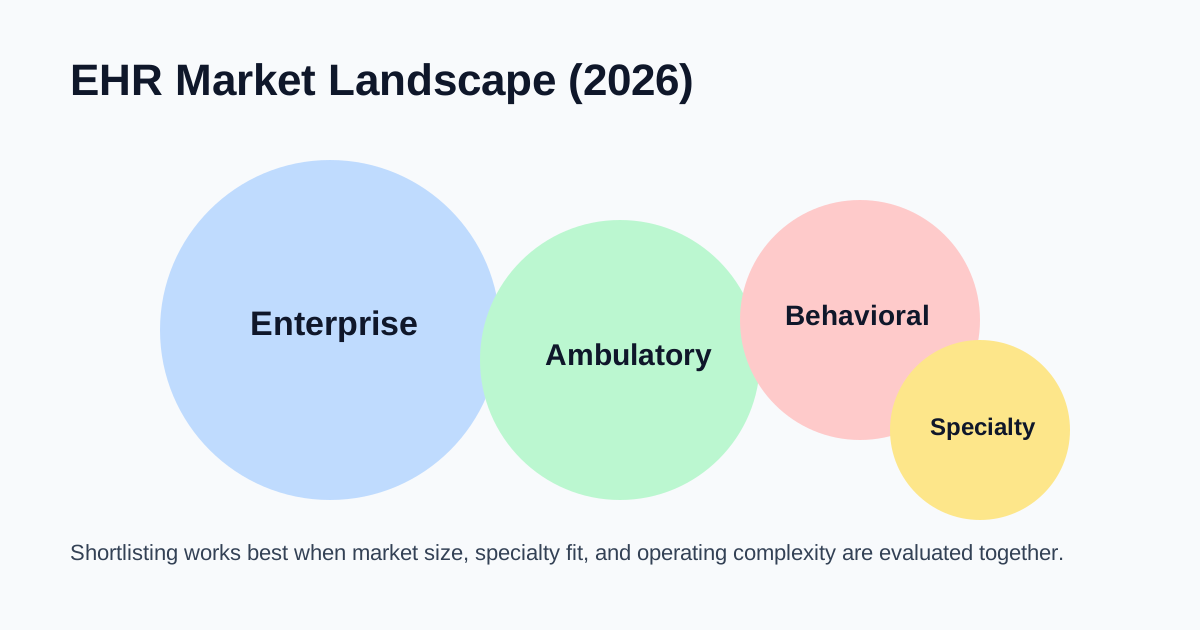
Our Top Picks at a Glance
WebPT
Rehab-focused platform with broad adoption and mature PT operational workflows.
Practice Perfect
Strong PT/OT/SLP support for multidisciplinary rehab organizations.
OptimisPT
Cloud PT platform designed for independent clinics planning scale.
ClinicSource
Solid fit for pediatric and multi-specialty therapy SMB operations.
Fusion Web Clinic
Documentation-oriented rehab platform for structured therapy workflows.
What Physical Therapy Practices Should Look For in an EHR
Physical therapy documentation is one of the most time-intensive workflows in outpatient healthcare. A typical PT evaluation requires range-of-motion measurements, manual muscle testing grades, functional limitation scores, special test results, and a detailed plan of care -- all before the therapist writes a single treatment note. Multiply that by 15 to 20 patients per day per therapist, and documentation overhead becomes the single biggest drag on clinic productivity. A general medical EHR treats these requirements as an afterthought, forcing therapists to document in free-text fields or bolt-on modules that were never designed for rehab workflows. The result is late-night charting, incomplete documentation, and claims that get denied for insufficient clinical detail.
The right PT EHR should accelerate documentation without sacrificing the clinical specificity that payers demand. That means structured evaluation templates with built-in ROM and strength grading, exercise prescription libraries that link to home exercise programs, progress note workflows that auto-pull objective data from previous visits, and plan-of-care management tools that track certification periods and re-evaluation deadlines. Beyond documentation, PT practices face unique operational challenges: managing multiple therapist schedules with different specialties, tracking insurance authorization limits and plan-of-care renewal deadlines, and demonstrating patient outcomes to payers who increasingly tie reimbursement to measurable progress. The six criteria below should anchor your evaluation process.
- PT-specific evaluation documentation: Your EHR must support structured initial evaluation templates that capture range of motion (goniometric measurements), manual muscle testing (0-5 grading), functional testing (Timed Up and Go, Berg Balance, 6-Minute Walk Test), and special tests (Lachman, McMurray, Neer, Hawkins-Kennedy) in a format that flows naturally during the patient encounter. The best platforms let you document ROM and strength with tap-or-click grids rather than free-text entry, and they carry forward baseline measurements so that progress notes automatically show change over time. This structured approach saves documentation time and produces the clinical detail that supports medical necessity for ongoing treatment. For more on how documentation speed impacts practice economics, see our documentation burden reduction guide.
- Exercise prescription and home exercise program (HEP) libraries: Exercise prescription is a core component of physical therapy, and your EHR should include a searchable library of exercises with images or videos, dosing parameters (sets, reps, frequency, hold time), and the ability to generate printed or digital home exercise programs that patients can access from their phone. Platforms that integrate with dedicated HEP services like MedBridge or HEP2go offer richer exercise content, but built-in libraries reduce integration complexity. The HEP should link directly to the treatment note so that prescribed exercises are documented automatically without duplicate data entry.
- Treatment plan and plan-of-care management: Medicare and most commercial payers require a written plan of care that is established within the first visit, reviewed and updated at defined intervals, and signed by the referring physician. Your EHR should track plan-of-care certification periods (typically 90 days for Medicare), alert therapists when recertification is due, and manage the physician signature workflow -- whether that happens via fax, electronic signature, or a referring provider portal. Missing a plan-of-care deadline does not just create a compliance issue; it can result in retroactive claim denials for every visit in the uncertified period. Learn more about compliance-aware EHR selection in our EHR selection process guide.
- Outcomes measurement integration: Payers and accreditation bodies increasingly expect PT practices to track and report patient outcomes using standardized tools. Your EHR should support functional outcome measures like the Focus on Therapeutic Outcomes (FOTO) platform, patient-reported outcome measures (PROMs) such as the DASH (Disabilities of the Arm, Shoulder and Hand), LEFS (Lower Extremity Functional Scale), and Oswestry Disability Index, and display outcome trends as longitudinal graphs within the patient chart. Practices that track outcomes systematically gain a competitive advantage in payer negotiations, value-based contracts, and quality reporting programs.
- Insurance authorization and visit limit management: Physical therapy benefits are among the most heavily managed in commercial insurance. Most plans impose visit limits (often 20 to 60 visits per year), require prior authorization for ongoing treatment, and demand plan-of-care renewals at defined intervals. Your EHR must track authorized visits per patient per payer, display remaining visits at check-in, alert scheduling staff when authorization is about to expire, and generate the clinical documentation needed to request additional visits. For Medicare patients, the system must also track the therapy cap threshold and flag when the KX modifier is required to certify that continued treatment is medically necessary. Our EHR cost guide covers how to weigh these compliance features against subscription costs.
- Multi-therapist scheduling and utilization tracking: PT clinics typically employ multiple therapists with different specialties (orthopedic, neurological, pelvic floor, sports, pediatric), and the scheduling system needs to match patients to the right therapist based on specialty, availability, and continuity of care preferences. Beyond basic appointment booking, the scheduler should track therapist utilization rates, manage concurrent patient treatments (common in high-volume outpatient PT), handle cancellation and no-show workflows, and report on scheduling efficiency metrics. Therapist utilization is the primary revenue lever in PT -- even a 5% improvement in schedule fill rate can translate to significant annual revenue gains. For broader operational guidance, see our clinic operating playbook.
Detailed Vendor Reviews
WebPT -- Best Overall PT SMB
WebPT is the most widely adopted EHR in the outpatient physical therapy market, and that market position is built on a genuinely strong rehab-specific workflow. The platform was founded by a physical therapist, and it shows in the documentation design. Initial evaluation templates include structured ROM and strength grading, special test documentation, functional outcome measures, and plan-of-care management with built-in certification tracking. Progress notes carry forward objective measurements from previous visits, making it easy to demonstrate clinical improvement over the course of treatment. WebPT also includes a robust exercise library with HEP generation and supports integration with outcomes platforms like FOTO.
Beyond documentation, WebPT has expanded into a broader practice management platform with scheduling, billing (through its WebPT Billing service or third-party integrations), a patient portal, referral tracking, and analytics. The scheduling module handles multi-therapist calendars with color-coded appointment types and supports the concurrent treatment model common in outpatient PT. The analytics dashboard provides visibility into referral patterns, therapist productivity, payer mix, and visit volume trends. For practices that want a single vendor for clinical and operational workflows, WebPT's integrated approach reduces the need for separate billing software or scheduling tools.
The primary trade-off is pricing. WebPT has moved to a quote-based model, and costs can escalate as you add billing services, analytics modules, and additional users. Some users report that the billing module, while convenient, does not match the depth of dedicated revenue cycle management services for complex payer scenarios. The interface is functional and well-organized but not as visually modern as some newer competitors. For most small to mid-size PT practices, WebPT remains the safest and most feature-complete choice. Practices with highly complex billing needs or those prioritizing a more modern interface may want to evaluate alternatives alongside it. For guidance on structuring vendor demos, see our EHR demo evaluation guide.
Practice Perfect -- Best Multi-Discipline Fit
Practice Perfect is designed for rehab organizations that span multiple therapy disciplines -- physical therapy, occupational therapy, speech-language pathology, and related services -- within a single practice or organization. The platform handles the scheduling, documentation, and billing complexities that arise when different therapy types have different session lengths, documentation requirements, and billing rules. For multidisciplinary clinics, the ability to manage PT, OT, and SLP workflows in one system without maintaining separate platforms for each discipline is a significant operational advantage.
Practice Perfect's documentation module supports discipline-specific templates with structured objective measures appropriate to each therapy type. PT evaluations include ROM, strength, and functional testing grids; OT templates support ADL assessments and fine motor documentation; SLP templates handle articulation, language, and swallowing evaluations. The scheduling system supports multi-provider, multi-discipline booking with appointment type rules that prevent scheduling conflicts. The billing engine handles the different CPT code sets and modifier requirements across therapy disciplines, including timed-code tracking for therapy services billed in 15-minute units.
The trade-off with Practice Perfect is that its breadth across disciplines means it may not go as deep in any single discipline as a PT-only platform like WebPT. Practices that are exclusively PT may find some of the multi-discipline features unnecessary, and the interface reflects the complexity of supporting multiple therapy types. Pricing is quote-based, and implementation requires more configuration than a single-discipline platform because each therapy type needs its own template setup and billing rules. For organizations that offer PT alongside OT and SLP services, Practice Perfect avoids the cost and complexity of running multiple EHR systems. For PT-only practices, the added complexity may not be justified. Review our EHR implementation checklist to plan a multi-discipline rollout.
OptimisPT -- Best Growth Option
OptimisPT is a cloud-based PT EHR designed for independent clinics that plan to grow from a single location to a multi-site operation. The platform balances the documentation depth needed for day-to-day clinical work with the operational infrastructure -- multi-location management, centralized reporting, and role-based access controls -- that growing practices need. OptimisPT supports structured PT evaluations, progress notes with objective data carry-forward, and plan-of-care tracking with recertification alerts, covering the core clinical requirements for outpatient PT.
Where OptimisPT stands out from single-location focused competitors is in its growth-oriented feature set. The platform includes organization-level dashboards that aggregate clinical and financial data across multiple locations, standardized template libraries that ensure documentation consistency as you add sites, and administrative controls that let practice owners manage user permissions and workflows centrally. The scheduling module supports multi-location, multi-provider booking, and the billing engine handles payer-specific rules across locations. For practice owners who have experienced the pain of outgrowing a simpler system and facing a costly migration, OptimisPT's built-in scalability is a compelling value proposition.
The limitation is that OptimisPT's pricing is quote-based and its feature set is designed for practices that are actively planning growth. A solo therapist operating a single location may find the platform more complex than necessary and would be better served by a lighter option. The platform's user community is smaller than WebPT's, which means fewer peer resources and third-party integrations. For independent PT clinics with a clear growth trajectory, OptimisPT provides the infrastructure to scale without switching platforms. For practices that expect to remain small, simpler options offer better value. For broader perspective on scaling clinic operations, see our multispecialty provider group EHR guide.
ClinicSource -- Best Pediatric Therapy Fit
ClinicSource fills a specific niche in the rehab EHR market: pediatric therapy and multi-specialty therapy practices that need documentation workflows designed for children and developmental populations. While ClinicSource supports adult PT workflows, its pediatric therapy templates, school-based therapy documentation, and IEP (Individualized Education Program) tracking set it apart from platforms designed primarily for adult orthopedic PT. For practices that treat a significant pediatric caseload, these specialized features eliminate the need to adapt adult-oriented documentation tools for children.
The platform covers the standard EHR requirements -- scheduling, documentation, billing, and reporting -- with published pricing that starts at $74.95 per month, making it one of the more affordable options for small therapy practices. ClinicSource includes customizable evaluation templates, progress note workflows, goal tracking with measurable objectives, and a billing module with electronic claims submission. The interface is straightforward and accessible for therapists who are not technology-oriented, and the self-service onboarding process allows small practices to get up and running without a lengthy implementation project.
The trade-off is that ClinicSource's feature depth for adult outpatient PT does not match WebPT or OptimisPT. The ROM and strength documentation tools are more basic, the exercise library is more limited, and the outcomes tracking is less sophisticated than platforms that focus exclusively on adult rehab. Multi-location management and advanced analytics are also limited compared to growth-oriented competitors. For pediatric therapy practices, school-based therapy programs, and small multidisciplinary clinics that serve children, ClinicSource is a strong and affordable choice. For adult outpatient PT practices, particularly those with complex payer mixes, other options on this list will be a better fit. Our EHR cost guide can help you compare pricing models across these options.
Fusion Web Clinic -- Best Documentation Focus
Fusion Web Clinic is built around a single premise: documentation should be the strongest part of a therapy EHR, not an afterthought. The platform's documentation engine supports highly structured evaluation and progress note templates for PT, OT, and SLP with standardized outcome measures, goal tracking, and objective data workflows designed to produce payer-ready documentation on the first pass. For practices that have struggled with claim denials due to insufficient documentation or auditors questioning the medical necessity of continued treatment, Fusion's documentation rigor addresses that problem directly.
Fusion Web Clinic's templates guide therapists through a structured documentation workflow that captures the clinical detail payers require -- baseline functional limitations, measurable goals with target dates, objective progress measures, and skilled intervention justification -- without leaving gaps that trigger denials. The platform also supports patient outcome tracking and generates reports that demonstrate treatment effectiveness at both the patient and practice level. Scheduling, billing, and practice management features are included, rounding out the platform as a complete practice solution rather than a documentation-only tool.
The limitation is that Fusion Web Clinic's focus on documentation structure can feel rigid to therapists who prefer more flexibility in how they write their notes. The template-driven approach works well for practices that want consistency and compliance, but therapists who are accustomed to free-form narrative notes may find the structured format constraining. Pricing is quote-based, and the platform's market footprint is smaller than WebPT's, which means fewer peer resources and community support options. For practices that prioritize documentation quality and compliance as their top criteria, Fusion Web Clinic is purpose-built for that goal. For practices that value flexibility and a larger support ecosystem, WebPT or Practice Perfect may be more comfortable choices. See our quality reporting guide for more on how documentation quality impacts compliance and reimbursement.
Medicare Compliance, Therapy Caps, and KX Modifier Requirements
Medicare compliance is one of the most critical and frequently misunderstood areas of PT billing, and your EHR's ability to handle it correctly has a direct impact on revenue and audit risk. The Medicare therapy threshold (formerly called the therapy cap) sets an annual dollar limit on outpatient therapy services. Once a patient's therapy charges exceed the threshold -- which is adjusted annually by CMS and was $2,330 for PT and SLP combined in 2025 -- the treating therapist must append the KX modifier to every subsequent claim line to certify that continued treatment is medically necessary and that the documentation supports that determination. If your EHR does not track cumulative therapy charges against the threshold and prompt for the KX modifier automatically, you are relying on billing staff to manually monitor every Medicare patient's spending against a moving target. That is a process that fails at scale.
Beyond the KX modifier, Medicare imposes targeted medical review thresholds at higher spending levels. When a patient's therapy charges exceed the targeted review threshold ($3,000 for PT/SLP combined in recent years), Medicare contractors can select claims for pre-payment or post-payment review. At this point, the quality of your documentation determines whether you get paid. Your notes must demonstrate skilled therapy services (not maintenance-level care), measurable functional progress, a reasonable expectation of improvement, and a plan of care that has been certified by a physician. EHRs that embed these requirements into the documentation workflow -- prompting therapists to record functional outcomes, progress toward goals, and skilled intervention justification at every visit -- produce notes that survive audits. EHRs that treat documentation as free-form narrative leave therapists to remember these requirements on their own, which leads to inconsistent documentation and elevated audit risk. For more on compliance-ready documentation, see our quality reporting guide.
The plan-of-care certification requirement adds another compliance layer. Medicare requires that a physician (or qualifying non-physician practitioner) certify the plan of care within 30 days of the initial evaluation and recertify it at least every 90 days thereafter. Your EHR should track these certification deadlines, generate plan-of-care documents formatted for physician signature, and maintain an audit trail showing when the plan was sent, signed, and returned. Practices that handle this workflow through fax-and-paper systems frequently miss certification deadlines, resulting in retroactive claim denials for every visit in the uncertified period. The financial exposure from a missed recertification can be significant -- a therapist treating a Medicare patient three times per week for 90 days without a certified plan of care faces potential denial of 36 or more visits. Purpose-built PT EHRs like WebPT and Fusion Web Clinic include plan-of-care tracking as a core feature. General medical EHRs rarely handle this workflow without significant customization. For a broader view of compliance requirements, see our denial prevention playbook.
Outcomes Measurement and the Shift Toward Value-Based PT
The physical therapy profession is in the early stages of a transition from volume-based to value-based reimbursement, and practices that build outcomes measurement into their clinical workflow now will be better positioned when payer contracts shift. The Merit-based Incentive Payment System (MIPS) already requires eligible PT providers to report quality measures, and commercial payers are increasingly incorporating outcome data into contract negotiations and network inclusion decisions. Your EHR should support standardized functional outcome measures -- including the DASH for upper extremity conditions, the LEFS for lower extremity conditions, the Oswestry Disability Index for lumbar spine, the Neck Disability Index for cervical spine, and general health measures like the Patient-Specific Functional Scale -- administered at evaluation, regular intervals, and discharge.
Integration with the Focus on Therapeutic Outcomes (FOTO) platform deserves specific evaluation. FOTO is the most widely used outcomes benchmarking system in outpatient PT, providing risk-adjusted outcome comparisons that allow practices to benchmark their results against national averages for similar patient populations. Practices that participate in FOTO can demonstrate to payers, referral sources, and patients that their outcomes are above average -- a powerful competitive differentiator when physician offices decide where to send their post-surgical rehab patients. WebPT includes native FOTO integration, and several other PT EHRs support FOTO data exchange through APIs or manual entry. If outcomes measurement is a strategic priority for your practice, verify the depth of FOTO integration during your demo evaluation rather than assuming it will work after purchase.
Patient-reported outcome measures (PROMs) are a related but distinct capability. While FOTO provides clinician-scored functional assessments, PROMs capture the patient's own perspective on their pain, function, and quality of life. Payers and accreditation bodies are placing increasing emphasis on PROMs as a measure of treatment effectiveness. Your EHR should support administering PROMs electronically -- ideally through the patient portal before the visit, so the therapist has the scores available during the session -- and displaying PROM trends as longitudinal charts in the patient record. Practices that combine clinician-scored outcome measures with patient-reported data have the strongest evidence base for demonstrating treatment value. For practices thinking about how to structure their operations for long-term competitiveness, our value-based care configuration guide provides a framework for aligning your EHR workflows with value-based payment models.
Multi-Therapist Scheduling and Clinic Utilization
Scheduling in a physical therapy practice is fundamentally more complex than in most medical specialties because of the concurrent treatment model. In a typical outpatient PT clinic, a therapist may have two or three patients in treatment simultaneously -- one performing exercises independently, one receiving manual therapy, and one being supervised by a therapy aide. The scheduling system must support this overlapping appointment structure while ensuring that the therapist's direct treatment time is allocated appropriately for billing purposes. If the scheduler only supports sequential one-patient-at-a-time booking, it forces the practice into an unrealistic scheduling model that either underutilizes therapists or creates scheduling chaos when the front desk tries to double-book manually.
Therapist utilization rate -- the percentage of available treatment hours that are filled with billable patient encounters -- is the single most important financial metric in outpatient PT. A therapist operating at 85 percent utilization generates significantly more revenue than one at 70 percent, and the difference flows almost entirely to the bottom line since the therapist's salary is a fixed cost. Your EHR should report on utilization rates by therapist, by day of week, and by time slot, making it easy to identify scheduling gaps and optimize appointment availability. The system should also track cancellation and no-show rates by therapist and by referral source, since these metrics directly impact utilization. Practices that monitor utilization data weekly and adjust scheduling templates monthly typically achieve 5 to 10 percentage points higher utilization than those that manage schedules reactively.
For multi-location PT organizations, scheduling becomes an organizational-level challenge. Patients may need to be seen at different locations based on therapist specialty, equipment availability, or geographic convenience. The EHR should support cross-location scheduling visibility so that front desk staff at one location can see availability and book appointments at another location. Centralized waitlist management is another valuable feature -- when a cancellation opens a slot, the system should automatically notify patients on the waitlist rather than leaving that revenue on the table. As practices grow beyond two or three locations, the scheduling module often becomes the bottleneck that determines whether a platform can scale with the organization. Evaluate multi-location scheduling carefully during the demo process, and ask for references from practices of similar size and complexity. For further guidance on scaling clinic operations, see our EHR change management guide and our post-go-live optimization guide.
Pricing Comparison
Physical therapy EHR pricing varies based on practice size, feature requirements, and whether billing services are included or handled separately. The table below reflects publicly available pricing and research-based estimates as of early 2026. Most PT EHR vendors use quote-based pricing, so the ranges shown may differ from your actual quoted price depending on provider count, locations, and module selection.
| Vendor | Monthly Cost | Pricing Model | Implementation Fee | Key Included Feature |
|---|---|---|---|---|
| WebPT | Quote-based (~$99+/mo per provider) | Per-provider, modular | Included with onboarding | PT documentation + HEP |
| Practice Perfect | Quote-based | Per-provider or per-org | Varies by configuration | Multi-discipline support |
| OptimisPT | Quote-based | Per-provider, scalable | Included with onboarding | Multi-location management |
| ClinicSource | From $74.95/mo | Tiered monthly plans | Self-service (minimal) | Pediatric therapy templates |
| Fusion Web Clinic | Quote-based | Per-provider | Varies by practice size | Structured documentation engine |
These base prices do not reflect the full cost of ownership. Add-on billing services (WebPT Billing, for example, is a separate fee), outcomes tracking modules, HEP integrations, additional user licenses, and data migration fees can significantly increase the total investment. For PT practices evaluating WebPT specifically, ask for a complete quote that includes the EHR, billing, analytics, and HEP modules as a bundle rather than pricing each separately. Our total cost of ownership guide provides a framework for calculating what you will actually pay over a three-year period, including hidden costs that vendors may not surface during the sales process.
Implementation Considerations for Physical Therapy Practices
Implementing a new EHR in a physical therapy practice requires planning around documentation workflows, scheduling continuity, and the billing handoff -- the three areas where disruption creates the most immediate financial impact. Unlike medical practices where a single provider sees patients independently, PT clinics often operate with therapists treating multiple patients concurrently, therapy aides and assistants contributing to treatment delivery, and front desk staff managing a high volume of scheduling changes throughout the day. Any system transition needs to account for this multi-role, high-throughput operating model. Plan for a two-to-four-week implementation period for a single-location practice, and add one to two weeks per additional location for multi-site organizations.
The most common implementation failure point in PT practices is the documentation workflow transition. Therapists who have spent years building muscle memory in their current system will need time to learn new template structures, exercise libraries, and objective documentation workflows. Do not underestimate this transition cost. Schedule hands-on documentation training at least one week before go-live, and have therapists practice documenting a full day's worth of patient encounters in a sandbox environment before treating live patients in the new system. Pay particular attention to how the new system handles timed CPT codes (97110, 97140, 97530, etc.), since underdocumentation of treatment time is one of the most common revenue leakage points in PT billing. The 8-minute rule for Medicare timed codes must be accurately reflected in your documentation workflow -- if the new system does not enforce this logic natively, you will need a manual process to verify it. For a full implementation roadmap, see our EHR implementation checklist.
Authorization and plan-of-care data migration deserves special attention. When you switch EHR systems mid-treatment-cycle, you risk losing track of where patients are in their authorized visit counts, plan-of-care certification periods, and re-evaluation schedules. Before go-live, run a report from your current system that lists every active patient with their authorized visits remaining, plan-of-care expiration date, and next re-evaluation due date. Import this data into the new system or enter it manually for every active patient. Missing a plan-of-care deadline or exceeding authorized visits because of a system transition is a preventable error that directly impacts revenue. Stage your go-live to avoid the beginning of the month when plan-of-care renewals are typically due, and assign a dedicated team member to audit authorization tracking for the first 30 days after go-live. Our data migration checklist covers this process in detail, and our guide on why EHR implementations fail identifies the operational risks that are specific to high-volume therapy practices.
Finally, plan for a productivity dip during the first two to three weeks after go-live and adjust your scheduling capacity accordingly. Most PT practices see a 15 to 25 percent reduction in patient throughput during the initial transition period as therapists learn the new documentation workflows and front desk staff adjust to new scheduling and check-in processes. Reducing patient volume slightly during this period prevents burnout, reduces after-hours charting, and gives staff time to build competence without compromising patient care quality. Track daily note completion times, claim submission rates, and scheduling fill rates during the first 30 days to identify bottlenecks early and address them before they become entrenched habits.
Bottom Line
The physical therapy EHR market is mature enough that there are strong options for every practice profile, but there is no single best platform for everyone. The recommendations break down by practice type:
- Small to mid-size outpatient PT practices should start with WebPT. It offers the deepest rehab-specific documentation, the largest user community, native FOTO outcomes integration, and a growing practice management suite that reduces the need for separate billing and scheduling systems.
- Multidisciplinary rehab organizations that combine PT, OT, and SLP under one roof should evaluate Practice Perfect for its ability to manage discipline-specific documentation, billing, and scheduling in a single platform without maintaining separate systems for each therapy type.
- Independent clinics with growth plans should consider OptimisPT for its multi-location management infrastructure, centralized reporting, and scalable architecture that prevents a costly platform migration as you add sites.
- Pediatric therapy practices and school-based programs should look at ClinicSource for its specialized documentation templates for developmental populations, IEP tracking, and affordable published pricing that works for small therapy organizations.
- Compliance-focused practices that prioritize documentation quality and audit readiness above all else should evaluate Fusion Web Clinic for its structured documentation engine that produces notes designed to withstand payer scrutiny.
Before committing to any platform, run a realistic pilot that tests the complete workflow from patient scheduling through claim payment. Pay particular attention to timed-code documentation accuracy, plan-of-care certification tracking, authorization management, and outcomes measurement -- these are the areas where PT-specific EHRs earn their value and where general medical EHRs consistently fall short. Request references from practices with similar patient volumes, payer mixes, and staffing models, and verify that the vendor's implementation team has experience with outpatient PT workflows specifically. The cost of choosing the wrong platform extends well beyond the monthly subscription -- it includes lost revenue from documentation-related denials, clinician overtime spent on after-hours charting, and the eventual migration cost when the practice outgrows the system. Start with our EHR selection process guide for a structured evaluation framework, and consult our demo evaluation guide to prepare for vendor presentations.