TherapyNotes vs SimplePractice (2026 Comparison)
An in-depth, side-by-side comparison of TherapyNotes and SimplePractice — the two most popular EHR platforms for therapists. We break down documentation, billing, telehealth, pricing, and more to help you choose the right fit.
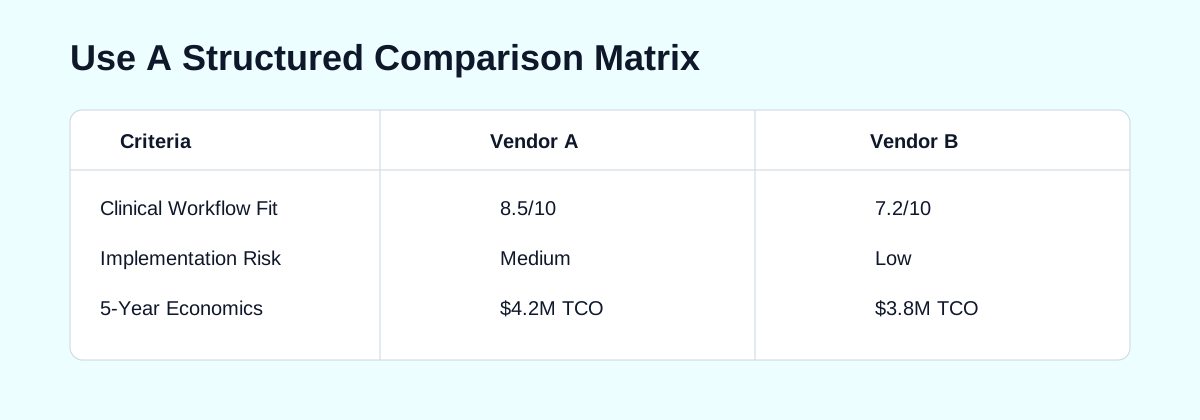
Need help choosing between TherapyNotes and SimplePractice?
Use our structured selection workflow for requirements, demos, and contracting.
TherapyNotes
Structured documentation for therapists
SimplePractice
Modern, consumer-grade therapist EHR
Overview: The Two Biggest Names in Therapist EHR
If you are a therapist, counselor, or social worker shopping for practice management software in 2026, the conversation almost always comes down to two names: TherapyNotes and SimplePractice. Together, they dominate the small-practice behavioral health EHR market, and for good reason. Both are cloud-based, both handle scheduling, documentation, billing, and telehealth, and both have earned loyal followings among mental health professionals.
But they are not the same product. TherapyNotes, founded in 2010, was built by a psychologist who wanted clinical documentation done right. It takes a structured, template-driven approach to note-writing and treats insurance billing as a first-class feature. SimplePractice, launched in 2012, took the opposite angle: start with beautiful design, make the client experience seamless, and build clinical tools around that consumer-grade interface.
The result is two platforms that look similar on a feature checklist but feel dramatically different in daily use. This guide breaks down every meaningful difference so you can make an informed choice. For a broader look at the behavioral health EHR landscape, see our full behavioral health EHR comparison.
Important caveat: Neither TherapyNotes nor SimplePractice is built for substance use disorder (SUD) treatment. If your practice requires ASAM-level documentation, bed management, or 42 CFR Part 2 compliance workflows, you need a purpose-built SUD platform like AZZLY Rize.
Clinical Documentation
TherapyNotes: Structured Templates That Guide Your Notes
TherapyNotes takes a distinctly clinical-first approach to documentation. When you sit down to write a progress note, you are working within a structured template that walks you through each section: presenting problem, interventions used, client response, mental status exam, and plan. The system ships with note types for individual therapy, group therapy, psychiatric evaluations, medication management, and more. Each template is designed to meet insurance documentation standards out of the box, which means fewer rejected claims due to insufficient clinical detail.
The Wiley Treatment Planner integration is a standout feature. Clinicians can build treatment plans by selecting from a library of evidence-based goals, objectives, and interventions organized by diagnosis. This is a significant time-saver, especially for clinicians who write dozens of treatment plans per month. The resulting plans are clean, consistent, and defensible in an audit.
TherapyNotes also includes built-in assessment tools such as the PHQ-9, GAD-7, and other standardized screening instruments. Scores are tracked over time and can be referenced in progress notes, giving you a longitudinal view of client outcomes.
The trade-off is flexibility. If you prefer free-text narrative notes or want to heavily customize your note templates, TherapyNotes can feel restrictive. The structured approach works best for clinicians who appreciate guardrails.
SimplePractice: Flexible Documentation With a Clean Interface
SimplePractice gives clinicians more freedom in how they document. The platform includes pre-built templates for common note types (SOAP, DAP, BIRP, and others), but it also lets you create fully custom templates with drag-and-drop form fields. If you have a unique documentation style or work in a niche modality, SimplePractice is more accommodating.
The note-writing experience itself is polished. The interface is clean and uncluttered, auto-save works reliably, and the overall design reduces the cognitive load of documentation. Many clinicians report that SimplePractice feels less like a medical record system and more like a modern productivity tool.
Treatment plans in SimplePractice are functional but less robust than TherapyNotes. You can create plans with goals and objectives, but there is no built-in treatment planner library comparable to the Wiley integration. Clinicians who want pre-built, evidence-based plan content will need to source that externally.
SimplePractice also supports assessment measures, though the library is smaller than what TherapyNotes offers. You can build custom forms and questionnaires to fill the gap, but this requires upfront setup time.
Bottom line: TherapyNotes wins on documentation depth and insurance-readiness. SimplePractice wins on flexibility and user experience. If documentation compliance is your top concern, lean toward TherapyNotes. If you want full control over your note format, SimplePractice gives you that freedom.
Billing and Claims
Billing is where TherapyNotes has historically held a clear edge, and it remains a significant differentiator in 2026.
TherapyNotes Billing
TherapyNotes was designed from the ground up with insurance billing in mind. The claim creation workflow automatically pulls diagnosis codes, CPT codes, and session details from your progress notes, reducing manual data entry and the errors that come with it. Claims are submitted electronically through an integrated clearinghouse, and ERA/EOB posting is automated.
The platform includes real-time eligibility verification, so you can check a client's coverage before the session. Claim tracking is built into the dashboard, making it straightforward to identify pending claims, denials, and outstanding balances. Denial management tools help you rework and resubmit rejected claims without starting from scratch.
TherapyNotes offers two claim submission pricing models: per-claim at $0.14 each, or an unlimited plan at approximately $65 per month. For practices submitting more than about 460 claims per month, the unlimited plan becomes the better deal. This flexibility lets solo practitioners keep costs low while giving busier practices a predictable expense.
SimplePractice Billing
SimplePractice handles insurance billing on the Essential ($69/month) and Plus ($99/month) plans. The Starter plan at $49/month does not include insurance filing, which is a critical limitation for any insurance-based practice.
The billing workflow in SimplePractice is competent. You can create claims from session notes, submit them electronically, and track their status. Autopay and credit card processing are well-integrated, which is a strength for practices with a significant private-pay client base. Client invoices, superbills, and statements look professional and can be shared through the client portal.
However, SimplePractice's billing module is not as deep as TherapyNotes. Denial management is more manual, ERA posting requires more intervention, and the claim scrubbing is less thorough. Practices that are heavily insurance-dependent and process a high volume of claims often find TherapyNotes more reliable for clean claim submission rates.
Bottom line: If insurance billing is a major part of your revenue, TherapyNotes is the stronger choice. If you run a mostly private-pay practice and value slick payment processing and client-facing invoices, SimplePractice handles that well.
Client Experience and Portal
This is where SimplePractice pulls ahead, and it is not particularly close.
The SimplePractice client portal is one of the best in the industry. Clients can request appointments, complete intake paperwork (including custom forms and consent documents), sign documents electronically, message their therapist securely, make payments, and access shared documents. The portal is mobile-friendly, and the onboarding flow for new clients is polished enough that most clients can complete intake without any hand-holding from your front desk.
SimplePractice also includes the Monarch therapist directory, a built-in marketing tool that lets prospective clients find your practice, read your profile, and book a consultation directly. For solo practitioners building a caseload, this is a meaningful growth channel that TherapyNotes does not offer.
TherapyNotes has a client portal, and it covers the basics: appointment reminders, intake forms, secure messaging, and online payments. But the experience is more utilitarian. The design is functional rather than inviting, and the intake flow requires more manual setup from the practice side. It gets the job done, but it does not impress clients the way SimplePractice does.
Bottom line: If client experience and first impressions matter to your practice (and they should), SimplePractice has a meaningful advantage. The portal and Monarch directory are real differentiators for practices competing on the consumer side.
Telehealth
Both platforms include built-in, HIPAA-compliant video telehealth. Neither requires a third-party integration for basic video sessions.
TherapyNotes telehealth is integrated into the scheduling workflow. You mark an appointment as a telehealth session, and the system generates a unique link for the client. Video quality is reliable, and the interface is straightforward. Sessions can be launched directly from the calendar, and a telehealth-specific note template is automatically attached. It is no-frills but dependable.
SimplePractice telehealth is similarly integrated but adds a few refinements. The video interface is more polished, screen sharing is supported, and the client-side joining experience is smoother (clients click a link from their portal or email reminder and enter the session without downloading software). SimplePractice also supports telehealth on mobile devices through its app, which is useful for both clinicians and clients.
Neither platform supports advanced telehealth features like virtual waiting rooms with multiple providers, breakout rooms, or recorded sessions. If you need those capabilities, you would pair either EHR with a dedicated telehealth platform.
Important note on plan availability: SimplePractice telehealth is only available on the Essential and Plus plans. It is not included in the $49/month Starter plan. TherapyNotes includes telehealth on all plans.
Bottom line: Telehealth is a near-draw. SimplePractice has a slightly more polished experience, but TherapyNotes includes it at every price point. Both are solid for standard one-on-one therapy sessions.
Pricing Deep Dive
Pricing is one of the most common questions in the TherapyNotes vs. SimplePractice debate, and the answer is more nuanced than headline prices suggest.
TherapyNotes Pricing (2026)
- Solo plan: $69/month for a single clinician. Includes documentation, scheduling, telehealth, client portal, and basic billing.
- Additional clinicians: Approximately $39/month per additional provider.
- Claim submission: $0.14 per claim, or approximately $65/month for unlimited claims.
- No long-term contract. Cancel anytime. Free 30-day trial available.
For a solo therapist submitting 80 insurance claims per month, the total cost is roughly $69 + $11.20 = $80.20/month. With the unlimited claim plan, it would be $69 + $65 = $134/month (only worthwhile at very high volumes).
SimplePractice Pricing (2026)
- Starter: $49/month. Single clinician. Basic documentation and scheduling. No telehealth, no client portal, no insurance filing.
- Essential: $69/month. Adds telehealth, client portal, insurance claims, and appointment reminders.
- Plus: $99/month. Adds group practice support, additional clinicians at $59/month each, and advanced reporting.
- No long-term contract. Cancel anytime. Free 30-day trial available.
The Starter plan is misleadingly cheap. Most therapists will need the Essential plan at a minimum, which brings the price to $69/month, the same as TherapyNotes. The moment you add a second clinician, SimplePractice requires the Plus plan ($99/month) plus $59/month per additional provider, compared to TherapyNotes at $69/month + $39/month per additional provider.
Cost Comparison: Group Practice Scenarios
| Scenario | TherapyNotes | SimplePractice |
|---|---|---|
| Solo, mostly private-pay | ~$69/mo | ~$69/mo (Essential) |
| Solo, 80 claims/month | ~$80/mo | ~$69/mo (Essential) |
| 3-clinician group | ~$147/mo | ~$217/mo (Plus + 2 adds) |
| 5-clinician group | ~$225/mo | ~$335/mo (Plus + 4 adds) |
| 10-clinician group | ~$420/mo | ~$630/mo (Plus + 9 adds) |
As the table shows, the pricing gap widens significantly for group practices. TherapyNotes is materially cheaper at scale. SimplePractice is competitive only for solo practitioners on the Essential plan.
Mobile Experience
SimplePractice has one of the best mobile apps in the behavioral health EHR space. The iOS and Android apps support nearly the full feature set: scheduling, note-writing, telehealth, secure messaging, billing, and client management. The apps are fast, well-designed, and regularly updated. Clinicians who work across multiple locations or prefer to document on a tablet will find the SimplePractice mobile experience excellent.
TherapyNotes offers a mobile-responsive web interface rather than a dedicated native app. You can access the platform through a mobile browser, and the experience is functional, but it is not optimized for touch interactions the way a native app would be. Note-writing on a phone is workable but not ideal. TherapyNotes is best experienced on a desktop or laptop.
Bottom line: If mobile access is a priority, SimplePractice wins decisively. If you primarily work from a desk, this is a non-factor.
Who Should Choose TherapyNotes
TherapyNotes is the better fit if:
- You are an insurance-heavy practice. TherapyNotes has stronger claim scrubbing, faster ERA posting, and better denial management. If clean claim rates and billing efficiency drive your revenue, this is the platform to pick.
- You value structured documentation. The built-in note templates, Wiley Treatment Planner integration, and assessment tracking tools make it easier to produce consistent, audit-ready notes.
- You are a group practice watching costs. At $39/month per additional clinician (versus $59/month for SimplePractice), TherapyNotes is significantly cheaper for practices with 3 or more providers.
- You need ONC certification. TherapyNotes is ONC-certified, which matters if you participate in Promoting Interoperability or other federal incentive programs.
- You prefer desktop-first workflows. If you do most of your work from a computer and do not need a best-in-class mobile app, TherapyNotes delivers where it counts.
Who Should Choose SimplePractice
SimplePractice is the better fit if:
- Client experience is a competitive advantage. The client portal, Monarch directory, and polished onboarding flow create a professional, modern impression that helps attract and retain clients.
- You are a solo practitioner building a practice. The Monarch directory is a built-in marketing channel, and the platform's design appeals to the self-pay, wellness-oriented client base that many solo therapists serve.
- You need strong mobile access. The native iOS and Android apps are best-in-class and support nearly all platform features. If you document on a tablet or manage your schedule from your phone, SimplePractice is the clear choice.
- You prefer documentation flexibility. Custom templates, drag-and-drop form builders, and a less prescriptive note-writing experience give you full control over how your clinical records look.
- You are primarily private-pay. SimplePractice's autopay, credit card processing, and client-facing billing features are well-suited for cash-pay and out-of-network practices.
- You are a wellness provider, not just a therapist. SimplePractice supports a broader range of practitioner types (dietitians, coaches, speech therapists) and its flexible templates accommodate diverse documentation needs.
Frequently Asked Questions
Is TherapyNotes better than SimplePractice?
It depends on your priorities. TherapyNotes is stronger for structured clinical documentation, insurance billing accuracy, and ONC certification. SimplePractice excels in user experience, mobile functionality, and client-facing features. Neither is objectively better. The right choice depends on whether your practice prioritizes clinical rigor and billing efficiency or modern design and client experience. For a broader comparison, see our full behavioral health EHR comparison.
Can I switch from SimplePractice to TherapyNotes (or vice versa)?
Yes, but migration requires careful planning. Neither platform offers a direct automated migration tool from the other. You will need to export client demographics, documents, and billing history from the old system and manually import or re-enter them. Budget 2 to 4 weeks for a solo practice and 4 to 8 weeks for a group practice. Many practices run both systems in parallel during the transition period to avoid disruption.
Do TherapyNotes and SimplePractice support substance use disorder (SUD) treatment?
Neither TherapyNotes nor SimplePractice is designed for SUD treatment. Both lack ASAM-level documentation, bed management, 42 CFR Part 2 compliance workflows, and state substance abuse reporting integrations that addiction treatment facilities require. SUD programs should evaluate purpose-built platforms like AZZLY Rize.
Which platform is cheaper for a solo therapist?
SimplePractice has a lower entry point at $49/month (Starter plan), but that plan lacks telehealth, the client portal, and insurance filing. The comparable Essential plan is $69/month, the same starting price as TherapyNotes. When you factor in claim submission fees ($0.14 per claim on TherapyNotes), the total monthly cost is often similar for insurance-heavy solo practices. Private-pay solo practices may find SimplePractice's Essential plan slightly more cost-effective since there are no per-claim charges.
Are TherapyNotes and SimplePractice HIPAA-compliant?
Yes. Both platforms are HIPAA-compliant and sign Business Associate Agreements (BAAs). They encrypt data in transit and at rest, maintain audit logs, and offer role-based access controls. TherapyNotes additionally holds ONC health IT certification, which provides an extra layer of standards compliance. SimplePractice does not hold ONC certification, but this does not affect HIPAA compliance status.
Verdict
TherapyNotes and SimplePractice are both excellent platforms, and the majority of therapists will be well-served by either one. The decision comes down to what you value most in your daily workflow.
Choose TherapyNotes if you want structured documentation that keeps you audit-ready, robust insurance billing that minimizes claim rejections, and a platform that scales affordably as your group practice grows. It is the clinician's EHR, built for people who think of documentation and billing as core clinical functions.
Choose SimplePractice if you want a modern, beautifully designed platform that impresses clients from the first touchpoint, a best-in-class mobile app, and the flexibility to customize your documentation to match your unique style. It is the entrepreneur's EHR, built for therapists who see their practice as a brand.
For practices that straddle both worlds, here is one practical heuristic: open your last month's revenue report. If more than 60% of your revenue comes from insurance, TherapyNotes is likely the better choice. If more than 60% comes from private pay, SimplePractice probably aligns better with your workflow.
Neither platform is appropriate for substance use disorder treatment programs. If your practice includes SUD services at any level of care, see our AZZLY Rize review for a purpose-built alternative.
Still weighing your options? Our full behavioral health EHR comparison covers additional vendors beyond these two, and our EHR selection guide walks through the entire vendor evaluation process from requirements gathering through contract negotiation.