Qualifacts vs Netsmart (2026): Enterprise Behavioral Health EHR Comparison
Detailed comparison of Qualifacts (CareLogic/Credible/InSync) and Netsmart (myAvatar/myEvolv) for enterprise behavioral health, community mental health, and human services organizations.
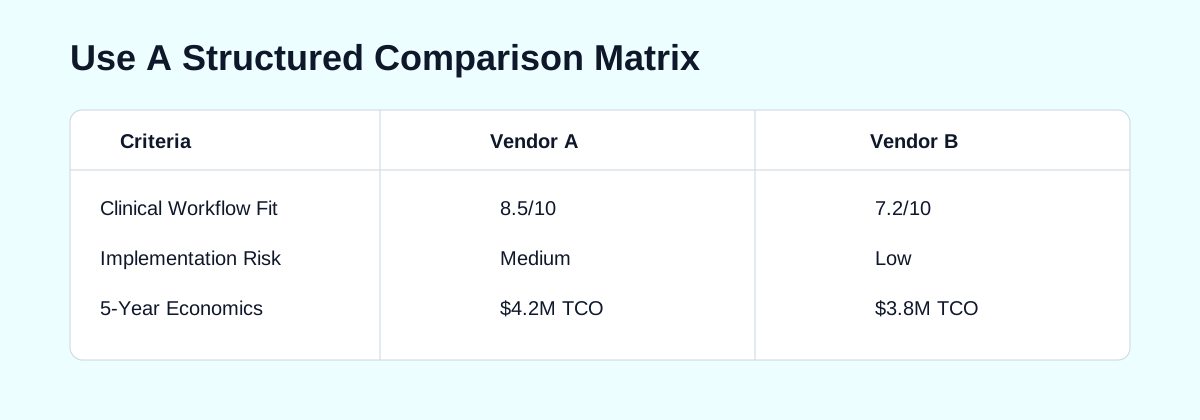
Need help choosing between Qualifacts and Netsmart?
Use our structured selection workflow for requirements, demos, and contracting.
Qualifacts
PE-backed behavioral health EHR operating three platforms: CareLogic, Credible, and InSync
Netsmart
Largest human services technology provider serving 24,000+ organizations
Overview: Two PE-Owned Enterprise Platforms
Qualifacts and Netsmart are the two dominant enterprise-scale EHR platforms in community behavioral health and human services. Both serve large organizations — CCBHCs, state-contracted agencies, multi-site community mental health centers, and IDD providers — and both have been through multiple private equity ownership transitions that have shaped their current trajectories.
Qualifacts was acquired by Warburg Pincus for $300 million in 2019, then merged with Credible Behavioral Health in 2020, then acquired InSync Healthcare Solutions in 2021. The result is a three-platform portfolio — CareLogic, Credible, and InSync — that serves 2,700+ organizations, including 33% of the nation's CCBHCs. Qualifacts iQ, the company's AI product, has emerged as one of the more credible AI offerings from an incumbent vendor, with 150+ organizations in production and the first ISO 42001:2023 certification in the behavioral health EHR space.
Netsmart is the oldest and largest player, founded in 1968 and now serving 500,000+ users across 24,000+ organizations. The company has been passed between GI Partners, Allscripts ($950M acquisition in 2016), TA Associates, and most recently Genstar Capital — four ownership changes in under a decade. Its CareFabric platform and myEvolv/myAvatar products are deeply embedded in state-level behavioral health infrastructure, with particular strength in Medicaid-driven reimbursement environments.
AI Capabilities
Qualifacts
Qualifacts iQ is one of the most substantive AI offerings from any behavioral health EHR incumbent. The product claims to cut note-taking time by 80% and increase provider capacity by 50%, with 150+ organizations actively using it in production. Qualifacts earned the first ISO 42001:2023 certification in the behavioral health EHR market, demonstrating formal AI governance processes. The company is also launching an AI scheduling agent in early 2026, expanding beyond documentation into operational workflow automation.
The iQ product's credibility is strengthened by published adoption metrics and formal certification — a contrast to many incumbent vendors whose AI claims lack specificity. However, it is still an add-on to a legacy platform architecture rather than a natively integrated AI system.
Netsmart
Netsmart has partnered with Remarkable Health to accelerate AI innovation, but specific shipped AI features are less documented than Qualifacts'. The company has the data advantage — 24,000+ organizations generating vast amounts of clinical and operational data — but converting that data advantage into production AI products has been slower than the market expected. Enterprise organizations evaluating Netsmart should ask for specific AI feature demonstrations rather than relying on partnership announcements.
Bottom Line
Qualifacts has a clear lead in production AI for the enterprise behavioral health segment. The iQ product, ISO 42001 certification, and published metrics give Qualifacts more AI credibility than Netsmart's partnership-driven approach. For organizations where AI-driven documentation is a near-term priority, Qualifacts has the more tangible offering. For a fundamentally different AI architecture, evaluate AI-native platforms.
Platform Architecture and Consolidation Risk
Qualifacts
Qualifacts operates three distinct EHR platforms — CareLogic, Credible, and InSync — each serving different market segments and customer bases. This creates a persistent question for buyers: which platform is the long-term go-forward system? PE-driven roll-ups often consolidate acquired products onto a single platform, which means customers on the sunset platform face forced migrations. Qualifacts has not publicly announced platform consolidation plans, but the risk is inherent in a three-platform architecture under PE ownership.
For new buyers, this means asking pointed questions about product roadmap investment per platform. Is your chosen platform receiving equal engineering resources as the others? What contractual protections exist if the company decides to sunset a platform? See our post-merger EHR consolidation playbook for a framework to evaluate these risks.
Netsmart
Netsmart's CareFabric platform includes myEvolv (web-based, configurable) and myAvatar (more traditional), plus myHealthPointe for patient engagement. The product line is broad but can feel fragmented. Implementations are complex — 9-24 months is typical for enterprise deployments — and the learning curve is steep, particularly for smaller organizations that lack dedicated IT and implementation resources.
Four ownership changes in under a decade create vendor stability concerns. Each transition introduces risk of leadership turnover, strategic pivots, and support disruption. Enterprise organizations signing multi-year contracts with Netsmart should negotiate data portability protections and support SLAs that survive ownership changes.
Bottom Line
Both platforms carry significant PE-driven consolidation and ownership-transition risk. Qualifacts' three-platform architecture creates product roadmap uncertainty; Netsmart's four ownership changes in a decade create organizational stability concerns. Enterprise buyers should negotiate exit protections and contractual safeguards regardless of which platform they choose.
CCBHC and Community Mental Health Fit
Qualifacts
Qualifacts serves 33% of the nation's CCBHCs, making it the dominant platform in the Certified Community Behavioral Health Center segment. CareLogic in particular has deep state reporting, outcome tracking, and Medicaid billing workflows designed for the CCBHC model. For organizations pursuing or maintaining CCBHC certification, Qualifacts' installed base and compliance expertise are meaningful advantages.
Netsmart
Netsmart has the broadest reach in community mental health and human services, serving state agencies, CCBHCs, IDD organizations, and multi-service human services providers. The platform's strength is its configurability for complex state-level reporting requirements and multi-program organizations. Netsmart leads satisfaction rankings in community-care depth, scoring 9.7/10 in its best categories.
Bottom Line
For CCBHCs specifically, Qualifacts has the market share advantage and CCBHC-specific workflow maturity. For broader human services organizations that combine behavioral health with IDD, child welfare, or social services, Netsmart's multi-service platform architecture is the more natural fit. See our best EHR for mental health guide for broader market context.
Implementation Complexity
Qualifacts
Implementation timelines for Qualifacts platforms vary by product and organization size. CareLogic implementations for mid-size community mental health organizations typically run 4-8 months. The three-platform reality means that implementation experience varies significantly depending on which product you're deploying — ensure your implementation team has specific experience with your chosen platform, not just Qualifacts in general.
Netsmart
Netsmart implementations are among the longest in behavioral health EHR: 9-24 months for enterprise deployments. The platform's depth and configurability are strengths for large organizations but translate into extended timelines, steep learning curves, and higher implementation costs. Organizations without dedicated internal IT resources often struggle with the complexity. See our implementation checklist for best practices.
Bottom Line
Qualifacts offers significantly shorter implementation timelines than Netsmart. For organizations that need to be operational on a new platform within 6 months, Qualifacts is the more realistic choice. Netsmart implementations are a commitment that requires executive patience and dedicated internal resources.
Pricing and Total Cost of Ownership
Both platforms use enterprise, quote-based pricing that is not publicly transparent. Netsmart typically sits at the higher end of the market given its enterprise scale and implementation complexity. Qualifacts' economic value scores lower in independent assessments, with pricing pressure being a consistent concern cited by customers.
Total cost of ownership for either platform should factor in extended implementation timelines (especially Netsmart's 9-24 months), training costs for complex systems, ongoing support and configuration fees, and the hidden cost of administrative burden from platforms that require significant manual effort for routine workflows.
Who Should Choose Qualifacts
- CCBHCs and organizations where CCBHC-specific compliance workflows are a primary requirement
- Mid-to-large community mental health organizations that need production AI capabilities (iQ)
- Organizations that want faster implementation timelines than Netsmart can deliver
- Programs already on CareLogic, Credible, or InSync that are satisfied with their current platform
Who Should Choose Netsmart
- Very large, multi-service human services organizations (behavioral health + IDD + social services)
- State agencies and organizations with complex state-level reporting requirements
- Enterprise organizations that need deep Medicaid billing configurability across multiple state environments
- Programs where community-care depth and breadth of service coverage outweigh implementation speed
Who Should Consider Neither
- SUD treatment centers and addiction programs should evaluate Kipu, Sunwave, or Ease for SUD-specific workflows
- Solo practitioners and small practices need therapy-focused platforms, not enterprise EHRs
- Organizations prioritizing AI-native architecture and modern UX over enterprise configurability should evaluate Ease
- Mid-size behavioral health groups without dedicated IT resources may find both platforms too complex — consider AZZLY Rize or Valant
Frequently Asked Questions
Which Qualifacts platform should I choose — CareLogic, Credible, or InSync?
CareLogic is typically positioned for larger community behavioral health organizations and CCBHCs. Credible serves mid-size behavioral health agencies. InSync targets multi-specialty practices. However, the product positioning has overlapped since the acquisitions, and Qualifacts' sales team will steer you based on your organization's profile. Ask specifically about engineering investment per platform and long-term product consolidation plans.
Has Netsmart's support quality changed through its ownership transitions?
Each of Netsmart's four ownership changes in under a decade introduced some degree of organizational disruption. Customer reviews note variable support quality — strong in some periods, inconsistent in others. The Genstar Capital acquisition is the most recent transition, and organizations should validate current support staffing levels and response time commitments before signing.
Are there better options for behavioral health groups that are not enterprise-scale?
Yes. Both Qualifacts and Netsmart are designed for enterprise complexity. Mid-size behavioral health organizations (5-50 clinicians) should evaluate platforms like Ease, AZZLY Rize, or Valant that offer purpose-built behavioral health workflows without enterprise-scale implementation overhead. See our behavioral health EHR comparison for the full landscape.
Verdict
Qualifacts is the stronger choice for CCBHC and community mental health organizations that need production AI capabilities (iQ), shorter implementation timelines, and deep CCBHC-specific compliance workflows. The three-platform architecture creates roadmap uncertainty, but for organizations already aligned to CareLogic, the platform delivers solid community behavioral health coverage.
Netsmart is the right choice for very large, multi-service human services organizations that need the broadest platform configurability and deepest state reporting coverage in the market. The trade-offs are real: extended implementation timelines (9-24 months), steep learning curves, enterprise pricing, and organizational instability from serial ownership changes.
Both platforms carry significant PE ownership risk. Enterprise buyers making multi-year commitments to either vendor should negotiate contractual protections that survive ownership transitions — including data portability guarantees, pricing escalation caps, and SLA-backed support terms. For a structured approach to this evaluation, see our EHR selection process guide.