Kipu vs Sunwave (2026): SUD EHR Market Leaders Compared
Head-to-head comparison of Kipu Health and Sunwave Health across clinical workflows, AI capabilities, billing, pricing, and implementation for behavioral health and addiction treatment organizations.
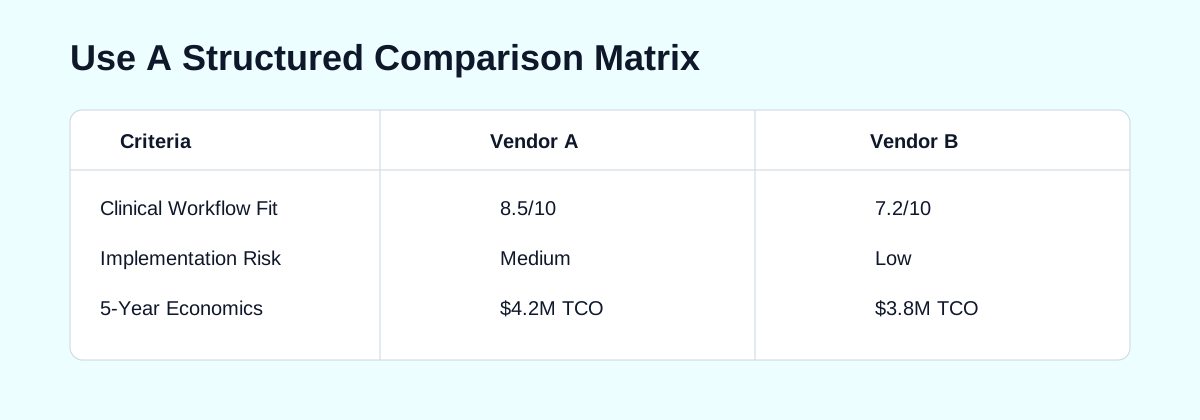
Need help choosing between Kipu Health and Sunwave Health?
Use our structured selection workflow for requirements, demos, and contracting.
Kipu Health
Market-leading addiction treatment EHR with the largest SUD installed base
Sunwave Health
All-in-one CRM, EMR, and RCM platform for behavioral health and SUD
Overview: Two PE-Backed Giants on Diverging Paths
Kipu Health and Sunwave Health are among the most widely adopted EHR platforms in addiction treatment and behavioral health. Both serve substance use disorder treatment centers, residential programs, and multi-facility organizations — but they carry different ownership structures and are heading in different strategic directions.
Kipu was the first cloud-based EMR purpose-built for addiction treatment, founded in 2012 by Cezar Kolodziej. TCV's ~$290 million investment in 2021 brought new leadership — CEO Paul Joiner and COO Rick Pharr replaced Kolodziej in day-to-day operations. The platform has since expanded through acquisitions like Hatch Compliance (2024) and now serves 6,000+ facilities.
Sunwave took a different path. After years of growth backed by Level Equity and Blueprint Equity, Sunwave merged with Lightning Step Technologies in October 2025, with a strategic growth investment from BVP Forge. The combined entity — led by former Lightning Step CEO Brent Michael — now serves over 3,000 facilities with 34,000+ users, making it one of the largest behavioral health software providers in the country.
Both platforms are firmly in the PE-backed camp, which means behavioral health providers should evaluate them with an eye toward the patterns that typically follow consolidation: potential price increases, reduced engineering investment, and platform migration risk. For organizations concerned about these dynamics, AI-native alternatives may offer a structurally different value proposition.
AI Capabilities
Kipu Health
Kipu holds an ISO 42001:2023 certification for AI management systems — a meaningful governance credential that signals organizational readiness for responsible AI development. However, specific shipped AI features remain limited in public-facing materials. The certification is a framework for responsible AI governance, but it is not the same as having production AI tools actively reducing clinician documentation burden today.
Sunwave Health
Sunwave was the first behavioral health EHR to ship a production AI product. MARA (Mental-Health Artificial Reasoning Agent), launched in October 2023, handles biopsychosocial summaries, H&Ps, and has expanded into CRM for outreach and admissions automation. The Lightning Step merger adds Lia, another AI documentation assistant. The combined entity has stated plans to accelerate AI innovation across the merged platform.
The presence of two AI products from two merging platforms creates integration questions. Will MARA and Lia converge into a single product, or will customers face uncertainty about which to adopt? The post-merger AI roadmap has not been fully clarified.
Bottom Line
Sunwave has a meaningful head start with shipped AI products in production use since 2023. Kipu has the governance certification but fewer visible AI tools in clinicians' hands today. For organizations where AI-driven documentation is a current priority, Sunwave's existing capabilities are more concrete. For a deeper AI-native approach, consider evaluating platforms like Ease where AI is the foundational architecture.
Clinical Documentation
Kipu Health
Kipu offers a comprehensive clinical documentation suite covering the full patient lifecycle: admissions, assessments, treatment planning, progress notes, e-prescribing, medication management, and discharge planning. The platform includes patient portal access with standardized outcome assessments (PHQ-9, GAD-7, BAM-R) and integrated telehealth. Fourteen years of iteration have produced deep SUD-specific workflows for detox, residential, PHP, IOP, and outpatient settings.
However, users report that certain workflows feel dated. The treatment plan module has been described as complex and underutilized. Nursing workflows lack a task-list view common in hospital EMRs, and data integrity concerns have been raised — users report that documentation can be overwritten without adequate audit trail protection.
Sunwave Health
Sunwave provides integrated clinical documentation with CRM and RCM in a single platform. Post-merger, the combined entity offers two documentation engines. Sunwave's platform emphasizes the patient timeline — a longitudinal view of all clinical interactions — while Lightning Step's medication management module is particularly well-regarded by users.
Users praise Sunwave's note review workflow as audit-friendly, but cite excessive clicking and navigation steps for certain documentation tasks. Form customization is limited: changes must be submitted as requests to the vendor rather than configured self-serve, which creates friction for organizations that need to adapt quickly to regulatory or payer requirements.
Bottom Line
Kipu has deeper SUD-specific clinical workflows built over a longer track record. Sunwave's post-merger platform is broader but introduces platform consolidation uncertainty. Neither platform leads in modern documentation UX compared to newer entrants.
Billing and Revenue Cycle Management
Kipu Health
Kipu includes integrated RCM with insurance verification, claims submission, and payment posting. The platform handles the complexity of behavioral health billing — multiple levels of care, split billing, and authorization management. However, pricing opacity makes it difficult to evaluate total cost of ownership. Users report maintenance charges (one reviewer cited $560/month) and express concern that losing access to records after contract termination creates effective vendor lock-in.
Sunwave Health
Sunwave's all-in-one approach integrates CRM, EMR, and RCM, reducing the need for separate billing systems or third-party RCM services. Lightning Step brought competitive pricing ($49/month per user for an all-in-one plan), though post-merger pricing has not been fully clarified. The billing module supports the full claim lifecycle with automated eligibility checks and ERA posting.
Bottom Line
Both platforms offer integrated RCM. Sunwave's pre-merger pricing transparency gives it an edge for cost-conscious organizations. Kipu's opaque pricing and data access restrictions after cancellation are significant considerations that should be addressed contractually before signing. For a comprehensive pricing framework, see our EHR cost guide.
CRM and Admissions
Kipu Health
Kipu includes a call center and CRM module that covers referral management, intake tracking, and admissions workflows. The platform tracks the journey from initial inquiry through verified admission. For straightforward admissions operations, Kipu's CRM capabilities are adequate but are not typically positioned as a strategic growth engine with deep pipeline analytics or multi-touch attribution.
Sunwave Health
CRM has been a core differentiator for Sunwave since its founding. The platform's admissions and outreach capabilities are more sophisticated than Kipu's, with MARA AI expanding into CRM to automate outreach and admissions workflows. The merger with Lightning Step adds additional admissions pipeline management capabilities, and the combined entity positions CRM-to-clinical continuity as a key value proposition.
Bottom Line
Sunwave has a stronger CRM and admissions pipeline story, particularly with AI-assisted outreach through MARA. For growth-oriented organizations where admissions conversion is a key KPI, Sunwave's integrated CRM is a meaningful advantage. Kipu covers the basics but may require supplemental tools for sophisticated pipeline management.
Implementation and Support
Kipu Health
Kipu's large installed base (6,000+ facilities) means extensive implementation experience. However, user reviews consistently cite support quality as a pain point. System performance issues — lagging at least a couple times a week according to some users — add to operational burden. The post-TCV leadership change may explain the reported decline in support responsiveness.
Sunwave Health
Pre-merger, both Sunwave and Lightning Step reported approximately 90% user satisfaction. Sunwave's support team has been praised for responsiveness. However, the merger introduces risk: integrating two support organizations while maintaining quality for 3,000+ facilities is a significant operational challenge. Lightning Step users had previously reported UI issues, slow server performance, and challenging initial setup.
Bottom Line
Sunwave's pre-merger support satisfaction is higher than Kipu's. The merger introduces uncertainty. For either platform, negotiate contractual support SLAs before signing. For a structured approach to vendor evaluation, see our EHR selection process guide.
Pricing and Total Cost of Ownership
Kipu uses opaque, quote-based pricing that users consistently describe as expensive. Sunwave and Lightning Step published more transparent pricing pre-merger (starting at $30/month and $49/month respectively), though post-merger pricing has not been fully clarified.
Beyond subscription costs, total cost of ownership should account for implementation fees, training time, support quality, and the hidden cost of administrative burden from a system that requires excessive manual effort. Additionally, both platforms carry PE ownership risk: post-acquisition price increases of 20-40% are common across PE-owned healthcare technology vendors. Lock in favorable pricing terms contractually before any PE-driven ownership transition.
Who Should Choose Kipu
- Established addiction treatment centers already deeply embedded in the Kipu platform with customized workflows
- Organizations that need proven SUD-specific clinical workflows refined over 14 years
- Programs that value the largest reference customer base in addiction treatment for due diligence
- Multi-facility networks where Kipu's Hatch Compliance integration addresses Joint Commission and CARF requirements
Who Should Choose Sunwave
- Organizations that want a single CRM + EMR + RCM platform to eliminate vendor sprawl
- Programs where AI-assisted documentation (MARA) and AI-driven admissions outreach are current priorities
- Cost-sensitive organizations that benefit from more transparent, competitive pricing
- Growing organizations that need sophisticated admissions pipeline management integrated with clinical workflows
Who Should Consider Neither
- Organizations concerned about PE ownership risk across both platforms should evaluate independent, AI-native alternatives
- Solo practitioners and small practices are better served by therapy-focused platforms
- Enterprise behavioral health organizations (500+ beds, complex state reporting) should evaluate Netsmart or Qualifacts
Frequently Asked Questions
How does the Sunwave-Lightning Step merger affect existing customers?
The October 2025 merger creates platform consolidation risk. Existing customers of either platform should clarify which system will be the go-forward product, what the migration timeline looks like, and what data portability protections exist in their contracts. Post-merger integration typically takes 12-24 months to stabilize, during which support quality and product velocity may be affected.
Is Kipu being sold again?
As of early 2026, market signals suggest Kipu may be in or approaching another ownership transition. Banker outreach, diligence activity, and industry conversations are consistent with an active or near-term sale process. Organizations evaluating Kipu should factor potential ownership changes into contract negotiations and migration planning.
Which platform has better AI?
Sunwave has shipped more AI products (MARA since October 2023, plus Lia from Lightning Step). Kipu has an AI governance certification (ISO 42001) but fewer documented production AI features. For organizations where AI is a strategic priority, evaluate both against AI-native platforms like Ease that were architecturally designed around AI from day one.
Can I switch from Kipu to Sunwave or vice versa?
Yes, but behavioral health EHR switching involves significant complexity. Budget 3-6 months and $25,000-$100,000+ depending on organization size for data migration, training, and workflow reconfiguration. Pilot with one facility before rolling out across a multi-site network.
Verdict
Kipu and Sunwave are both capable behavioral health EHR platforms with deep SUD treatment workflows. Kipu has the longer track record and larger installed base; Sunwave has more concrete AI capabilities, stronger CRM, and more transparent pricing.
The more important question for operators evaluating these platforms in 2026 is whether either PE-backed incumbent can deliver the innovation trajectory that modern behavioral health operations demand. Both carry PE ownership overhead — the pressure to expand margins, the potential for price increases, and the risk that engineering investment gets optimized for financial returns rather than clinical outcomes.
Organizations making a 3-5 year technology decision should evaluate both platforms against independent alternatives that are not subject to these structural constraints. The total cost of ownership extends far beyond subscription pricing — it includes the opportunity cost of being on a platform whose roadmap is driven by financial sponsors rather than clinical needs. For a comprehensive market view, see our behavioral health EHR comparison.