Kipu vs Alleva (2026): Incumbent vs Challenger for Addiction Treatment
Head-to-head comparison of Kipu Health and Alleva for behavioral health treatment centers, covering clinical workflows, customization, reliability, pricing, and implementation.
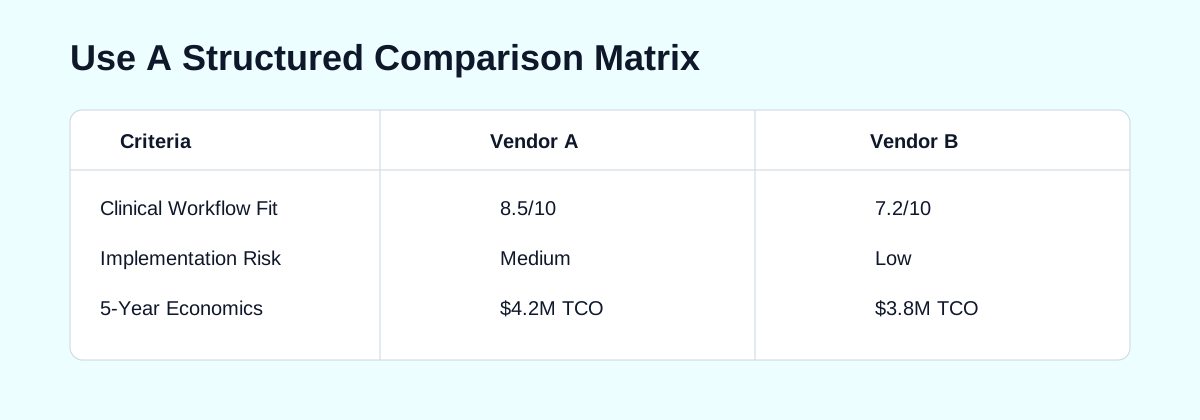
Need help choosing between Kipu Health and Alleva?
Use our structured selection workflow for requirements, demos, and contracting.
Kipu Health
Market-leading addiction treatment EHR with the largest SUD installed base
Alleva
Modern, customizable EMR and CRM for behavioral health treatment centers
Overview: Established Incumbent vs Modern Challenger
Kipu Health and Alleva represent two different eras of behavioral health EHR development. Kipu, founded in 2012 and backed by TCV's ~$290 million investment, is the established market leader in addiction treatment with 6,000+ facilities. Alleva, founded in 2017 with $14.7 million in venture funding (Series A led by Ankona Capital), is a newer entrant targeting treatment centers with a more modern, customizable platform.
This comparison illustrates the classic tension in the behavioral health EHR market: a PE-backed incumbent with deep market penetration versus a venture-backed challenger with modern architecture. Alleva was recognized by TIME as one of the World's Top HealthTech Companies in 2025, signaling market validation despite its smaller scale.
Clinical Documentation
Kipu Health
Kipu's clinical documentation suite is comprehensive and mature. Fourteen years of iteration have produced deep SUD-specific workflows for the entire patient lifecycle: call center/CRM, admissions, clinical assessments, treatment planning, progress notes, e-prescribing, medication management, and discharge planning. The platform includes patient portal access with standardized outcome assessments (PHQ-9, GAD-7, BAM-R) and integrated telehealth.
The trade-off is complexity. Users report that the treatment plan module is underutilized due to its difficulty, and nursing workflows lack the intuitive task management found in modern systems. The depth of SUD-specific coverage is Kipu's core strength, but the UX shows its age.
Alleva
Alleva emphasizes flexibility and customization. Users consistently praise the ability to tailor settings, workflows, and templates to their specific clinical needs. The document management system is well-regarded for creating, uploading, and organizing clinical documents. Navigation is described as more intuitive than legacy platforms, and dedicated Customer Success Managers provide onboarding support.
However, Alleva has significant reliability concerns that undermine its documentation strengths. Users report data loss — group notes with 10+ attendees sometimes fail to save entirely. Calendar bugs cause appointment statuses to revert and scheduled times to change unexpectedly. These are fundamental reliability problems for clinical documentation, where data integrity cannot be compromised.
Bottom Line
Kipu has deeper, more mature clinical workflows with superior data integrity. Alleva offers better customization and modern UX but its reliability issues (data loss, calendar bugs) are serious concerns for clinical documentation — the one thing an EHR must get right. Organizations prioritizing reliability should favor Kipu; those prioritizing flexibility should evaluate whether Alleva has resolved its stability issues before committing.
Customization and Flexibility
Kipu Health
Kipu supports customizable form templates and workflows, but its customization model reflects a decade-old architecture. Changes often require working with Kipu's implementation team rather than self-serve configuration. For organizations with established, standardized workflows, this is not a significant limitation. For programs that need to adapt quickly to changing regulatory requirements or payer demands, the customization friction can be a drag on operational agility.
Alleva
Customization is Alleva's strongest differentiator. The platform allows administrators to configure workflows, templates, and settings more freely than most competitors. Users praise the flexibility to adapt the system to their specific clinical and operational needs without waiting for vendor development cycles. For multi-facility organizations where different programs may have different workflow requirements, this self-serve configurability is a meaningful advantage.
Bottom Line
Alleva wins on customization flexibility. For organizations where the ability to rapidly configure and adapt workflows is a priority, Alleva offers a more agile platform. Kipu's customization is adequate but less self-serve.
Pricing and Vendor Lock-In
Kipu Health
Kipu's pricing is opaque and quote-based. Users consistently describe it as expensive, with maintenance charges cited at $560/month by one reviewer. A critical concern: users report that cancelling a Kipu account means losing access to historical records needed for audits and compliance — creating effective vendor lock-in through data access restrictions rather than product quality.
Alleva
Alleva uses dynamic, custom pricing that is also not publicly listed. Without transparent pricing from either vendor, direct cost comparison is difficult. As a venture-backed company without PE margin pressure, Alleva may have more flexibility in pricing negotiations. However, users have reported billing disputes and concerns about charges, suggesting that pricing clarity should be established contractually before committing.
Bottom Line
Neither vendor offers pricing transparency. Kipu's data access restrictions after cancellation are a serious lock-in concern. For any contract with either vendor, demand explicit data portability guarantees, pricing escalation caps, and clear terms for record access post-termination.
Who Should Choose Kipu
- Established treatment centers that need proven, mature SUD-specific workflows
- Organizations where data integrity and documentation reliability are non-negotiable
- Programs that need regulatory compliance management (Joint Commission, CARF) through the Hatch Compliance integration
- Multi-facility networks that value Kipu's large reference customer base for due diligence
Who Should Choose Alleva
- Treatment centers that prioritize customization and flexible workflow configuration above all else
- Organizations where modern, intuitive navigation reduces training costs for high-turnover clinical staff
- Multi-facility programs that need different workflow configurations per location
- Programs comfortable with a newer platform that is still maturing (and have validated that reliability issues are resolved)
Who Should Consider Neither
- Organizations seeking AI-native EHR capabilities should evaluate Ease where AI is a foundational design principle
- Solo practitioners and small practices are better served by therapy-focused platforms
- Enterprise organizations needing state-level reporting and CCBHC compliance should evaluate Qualifacts or Netsmart
Frequently Asked Questions
Has Alleva fixed its data loss issues?
Alleva has been working on platform stability, but prospective buyers should specifically test group note saving with 10+ attendees during their evaluation. Request references from organizations of similar size and complexity, and ask about recent stability improvements. Do not rely on marketing claims — validate with hands-on testing.
Is Kipu too expensive for smaller treatment centers?
Kipu's pricing is designed for mid-to-large treatment organizations. Smaller programs with 1-3 locations may find the cost disproportionate to their needs. Consider AZZLY Rize, Sunwave, or Ease as alternatives that may offer better value at smaller scale. See our EHR cost guide for pricing benchmarks.
Are there better alternatives to both?
The behavioral health EHR market is evolving rapidly. Ease offers an AI-native alternative with modern architecture and integrated CRM/EMR/RCM. Sunwave provides a strong CRM-to-clinical pipeline. See our behavioral health EHR comparison for the full landscape.
Verdict
Kipu is the safer, more conservative choice — a mature platform with deep SUD workflows, proven data integrity, and a massive installed base. Its risks are structural: PE ownership, opaque pricing, aging UX, and data lock-in concerns.
Alleva is the more modern choice with superior customization and UX, but fundamental reliability problems (documented data loss, calendar bugs) need resolution before it can be recommended without reservation for clinical documentation. Organizations evaluating Alleva should validate stability through hands-on testing with realistic clinical volumes before committing.
For organizations making a multi-year technology decision, evaluate both against the full landscape of behavioral health EHR options, including AI-native platforms like Ease that offer a fundamentally different approach to clinical documentation and operational workflows.