Epic vs Oracle Health (Cerner): Full EHR Comparison for 2026
Detailed head-to-head comparison of Epic Systems and Oracle Health (formerly Cerner). Covers clinical documentation, interoperability, pricing, AI features, implementation timelines, and guidance on which enterprise EHR is right for your organization.
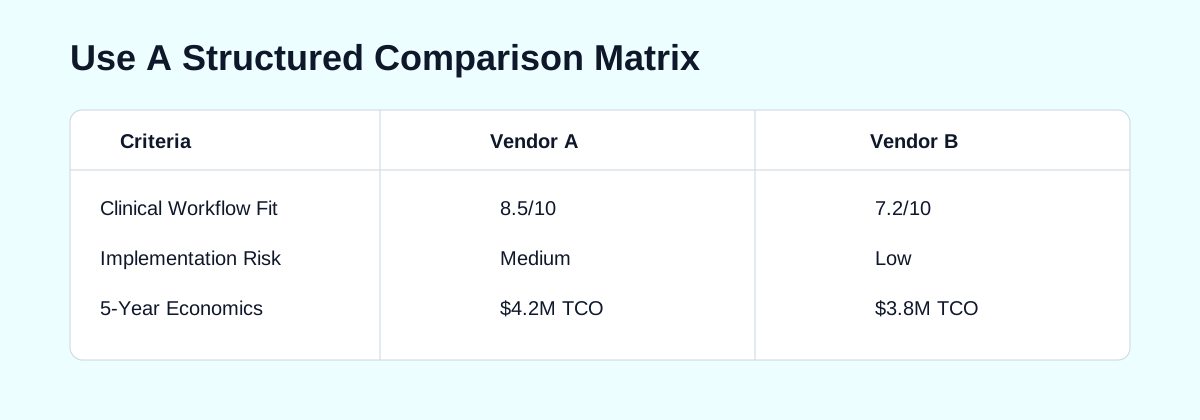
Need help choosing between Epic Systems and Oracle Health (Cerner)?
Use our structured selection workflow for requirements, demos, and contracting.
Epic Systems
Dominant EHR for large health systems
Oracle Health (Cerner)
Enterprise hospital EHR on Oracle Cloud
Overview: Two Titans of Hospital EHR
Epic Systems and Oracle Health (formerly Cerner) are the two largest EHR platforms in U.S. hospitals. Together, they power electronic health records for the majority of acute-care hospitals in the country. Both were founded in 1979, and both have spent decades building deeply integrated clinical, financial, and operational platforms for complex healthcare organizations.
But the similarities end at their scale. Epic is a privately held, founder-led company based in Verona, Wisconsin, with a famously opinionated approach to product design and a loyal customer base that consistently ranks it highest in satisfaction surveys. Oracle Health is the product of Oracle Corporation's $28.3 billion acquisition of Cerner in 2022, and it is undergoing a fundamental transformation as the legacy Cerner Millennium platform migrates to Oracle Cloud Infrastructure (OCI).
This comparison is designed for CIOs, CMIOs, and IT steering committees evaluating these two platforms for a new implementation, contract renewal, or potential migration. We cover clinical capabilities, interoperability, cost, AI features, and market trajectory with specific data points to help inform your decision.
Choose Epic if you need...
- Highest clinician satisfaction and usability ratings
- The largest health information exchange network (Care Everywhere)
- Proven integrated platform across inpatient, ambulatory, and revenue cycle
- Strong MyChart patient engagement ecosystem
- Access to a deep pool of trained implementation consultants
Choose Oracle Health if you need...
- Lower initial licensing costs for mid-size hospitals
- Federal, VA, or Department of Defense healthcare alignment
- Oracle Cloud Infrastructure integration across your enterprise
- A vendor willing to negotiate more aggressively on pricing
- Flexibility with third-party integrations and open architecture
Clinical Documentation
Clinical documentation is where Epic has maintained a consistent advantage. In KLAS "Best in KLAS" rankings over the past five years, Epic has won the acute-care EMR category every year, with particularly strong scores in physician documentation workflows, order entry, and clinical decision support. Epic's documentation environment uses a single integrated database, meaning data entered in one module (such as an ED note) flows automatically to inpatient documentation, discharge summaries, and billing without manual reconciliation.
Oracle Health's Cerner Millennium platform offers comprehensive documentation capabilities, but its legacy architecture shows its age in certain areas. Millennium was originally designed with a more modular approach, where different components (PowerChart, SurgiNet, FirstNet) handle different clinical contexts. While this modularity provided flexibility, it also created inconsistencies in the documentation experience as clinicians moved between modules. Oracle is actively addressing this with its next-generation cloud platform, which aims to unify the documentation experience.
Physician usability: Epic scores approximately 4.2 out of 5 in physician satisfaction surveys, compared to Oracle Health's 3.5-3.7. The gap is widest in documentation speed and workflow efficiency, where Epic's SmartPhrases, SmartLinks, and BestPractice Alerts create a documentation experience that physicians find more intuitive once trained.
Nursing documentation: Both platforms offer strong nursing documentation with flowsheets, care planning, and medication administration records. Epic's advantage is less pronounced in nursing workflows than in physician documentation, and some organizations report that Cerner Millennium's CareCompass nursing dashboard is competitive with Epic's equivalent tools.
Interoperability: Care Everywhere vs Oracle Health Network
Interoperability is a critical differentiator in 2026, and Epic holds a substantial advantage here. Epic's Care Everywhere network connects over 305 million patient records and spans the majority of U.S. academic medical centers, large health systems, and a growing number of community hospitals. Through the Carequality framework, Care Everywhere also exchanges data with non-Epic systems, including Oracle Health and athenahealth installations. This network effect means that an Epic hospital can typically pull a patient's complete longitudinal record from other organizations during an admission, reducing duplicate testing and improving care coordination.
Oracle Health participates in interoperability through the CommonWell Health Alliance (which Cerner co-founded) and more recently through Carequality connections. Oracle Health Network provides record exchange capabilities, but its network reach is smaller than Epic's. Oracle has been working to close this gap by joining additional exchange frameworks and improving FHIR R4 API support, but the sheer volume of patient data accessible through Care Everywhere gives Epic a structural advantage that is difficult to replicate.
FHIR and API access: Both vendors support FHIR R4 APIs as required by the 21st Century Cures Act and ONC regulations. Epic's App Orchard (now the Epic App Market) offers a curated marketplace of SMART on FHIR applications with hundreds of third-party integrations. Oracle Health's open API platform provides similar capabilities but with fewer pre-built integrations available in its marketplace. Oracle's traditional strength has been openness to third-party integration, but Epic has closed much of this gap while maintaining tighter quality control over its app ecosystem.
TEFCA compliance: Both Epic and Oracle Health are participating in the Trusted Exchange Framework and Common Agreement (TEFCA), which aims to establish a national interoperability floor. As of early 2026, both vendors have made progress on TEFCA connectivity, but neither has achieved full participation across all exchange purposes. Organizations should verify the specific TEFCA exchange capabilities available for their target deployment timeline.
Implementation and Migration
Implementation timelines and success rates are where organizations often experience the biggest surprises during an EHR selection. Both Epic and Oracle Health are complex enterprise platforms that require significant organizational commitment.
Epic implementation: A single-hospital Epic deployment typically takes 12 to 24 months. Multi-hospital health systems doing phased rollouts should plan for 3 to 5 years. Epic requires organizations to commit dedicated internal resources (often 50-100+ FTEs for large implementations) and assigns its own implementation consultants. Epic's methodology is highly structured and prescriptive, which reduces customization flexibility but improves go-live success rates. Community Connect implementations, where smaller practices access Epic through a host health system, average 6 to 12 months.
Oracle Health implementation: A mid-size hospital Cerner Millennium deployment also takes 12 to 24 months, with larger multi-facility deployments extending to 24 to 36 months. Oracle Health has historically offered more flexibility in implementation methodology, allowing organizations to phase modules more granularly. However, this flexibility has sometimes led to longer timelines and scope creep. Oracle's new OCI-based cloud deployments aim to compress implementation timelines, but real-world data on cloud implementation speed is still limited as of early 2026.
Migration from Cerner to Epic: This is a growing trend. Several major health systems have migrated from Cerner Millennium to Epic in recent years, with notable examples including CommonSpirit Health and UC Davis Health. These migrations are among the most complex IT projects in healthcare, typically costing $50 million to $150 million or more and taking 18 to 36 months. Data migration, interface rebuilds, workflow redesign, and end-user retraining are the primary cost drivers. Organizations considering this switch should plan for a 10-20% productivity dip during the first 3-6 months after go-live.
Workforce availability: Epic has a significant advantage in workforce availability. The Epic certification program has produced a large pool of trained analysts, project managers, and consultants. Oracle Health/Cerner consultants are also available but in smaller numbers, and the post-acquisition period has seen some attrition in the Cerner consulting ecosystem. This workforce gap affects both implementation timelines and ongoing optimization.
Total Cost of Ownership
Cost is the area where Oracle Health has traditionally held an advantage, though the full picture is more nuanced than headline licensing numbers suggest.
| Cost Component | Epic | Oracle Health |
|---|---|---|
| Initial License (mid-size hospital) | $10M-$20M | $2M-$5M |
| Implementation Services | $5M-$15M | $3M-$10M |
| Annual Maintenance (% of license) | 15-22% | 18-22% |
| Hardware / Infrastructure | $2M-$8M | $1M-$5M (less with OCI) |
| Training | $1M-$3M | $0.5M-$2M |
| Estimated 5-Year TCO | $25M-$60M+ | $10M-$30M |
The numbers above tell only part of the story. Epic's higher upfront cost is often offset by several factors: higher clinician satisfaction reduces turnover costs, the integrated platform reduces the need for costly third-party bolt-on systems, and Epic's stronger revenue cycle management tools can improve collection rates. Several studies have shown that health systems migrating to Epic from other platforms see net revenue improvements of 2-5% within 18 months of go-live, driven by improved charge capture, reduced claim denials, and better coding accuracy.
Oracle Health's lower initial price point is a genuine advantage for budget-constrained mid-size hospitals. Oracle has also introduced subscription-based cloud pricing for OCI-hosted deployments, which reduces the capital expenditure burden. However, organizations should factor in the cost of third-party integrations, additional bolt-on modules, and the potential for future migration if Oracle's cloud platform evolution does not meet expectations.
AI and Innovation
Both Epic and Oracle Health are investing aggressively in artificial intelligence and machine learning, but their approaches differ significantly.
Epic's AI strategy focuses on embedded machine learning models and strategic partnerships. Epic has deployed predictive models for sepsis, patient deterioration, hospital readmission risk, and no-show prediction that run directly within the Epic environment. For ambient clinical documentation, Epic has partnerships with Nuance (Microsoft DAX Copilot) and Abridge, allowing physicians to generate clinical notes from natural conversation during patient encounters. Epic's approach has been to validate AI tools rigorously before deployment and to make them available as configurable modules that health systems can activate. As of early 2026, Epic reports that over 300 health systems are using at least one of its AI-powered tools in production.
Oracle Health's AI strategy leverages Oracle Corporation's broader cloud and AI infrastructure. The Oracle Health Clinical Digital Assistant uses generative AI for clinical documentation, order entry, and summarization. Oracle's advantage is its access to Oracle Cloud Infrastructure, which provides scalable compute resources for training and running large language models. Oracle has also signaled plans to integrate clinical AI with its enterprise database and analytics capabilities, potentially enabling population health insights that draw on both clinical and financial data. However, many of Oracle's AI features are still in early deployment stages, and the production track record is shorter than Epic's.
Innovation pace: Epic has historically released major platform updates on a quarterly cycle, with features moving from development to production at a predictable cadence. Oracle Health's innovation pace has been disrupted by the acquisition and platform migration, with some customers reporting that new feature delivery slowed during 2023-2024 as resources were redirected to the cloud migration effort. Oracle has increased its R&D investment and committed to accelerating feature delivery, but the proof will be in production deployments over the next 12-18 months.
Market Position and Trajectory
Epic is the dominant force in the U.S. EHR market. It holds approximately 37-44% of the ambulatory EHR market share and is the most widely installed system in hospitals with 500 or more beds. Epic has been on a sustained growth trajectory, winning new contracts and migration deals from competitors including Oracle Health. In recent years, major health systems such as CommonSpirit Health, Mass General Brigham, and UC Health have selected Epic for system-wide implementations or migrations from other platforms.
Oracle Health holds approximately 21-23% of the acute-care hospital EHR market. Its strongest position is in government healthcare: Cerner won the massive Department of Defense MHS GENESIS contract (valued at over $4.3 billion), and the Department of Veterans Affairs also uses Oracle Health's platform (though the VA deployment has faced well-publicized challenges and delays). In the commercial hospital market, Oracle Health has lost market share to Epic over the past three years, with several high-profile defections.
Customer retention: Epic's customer retention rate exceeds 95%, among the highest in enterprise software. Once a health system implements Epic, switching away is extremely rare. Oracle Health's retention rate has declined since the Oracle acquisition, with some long-time Cerner clients citing uncertainty about the platform's direction as a factor in their decision to evaluate alternatives. Oracle is actively working to stabilize its customer base through contract renegotiations and early access to cloud platform features.
International expansion: Both vendors have international presence, but neither dominates outside the U.S. the way they do domestically. Epic has notable installations in the Netherlands, Denmark, Finland, Australia, and the UK (including NHS deployments). Oracle Health has international installations in the UK, Middle East, and Australia. Neither vendor has a commanding global market share compared to regional players in various countries.
Who Should Choose Epic
Epic is the right choice for organizations that prioritize clinician satisfaction, deep platform integration, and long-term stability. Specifically, Epic is the stronger option if your organization matches one or more of these profiles:
- Large health systems (500+ beds) that need a single integrated platform across inpatient, ambulatory, surgical, ED, pharmacy, and revenue cycle. Epic's unified database eliminates interface complexity between modules.
- Academic medical centers that need research integration, complex order sets, and the ability to recruit and retain physicians who increasingly expect to work in an Epic environment.
- Organizations prioritizing interoperability that need access to the largest health information exchange network. Care Everywhere's reach is a genuine clinical advantage for patient care quality.
- Health systems with strong MyChart adoption goals that want to use the patient portal as a competitive differentiator for patient acquisition and retention.
- Organizations willing to invest upfront for lower long-term operational complexity and higher clinician productivity. Epic's higher initial cost can be offset by reduced bolt-on system costs and improved revenue cycle performance.
Epic is generally not the right choice for community hospitals with fewer than 200 beds that cannot justify the implementation cost, or for organizations that need extreme customization flexibility (Epic's prescriptive approach limits deep customization). For Epic's full profile, see our Epic Systems review.
Who Should Choose Oracle Health
Oracle Health is a strong option for organizations that need an enterprise-grade hospital EHR at a lower price point, or those with specific strategic alignment with Oracle's ecosystem. Consider Oracle Health if your organization matches these profiles:
- Mid-size community hospitals (200-500 beds) where Epic's implementation cost is prohibitive. Oracle Health's lower licensing fees can represent a savings of $5-15 million compared to Epic for a comparable deployment.
- Government and military healthcare organizations that need to align with the MHS GENESIS platform or VA requirements. Oracle Health's federal contracts and government-specific capabilities are unmatched.
- Organizations already invested in Oracle infrastructure (Oracle Database, Oracle ERP, Oracle Cloud) that can leverage synergies across the Oracle ecosystem for analytics, supply chain, and financial management.
- Health systems willing to bet on Oracle's cloud transformation that want to be early adopters of the next-generation OCI-based platform and believe Oracle's AI and cloud investments will pay off by 2027-2028.
- Organizations that value open architecture and want more flexibility to integrate best-of-breed third-party solutions rather than relying on a single vendor's ecosystem for every capability.
Oracle Health is not the right choice for small ambulatory practices (under 50 providers), organizations that need the fastest possible interoperability network access, or health systems where physician satisfaction with the EHR is a top strategic priority. For Oracle Health's full profile, see our Oracle Health review.
Frequently Asked Questions
Is Epic better than Oracle Health (Cerner)?
Epic consistently outperforms Oracle Health in KLAS satisfaction surveys and physician usability ratings, scoring higher in clinical documentation, order management, and overall satisfaction. However, Oracle Health offers lower initial licensing costs and stronger federal/government healthcare contracts. The best choice depends on your organization's size, budget, existing infrastructure, and whether you prioritize clinician satisfaction or total cost of ownership.
How much does it cost to switch from Cerner to Epic?
Switching from Oracle Health (Cerner Millennium) to Epic typically costs $50 million to $150 million or more for a large health system. This includes Epic licensing ($10M-$30M+), implementation services, data migration, interface rebuilds, hardware upgrades, end-user training, and productivity loss during the transition. The full migration process usually takes 18 to 36 months. Some organizations spend more on the migration than they spent on the original Cerner implementation.
What is Epic Care Everywhere vs Oracle Health Network?
Epic Care Everywhere is a health information exchange network connecting over 305 million patient records across Epic and non-Epic organizations via the Carequality framework. Oracle Health Network (formerly CommonWell Health Alliance) provides similar interoperability but with a smaller network footprint. Epic's network advantage is significant because it connects the majority of U.S. academic medical centers and large health systems, making it easier to pull complete patient records during care transitions.
Should I wait for Oracle's next-generation cloud EHR?
Oracle has invested heavily in a cloud-native EHR platform on Oracle Cloud Infrastructure (OCI), promising AI-driven automation and modern architecture. As of early 2026, the next-generation platform is still in limited deployment. If your current Cerner Millennium system is stable and functional, a wait-and-evaluate approach through 2027 is reasonable. However, if you are experiencing significant operational issues or your contract is expiring, evaluating Epic and other alternatives in parallel is prudent given the uncertainty around Oracle's timeline.
Which EHR has better AI and automation features in 2026?
Both vendors are investing aggressively in AI. Epic integrates ambient documentation through partnerships with Nuance DAX Copilot and Abridge, and has deployed machine learning models for sepsis prediction, deterioration alerts, and clinical decision support across 300+ health systems. Oracle Health launched its Clinical Digital Assistant using generative AI for documentation and order entry, backed by Oracle's cloud infrastructure. Epic currently has a larger installed base of AI-enabled features in production, while Oracle is positioning its OCI platform as a more scalable long-term AI foundation.
Verdict
Epic is the safer, more proven choice for most large health systems. It leads in clinician satisfaction, interoperability, market share, customer retention, and AI feature maturity. If your organization can afford the higher upfront investment, Epic delivers a more integrated experience with lower long-term operational friction.
Oracle Health is a viable option for budget-conscious mid-size hospitals and government healthcare organizations. Its lower licensing costs, federal healthcare alignment, and Oracle Cloud Infrastructure roadmap make it worth evaluating, especially for organizations already invested in the Oracle ecosystem. The success of Oracle's cloud transformation over the next 18-24 months will largely determine whether Oracle Health can close the satisfaction gap with Epic.
The bottom line: Organizations selecting an EHR in 2026 should evaluate both platforms against their specific needs, budget constraints, and risk tolerance. Request KLAS reports, conduct thorough reference calls with similar organizations, and negotiate aggressively on pricing. For organizations currently on Cerner Millennium, the decision to migrate to Epic versus waiting for Oracle's cloud platform is the most consequential IT decision they will make this decade. Make it with complete data, not vendor hype.