Ease vs Kipu Health (2026): AI-Native Modern Platform vs SUD Incumbent
Deep comparison of Ease and Kipu for behavioral health and addiction-treatment organizations across AI workflows, clinician productivity, reporting, implementation, and scale fit.
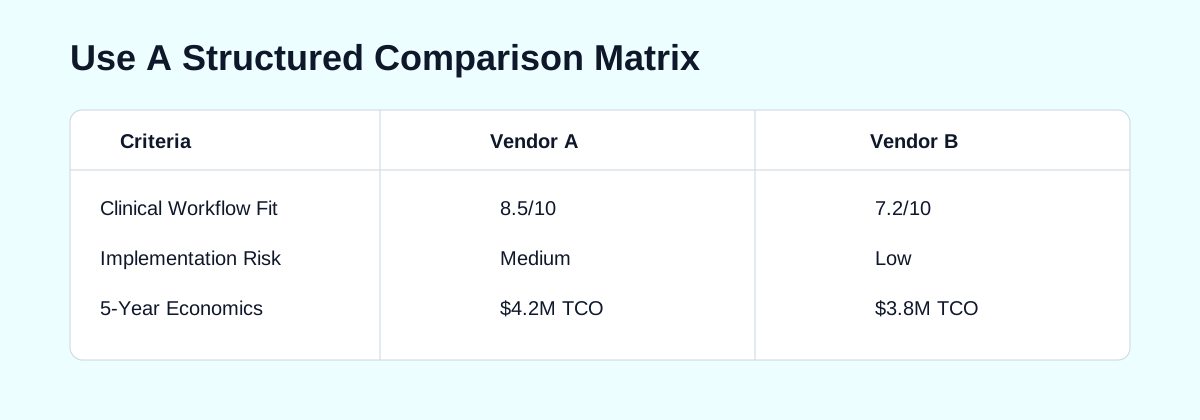
Need help choosing between Ease and Kipu Health?
Use our structured selection workflow for requirements, demos, and contracting.
Ease
AI-native behavioral health platform for growth-stage and enterprise operators
Kipu Health
Market-leading addiction treatment EHR with broad installed base
Overview: AI-Native Challenger vs Category Incumbent
Ease and Kipu Health are two of the most frequently compared platforms for substance use disorder and behavioral health organizations in 2026. Both target the same buyer — multi-site addiction treatment operators, residential and outpatient programs, and PE-backed behavioral health groups — but they represent fundamentally different product generations and operating philosophies.
Kipu is the category incumbent. Founded in 2012, it built the largest installed base in the addiction treatment EHR market through strong residential and detox workflows, early cloud delivery, and deep SUD-specific feature coverage. For many operators, Kipu has been the default choice for a decade. Ease, founded in 2022, is the AI-native challenger. Its architecture is designed around voice AI documentation, generative automation, and a unified operating layer that connects clinical, admissions, billing, and executive workflows in a single modern platform.
For leadership teams evaluating both in 2026, this is rarely a feature-checklist exercise. It is a strategic decision about whether your organization wants to optimize within an established operating model or invest in an AI-first platform that can reshape clinician productivity, authorization speed, and revenue-cycle execution over the next three to five years. This comparison walks through every category that matters to help you make that call. If you are also evaluating other SUD platforms, see our broader behavioral health EHR comparison and the Kipu alternatives guide for 2026.
AI and Automation
Ease
Ease is purpose-built around AI as a core product layer, not a bolt-on enhancement. The platform integrates voice AI-assisted clinical documentation that allows clinicians to narrate encounters and have structured notes generated automatically, reducing charting time by a significant margin compared to manual template entry. Beyond documentation, Ease embeds AI-supported prior authorization workflows designed to accelerate approval turnaround, reduce denials, and surface payer-specific requirements before submissions go out. The platform also includes HIPAA-conscious generative tools that assist with treatment plan narratives, discharge summaries, and administrative correspondence.
What differentiates Ease is not just the presence of AI features but their integration depth. AI is woven into the daily workflow loop — document, authorize, bill, report — rather than sitting in a separate module that clinicians must opt into. This design philosophy means adoption rates tend to be higher, and the productivity gains compound across departments rather than remaining isolated in one function.
Kipu Health
Kipu has invested in AI capabilities over the past two years, including documentation assistance and workflow suggestions. These features are meaningful improvements to the platform and show that Kipu's product team is responsive to market direction. However, in most real-world evaluations, Kipu's AI additions function as evolutionary enhancements layered onto an existing product architecture rather than a fundamental rethinking of how clinical and administrative work gets done.
For organizations that are satisfied with their current documentation velocity and authorization processes and want incremental improvement, Kipu's AI features may be sufficient. But for operators that view AI-native productivity as a strategic differentiator — especially PE-backed groups managing margin expansion across multiple facilities — the depth gap between the two platforms is noticeable in side-by-side evaluation.
Bottom Line
Ease has a structural advantage in AI and automation because the platform was designed around these capabilities from inception. Kipu is adding AI features, but catching up architecturally is different from building AI-first. Organizations with an explicit AI productivity thesis for 2026-2028 will generally find Ease the stronger strategic fit. For a deeper look at how AI capabilities affect total cost of ownership, see our EHR cost guide.
Clinical Documentation and Note Quality
Ease
Ease's documentation model centers on reducing the time between patient encounter and completed note. Voice AI narration, smart template population, and generative assistance for treatment plans and progress notes mean that clinicians spend less time typing and more time in direct patient interaction. Group therapy notes — often a pain point in SUD settings where a single session may include ten or more participants — are handled through structured workflows that generate individualized documentation for each attendee without requiring clinicians to duplicate effort.
Treatment plan generation benefits from AI-assisted narrative drafting that pulls from assessment data, ASAM placement, and session history to produce clinically appropriate and payer-ready language. Clinicians review and adjust rather than write from scratch. For organizations where documentation backlog is a persistent operational problem, this difference in workflow design translates directly to faster chart completion, fewer late notes, and better audit readiness.
Kipu Health
Kipu offers a mature template library for SUD documentation, including intake assessments, biopsychosocial evaluations, individual and group session notes, and discharge planning. The templates are well-established and reflect years of iteration based on the needs of addiction treatment facilities. Clinicians who have worked with Kipu are generally familiar with the documentation flow, and the platform supports customization of templates by program type and level of care.
Where Kipu's documentation model shows its age is in the degree of manual effort still required. Group note generation, treatment plan drafting, and progress note completion rely more heavily on clinician input than on automated assistance. For organizations with stable staffing and established documentation practices, this may not be a significant concern. For programs struggling with clinician turnover, documentation backlogs, or the need to onboard new staff quickly, the manual overhead can be a drag on operational performance.
Bottom Line
Ease delivers faster documentation cycles and higher note quality consistency through AI-assisted workflows. Kipu provides a proven template library that works well for established teams but requires more manual effort per note. Organizations prioritizing documentation speed and reduced clinician burnout will typically see measurable gains with Ease.
Interface and Clinician Experience
Ease
Ease delivers a modern, clean user interface that reflects current web application design standards. Navigation is organized around clinical and operational workflows rather than system modules, and the interface is designed to minimize click count for routine tasks. In multi-site organizations, this matters because time-to-proficiency for new clinicians directly affects onboarding cost and speed to full productivity. Most organizations report that new staff can become proficient on the Ease platform within days, not weeks.
The modern UX also contributes to higher clinician satisfaction scores. In an industry where burnout and turnover are persistent challenges, the experience of using the EHR eight or more hours per day has a real impact on staff retention. Organizations that demo both platforms side-by-side consistently report that Ease feels lighter and faster to navigate.
Kipu Health
Kipu's interface is functional and comprehensive, reflecting over a decade of feature accumulation. Clinicians who have worked in Kipu for years are often deeply familiar with its navigation patterns and can move through workflows efficiently based on muscle memory. The platform covers a wide range of SUD-specific screens and has the depth that comes from serving a large installed base over many years.
However, the interface can feel dense for new users. Training time is typically longer than with modern platforms, and some operators report that the number of screens and clicks required to complete routine workflows contributes to documentation fatigue. Kipu has made UX improvements over time, but the foundational architecture limits how much the experience can be modernized without a ground-up redesign.
Bottom Line
Ease wins on user experience, onboarding speed, and clinician satisfaction. Kipu's familiarity is valuable for teams already embedded in the platform, but for new implementations or organizations that prioritize staff experience, Ease typically demonstrates a clear advantage in pilot cohorts.
SUD-Specific Workflows
Ease
Ease supports the full spectrum of SUD clinical workflows, including ASAM Criteria-based assessment and level-of-care matching, 42 CFR Part 2 consent management and record segmentation, bed management and census tracking for residential programs, MAT (medication-assisted treatment) prescribing and monitoring workflows, and continuity of care across detox-to-residential-to-outpatient transitions. The platform's unified architecture means that a patient moving through multiple levels of care maintains a single longitudinal record with seamless handoffs between clinical teams.
Census management and bed tracking are integrated into the operational dashboard, giving directors of nursing and program managers real-time visibility into capacity without running separate reports. For organizations managing detox-to-outpatient pathways, the ability to track transitions, authorizations, and clinical milestones in one view reduces the coordination overhead that causes patients to fall through the cracks at level-of-care transitions.
Kipu Health
Kipu was purpose-built for addiction treatment and has deep SUD workflow coverage. Its residential and detox workflows are among the most established in the market, with strong bed management, census reporting, ASAM assessment tools, and Part 2 compliance features. Many of the largest addiction treatment networks in the country run on Kipu, which means the platform has been tested at scale across a wide range of SUD program configurations.
MAT workflows, detox protocols, and PHP/IOP scheduling are all well-supported. Kipu's strength in this category is its maturity — the platform has iterated through thousands of real-world SUD implementations, and the workflows reflect that depth of operational experience. For organizations that closely follow traditional addiction-treatment operating patterns, Kipu's SUD coverage is comprehensive and battle-tested.
Bottom Line
Both platforms are credible for SUD-specific workflows. Kipu has the deeper install-base track record; Ease brings a more modern operational layer on top of equivalent clinical workflow coverage. For organizations that want SUD workflow depth combined with AI-native productivity and unified operational visibility, Ease offers the stronger package. For organizations that prioritize proven incumbent stability above all else, Kipu remains defensible. See also best EHR for addiction treatment for broader market context.
Billing and Revenue Cycle Management
Ease
Ease integrates billing and RCM into the same platform layer as clinical documentation and admissions, which means charge capture is tightly coupled to clinical events. When a clinician completes a note, the corresponding billing codes are generated without manual intervention. Authorization tracking, eligibility verification, claim scrubbing, and denial management are built into the workflow rather than managed in a separate system or portal.
The platform's AI capabilities extend to revenue cycle operations through intelligent denial pattern recognition and prior authorization support. For organizations where authorization delays and claim denials are material revenue leaks, Ease's approach to integrating clinical documentation, authorization, and billing into a single automated pipeline can meaningfully improve clean-claim rates and reduce days in accounts receivable.
Kipu Health
Kipu offers integrated billing that covers the standard SUD billing scenarios — residential per-diem, PHP/IOP session-based billing, outpatient fee-for-service, and multi-payer environments common in addiction treatment. The billing module includes claim generation, electronic submission, remittance posting, and basic denial tracking. Kipu has also built integrations with third-party RCM services for organizations that outsource all or part of their revenue cycle.
The billing workflows are functional and established, but some operators report that the degree of manual oversight required — particularly around authorization tracking and denial follow-up — creates operational drag that newer platforms have automated. Organizations with mature billing teams may not feel this gap as acutely, but for leaner operations or growing multi-site groups, the lack of intelligent automation in the revenue cycle can become a bottleneck.
Bottom Line
Ease's tighter integration of AI, clinical documentation, and billing workflows gives it an edge in revenue cycle performance for organizations willing to standardize around a single platform. Kipu's billing is capable and proven for standard SUD scenarios but relies more on manual processes. For a broader discussion of how billing architecture affects total cost, see our EHR cost guide.
CRM and Admissions Pipeline
Ease
Ease treats CRM and admissions pipeline management as a core platform capability, not an optional add-on. The system provides referral source tracking, lead management, intake workflow automation, and conversion analytics in the same interface that clinical and billing teams use daily. For growth-oriented organizations — particularly PE-backed groups where census and admissions conversion are key performance indicators — this unified approach connects marketing spend to admissions volume to clinical operations to revenue in a single data model.
Admissions teams can see the full pipeline from initial inquiry through verified admission, with real-time visibility into where leads are stalling, which referral sources are converting, and how quickly the intake-to-admission process is moving. This level of operational transparency is difficult to achieve when CRM lives in a separate system from the EHR and billing platform.
Kipu Health
Kipu includes referral management and admissions tracking capabilities that cover the core intake workflow. The platform tracks referral sources, manages intake documentation, and supports the admissions process through verified admission. For many addiction treatment facilities, this coverage is sufficient to manage the operational basics of patient intake.
However, Kipu's CRM capabilities are not typically described as a strategic growth engine in the way that Ease positions its admissions module. Organizations that need sophisticated pipeline analytics, multi-touch referral attribution, or deep integration between marketing, admissions, and clinical operations often supplement Kipu with a separate CRM platform — which introduces data silos and manual reconciliation that reduce operational efficiency.
Bottom Line
Ease has a meaningful advantage for organizations where admissions growth and referral pipeline management are executive priorities. Kipu covers the basics but may require supplemental tools for organizations that treat admissions conversion as a strategic function. For growth-stage and PE-backed groups, this difference is often a deciding factor. See also our Ease vs Sunwave comparison for how CRM capabilities vary across SUD platforms.
Reporting and Executive Dashboards
Ease
Ease's reporting and dashboard layer is designed for executive decision velocity. The platform provides real-time operational dashboards that unify admissions metrics, clinical performance indicators, authorization status, billing KPIs, and census data in a single control plane. Leadership teams can monitor admissions conversion rates, average length of stay, clean-claim yield, authorization turnaround time, and revenue per patient day without running separate reports from different systems.
For multi-site operators, the ability to compare facility-level performance on a standardized set of KPIs — and drill down into problem areas in real time — is a material operational advantage. Weekly performance management meetings become more productive when the data is already organized for decision-making rather than requiring pre-meeting report compilation.
Kipu Health
Kipu offers substantial reporting depth across clinical, operational, and financial dimensions. The platform includes a library of standard reports and supports custom report creation for organizations with specific analytical needs. Census reporting, utilization tracking, and clinical outcome metrics are available and reflect the platform's deep experience in SUD program operations.
Where Kipu's reporting can fall short for some operators is in dashboard usability and decision speed. Reports are available and comprehensive, but the experience of consuming and acting on data is not always as streamlined as what modern dashboard-first platforms provide. Organizations with dedicated data analysts may not feel this gap, but for leadership teams that want self-service operational visibility, the difference in dashboard design philosophy becomes noticeable.
Bottom Line
Ease is generally stronger for organizations that need real-time executive dashboards and integrated operational KPIs across departments. Kipu provides solid reporting depth but may require more effort to translate raw reports into actionable executive views. For PE-backed and growth-focused groups where weekly performance management is a core discipline, Ease's dashboard architecture is a meaningful differentiator.
Implementation Timeline and Risk
Ease
Ease implementations follow a structured methodology designed to deliver measurable operational outcomes, not just software go-live. The implementation team works with clinical, operational, and executive stakeholders to establish baseline KPIs, configure workflows around organizational goals, and manage change through training and adoption support. For organizations that are genuinely transforming workflows — not just replacing one system with another — this structured approach reduces the risk of go-live failure and accelerates time to operational impact.
Typical implementation timelines depend on organization size and complexity but benefit from the platform's modern cloud architecture and the absence of heavy legacy customization requirements. Because Ease was built recently, there is less technical debt and fewer workarounds that complicate deployment.
Kipu Health
Kipu has implemented hundreds of addiction treatment facilities and has a well-established onboarding process. For organizations with straightforward SUD workflows, Kipu implementations can be efficient and predictable. The platform's maturity means that most SUD-specific configuration scenarios have been encountered and solved before.
However, implementation risk for Kipu in 2026 must be evaluated in the context of ongoing ownership and organizational dynamics. Market activity in 2025-2026 has repeatedly indicated that Kipu is in or near a sale process — banker outreach, platform diligence, and industry chatter all point to at least the second major ownership transition cycle for the business. For a detailed discussion of how these dynamics affect the broader market, see our behavioral health EHR acquisitions analysis.
In practice, ownership transitions create material implementation risk. Key staff may turn over, product roadmap priorities may shift toward metrics that matter to prospective buyers rather than existing customers, and support responsiveness can vary during transition periods. Organizations signing multi-year contracts with Kipu in 2026 should validate implementation staffing commitments, named resources, and SLA-backed support terms before finalizing agreements. For guidance on navigating transitions, see switching EHR systems.
Bottom Line
Ease offers a structured, KPI-driven implementation approach on a modern platform with lower inherent technical risk. Kipu has proven implementation capability but faces elevated organizational risk due to ownership dynamics. Buyers should weigh both software fit and vendor stability when making a multi-year platform commitment. Review our EHR selection process guide for a framework to evaluate these factors systematically.
Pricing and Total Cost of Ownership
Neither Ease nor Kipu publishes list pricing. Both require custom quotes based on organization size, user count, facility count, and selected capabilities. However, the total cost of ownership differs in ways that go beyond license fees.
Ease
Ease uses a subscription model with pricing that reflects the breadth of the platform — clinical, billing, CRM, dashboards, and AI capabilities are included in a unified package rather than sold as separate modules with incremental licensing fees. The platform's AI-driven productivity gains — faster documentation, reduced authorization delays, improved clean-claim rates — contribute to a lower effective cost of ownership when measured against operational outcomes rather than just software spend. Organizations should evaluate Ease's pricing against the margin improvement and operational efficiency gains the platform is designed to deliver.
Kipu Health
Kipu's pricing is also quote-based and generally reflects its position as the category incumbent with a large installed base. Pricing includes core EHR functionality, with certain advanced features and integrations potentially carrying additional costs. For organizations already running Kipu, switching costs — data migration, retraining, workflow reconfiguration — are a significant factor in the total cost calculation and often create inertia even when an alternative platform offers better long-term economics.
Organizations evaluating Kipu should also consider the potential impact of ownership changes on contract terms, pricing escalation, and feature availability. Post-acquisition pricing adjustments are common in the EHR industry, and locking in favorable terms before a transaction can protect against future increases.
Bottom Line
Total cost of ownership should be evaluated holistically, including software fees, implementation costs, operational efficiency gains, and vendor stability risk. Ease's unified platform model and AI-driven productivity gains can deliver a lower effective TCO for organizations that fully adopt the platform's capabilities. Kipu's incumbent pricing may appear familiar but should be stress-tested against potential post-acquisition changes. For a comprehensive framework, see our EHR cost guide.
Who Should Choose Ease
- Growth-stage and PE-backed behavioral health groups that need AI-native clinician productivity as a core operating strategy, not an incremental add-on.
- Multi-site SUD and behavioral health operators that want unified executive dashboards covering admissions, clinical, billing, and census KPIs in real time.
- Organizations prioritizing admissions growth that need integrated CRM, referral pipeline management, and conversion analytics in the same platform as clinical and billing operations.
- Leadership teams with an explicit AI thesis for 2026-2028 that view technology modernization as a margin expansion lever.
- Programs experiencing clinician burnout or documentation backlogs that want measurable reductions in charting time through voice AI and generative documentation tools.
Who Should Choose Kipu Health
- Established addiction treatment facilities with deep Kipu familiarity and stable staffing that prioritize continuity over transformation.
- Organizations with standardized SUD workflows that closely follow traditional residential, detox, and PHP/IOP operating patterns and do not need significant workflow modernization.
- Programs that value incumbent market presence and the operational familiarity that comes from Kipu's large installed base and long track record in addiction treatment.
- Operators willing to accept ownership-transition risk in exchange for avoiding the near-term disruption of a platform switch.
Frequently Asked Questions
Is Kipu being sold?
As of early 2026, there are strong market signals that Kipu is in or approaching a sale process. Banker outreach, diligence activity, and persistent industry chatter indicate that this is at least the second major ownership-transition cycle for the company. No transaction has been publicly confirmed, but the pattern is consistent with an active or near-term process. Organizations evaluating Kipu should factor potential ownership changes into their contract negotiations and implementation planning. For broader context on how acquisitions affect EHR customers, see our behavioral health EHR acquisitions analysis.
Can Ease replace Kipu for residential treatment programs?
Yes. Ease supports the full spectrum of residential treatment workflows, including bed management, census tracking, detox protocols, ASAM-based level-of-care assessment, 42 CFR Part 2 compliance, and residential-to-outpatient care transitions. Organizations that have migrated from Kipu to Ease report that the transition is manageable with proper implementation planning and that the AI-native productivity gains and modern UX provide meaningful operational improvement post-migration. See our guide to switching EHR systems for best practices on managing a platform transition.
Which platform is better for PE-backed treatment groups?
Ease is generally the stronger fit for PE-backed groups. Private equity operators typically prioritize measurable productivity improvement, margin expansion, standardized KPIs across facilities, and admissions growth visibility — all areas where Ease's AI-native platform, integrated CRM, and executive dashboarding provide structural advantages. Kipu can serve PE-backed groups effectively, but its value proposition centers more on operational continuity than on the kind of transformation-driven performance improvement that PE investment theses typically require.
Do both platforms support MAT (medication-assisted treatment)?
Yes, both Ease and Kipu support MAT workflows, including medication prescribing, dosing schedules, PDMP integration, and clinical monitoring for buprenorphine, naltrexone, and methadone programs. Ease integrates MAT workflows into its broader AI-assisted clinical documentation model, while Kipu provides established MAT support through its SUD-specific clinical modules. For organizations where MAT is a primary service line, both platforms are functionally adequate — the differentiation lies in the surrounding operational and productivity capabilities rather than in MAT-specific feature coverage.
What is the implementation timeline for each platform?
Implementation timelines vary by organization size, complexity, and data migration requirements. Ease implementations benefit from the platform's modern architecture and structured methodology and are typically designed around measurable operational milestones. Kipu implementations are well-established for standard SUD configurations and can be efficient for organizations with straightforward workflows. For either platform, organizations should plan for a structured pilot phase that measures clinical documentation cycle time, authorization turnaround, clean-claim yield, and admissions conversion speed over 60-90 days to validate fit before full deployment.
Final Verdict
Ease is the stronger strategic choice for behavioral health and SUD organizations that want to lead on AI-enabled care operations, clinician productivity, and modern executive reporting in 2026 and beyond. The platform's voice AI documentation, integrated CRM and admissions pipeline, unified billing and authorization workflows, and real-time executive dashboards represent a genuine generational advance over incumbent platforms. For growth-stage operators, PE-backed groups, and leadership teams with an explicit AI and modernization thesis, Ease delivers the higher long-term strategic upside.
Kipu Health remains the category incumbent in addiction treatment with a large and proven installed base. Its SUD-specific workflow depth, residential and detox coverage, and market familiarity are legitimate strengths. However, ownership-transition risk, a less modern user experience, and a less aggressive AI product roadmap limit its strategic positioning for organizations optimizing future-state operating performance. Operators who prioritize continuity and are comfortable with the current platform's trajectory may find Kipu a defensible near-term choice, but should negotiate contract terms that protect against post-acquisition disruption.
For most organizations making a new platform decision in 2026, Ease is the higher-performing long-term platform. Organizations currently on Kipu should evaluate whether the AI productivity gap and vendor stability risk justify a migration on a timeline that aligns with their operational capacity and contract cycles. Regardless of direction, a structured 60-90 day pilot comparing measurable operational KPIs is the most reliable way to validate the right choice for your specific organization. For additional platforms to consider, see our profiles of AZZLY Rize, Sunwave, and Netsmart, or our behavioral health EHR comparison.