athenahealth vs eClinicalWorks: Cloud Ambulatory EHR Comparison (2026)
In-depth head-to-head comparison of athenahealth and eClinicalWorks — the two largest cloud-based ambulatory EHR platforms. Covers revenue cycle management, clinical documentation, interoperability, AI features, pricing, implementation, and KLAS ratings to help ambulatory practices choose the right system.
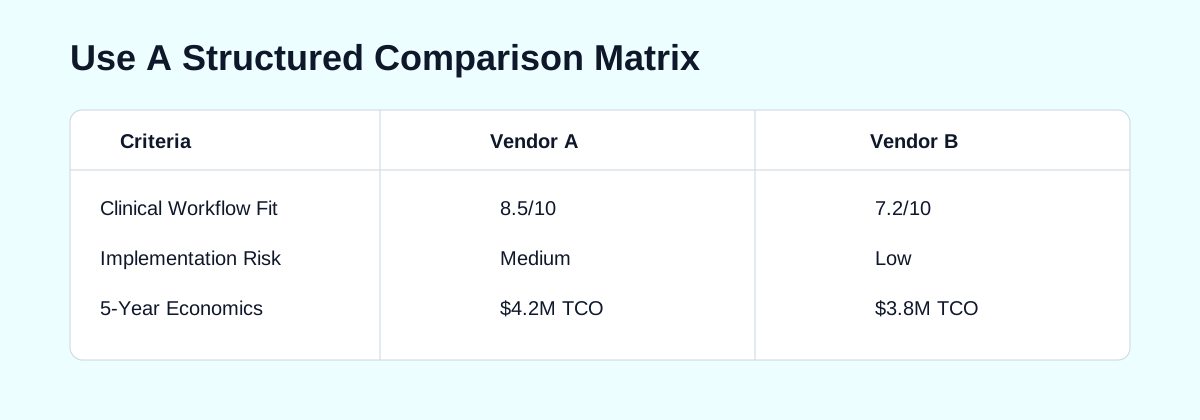
Need help choosing between athenahealth and eClinicalWorks?
Use our structured selection workflow for requirements, demos, and contracting.
athenahealth
Cloud-native EHR with best-in-class RCM
eClinicalWorks
Largest cloud ambulatory EHR by user count
Overview: The Two Largest Cloud Ambulatory EHRs
athenahealth and eClinicalWorks are the two most widely deployed cloud-based EHR platforms in the U.S. ambulatory market. Together, they serve hundreds of thousands of providers across primary care, specialty practices, urgent care centers, and federally qualified health centers (FQHCs). If you are evaluating cloud EHRs for an ambulatory practice, there is a high probability that both of these vendors are on your shortlist.
athenahealth, founded in 1997, pioneered the cloud-based EHR model with a network-enabled approach that treats revenue cycle management as a core differentiator rather than an afterthought. The company was taken private by Veritas Capital and Evergreen Coast Capital in 2019, and it continues to invest heavily in its connected platform. athenahealth consistently earns strong marks in KLAS and user satisfaction surveys, with particular strength in billing performance, interoperability, and customer support.
eClinicalWorks, founded in 1999, has grown into the largest cloud ambulatory EHR by sheer user count, serving over 150,000 physicians and nurse practitioners across all 50 states. The platform offers a comprehensive suite spanning EHR, practice management, patient engagement, population health, and telehealth. eClinicalWorks has a particularly strong presence among FQHCs and large multi-provider ambulatory groups. However, the vendor faced a significant reputational challenge in 2017 when it paid $155 million to settle a Department of Justice False Claims Act lawsuit related to ONC certification compliance, an event that still factors into some organizations' risk assessments.
This comparison is designed for practice administrators, physician owners, and IT leaders evaluating these two platforms for a new implementation, system replacement, or contract renewal. We cover every dimension that matters — revenue cycle, clinical documentation, interoperability, AI, pricing, implementation, and user satisfaction — with specific data points to support your decision.
Choose athenahealth if you need...
- Best-in-class revenue cycle management with network-powered rules engine
- Strong interoperability across the athenanet provider network
- Higher-rated usability and customer support
- A vendor financially aligned with your billing performance
- Proven platform for small to mid-size ambulatory practices
Choose eClinicalWorks if you need...
- Lower upfront cost with flat per-provider pricing
- FQHC-specific features including UDS reporting and sliding fee schedules
- Population health tools for value-based care contracts
- Comprehensive all-in-one platform at a competitive price point
- Support for very large ambulatory organizations (100+ providers)
Revenue Cycle Management
Revenue cycle management is the single most important differentiator in this comparison, and it is where athenahealth has built its strongest competitive advantage. Understanding the difference in RCM philosophy between these two platforms is essential to making the right choice.
athenahealth: Network-Powered RCM
athenahealth's approach to revenue cycle management is fundamentally different from most EHR vendors. Rather than simply providing billing software tools, athenahealth operates a continuously updated rules engine that learns from the collective billing experience of its entire network — over 160,000 providers submitting claims to thousands of payers. When one practice discovers that a specific payer has changed a billing requirement or introduced a new denial pattern, that intelligence is propagated across the network, so every athenahealth practice benefits.
This network effect translates into measurable billing performance. athenahealth reports first-pass claim acceptance rates above 95% across its network, and practices using athenaClinicals with athenaCollector typically see days in A/R in the low-to-mid 30s. The platform automates eligibility verification, prior authorization tracking, claim scrubbing, denial management, and patient balance follow-up. When claims are denied, athenahealth's work queues route them to the appropriate staff with specific instructions for resolution based on the denial reason and payer-specific appeal requirements.
The percentage-of-collections pricing model is central to this strategy. Because athenahealth earns a share of what it helps you collect, the company is financially incentivized to optimize your revenue cycle continuously. This alignment is unusual in the EHR market and is a primary reason practices choose athenahealth.
eClinicalWorks: Integrated Billing Tools
eClinicalWorks includes a full practice management and billing module within its platform. The system handles charge capture, claim submission, ERA posting, denial tracking, and patient billing. The billing workflow is integrated with the clinical documentation, so diagnosis and procedure codes flow from the encounter note to the claim with minimal manual intervention.
eClinicalWorks offers automated claim scrubbing, batch claim submission, and reporting dashboards for A/R aging, denial rates, and payer performance. The platform also provides an optional Revenue Cycle Management service (RCM as a Service) where eClinicalWorks staff handle end-to-end billing operations for practices that prefer to outsource. However, the depth of eClinicalWorks' claim intelligence and payer rules engine does not match athenahealth's network-powered approach. Practices on eClinicalWorks are more reliant on their own billing staff or outsourced RCM team to stay current with payer requirement changes.
KLAS data consistently rates athenahealth higher than eClinicalWorks in revenue cycle management, claims management, and overall billing satisfaction. For practices where billing performance directly drives financial viability, this gap is significant.
Verdict on RCM
athenahealth wins decisively on revenue cycle management. Its network-powered rules engine, financial alignment through percentage-of-collections pricing, and consistently higher KLAS ratings make it the stronger choice for practices that prioritize billing performance. eClinicalWorks offers competent integrated billing tools, but practices should expect to invest more in internal billing expertise or outsourced RCM services to achieve comparable results.
Clinical Documentation & Workflows
Both platforms provide comprehensive clinical documentation capabilities for ambulatory encounters, but they differ in approach and user experience.
athenahealth Clinical Documentation
athenaClinicals uses a structured-yet-flexible documentation approach with configurable encounter templates, order entry, e-prescribing (including EPCS for controlled substances), lab and imaging integration, and clinical decision support. The interface is web-based and accessible from any browser, with a relatively clean and modern design that has been progressively updated over the past several years.
athenahealth's documentation workflow emphasizes efficiency. The platform uses smart defaults, pre-populated fields based on appointment type and patient history, and a streamlined order-entry process. Providers can document using point-and-click templates, free text, voice dictation (through integrations with third-party transcription services), or a combination. athenahealth has also introduced ambient AI documentation capabilities, allowing providers to generate notes from patient conversations.
A key strength is the quality-of-care alerts embedded in the clinical workflow. athenahealth uses its network data to surface care gaps, preventive screening reminders, and payer-specific quality measure requirements at the point of care. This integration between clinical documentation and quality/billing requirements reduces the burden of documentation for value-based care compliance.
eClinicalWorks Clinical Documentation
eClinicalWorks provides a feature-rich clinical documentation environment with customizable progress note templates, structured data entry, voice recognition (through Dragon Medical integration), e-prescribing with EPCS, and comprehensive order management. The platform supports a wide range of clinical workflows including office visits, procedures, telehealth encounters, and group visits.
eClinicalWorks has invested in its Eva (eClinicalWorks Virtual Assistant) AI platform, which provides voice-enabled navigation, documentation assistance, and clinical decision support. Eva allows providers to use natural language commands to navigate the chart, place orders, and generate documentation. The platform also includes structured templates for a wide range of specialties and encounter types.
However, clinical documentation usability is an area where eClinicalWorks has historically received lower marks. User reviews frequently cite a steeper learning curve, a more cluttered interface, and workflows that require more clicks to accomplish common tasks compared to athenahealth. While eClinicalWorks has made interface improvements, the usability gap remains a consistent theme in user feedback and KLAS data.
Verdict on Clinical Documentation
athenahealth offers a cleaner, more intuitive documentation experience with better-rated usability. eClinicalWorks provides a more feature-dense platform with strong customization capabilities, but at the cost of a steeper learning curve and lower user satisfaction scores. Practices that prioritize ease of use and provider adoption speed should lean toward athenahealth. Practices that need highly customizable templates and are willing to invest in training may find eClinicalWorks sufficient.
Interoperability & Data Exchange
Interoperability — the ability to exchange clinical data with other healthcare organizations and systems — is increasingly critical in ambulatory care. Both vendors support standard exchange frameworks, but their network reach and ease of data exchange differ meaningfully.
athenahealth Interoperability
athenahealth's network-based architecture gives it a natural advantage in interoperability. The athenanet network connects over 160,000 providers, and clinical data flows automatically between athenahealth practices without requiring manual exchange or separate HIE connections. When a patient sees two different providers who both use athenahealth, their clinical records are accessible through the network.
Beyond its own network, athenahealth participates in both the Carequality and CommonWell Health Alliance interoperability frameworks, enabling data exchange with non-athenahealth providers, including Epic, Oracle Health, and other EHR systems. athenahealth also supports FHIR R4 APIs as required by the 21st Century Cures Act, with an open API marketplace for third-party integrations. The platform is actively working toward TEFCA (Trusted Exchange Framework and Common Agreement) compliance.
KLAS rates athenahealth among the top ambulatory EHR vendors for interoperability, reflecting both the breadth of its network connections and the reliability of its data exchange processes.
eClinicalWorks Interoperability
eClinicalWorks has invested in interoperability through its PRISMA health information search tool, which aggregates patient records from multiple sources into a single consolidated view. PRISMA connects to health information exchanges, Carequality participants, and other data sources to surface relevant clinical information during patient encounters.
The platform supports FHIR R4 APIs, CCDA document exchange, and standard lab and pharmacy interfaces. eClinicalWorks also participates in Carequality for cross-network data exchange. However, eClinicalWorks does not have the same network-inherent data sharing that athenahealth benefits from — because eClinicalWorks practices are not connected through a shared data network in the same way, interoperability depends more on external exchange frameworks and patient consent workflows.
It is worth noting that the 2017 DOJ settlement included allegations related to data portability, and eClinicalWorks has made substantial improvements in this area since then. However, interoperability remains an area where eClinicalWorks receives lower ratings compared to athenahealth in KLAS surveys.
Verdict on Interoperability
athenahealth has a clear advantage in interoperability thanks to its network-inherent data sharing and strong participation in national exchange frameworks. Practices that exchange data frequently with outside providers, hospitals, or specialists should weight this advantage heavily. eClinicalWorks' PRISMA tool provides useful data aggregation, but the overall interoperability experience is rated lower.
AI Features
Both athenahealth and eClinicalWorks are investing in artificial intelligence, though their approaches and current feature maturity differ.
athenahealth AI
athenahealth has introduced AI capabilities focused on reducing administrative burden and improving revenue cycle performance. The platform offers ambient documentation features that generate clinical notes from provider-patient conversations, reducing manual charting time. athenahealth's AI also powers its claim prediction engine, which uses machine learning to identify claims likely to be denied before submission and routes them for correction.
The network-powered rules engine itself is a form of applied intelligence — it continuously learns from the collective billing experience of the entire athenahealth network and applies those learnings to individual practice claims. athenahealth has also introduced AI-driven patient outreach and engagement features, including automated appointment reminders and care gap notifications tailored to individual patient risk profiles.
eClinicalWorks AI
eClinicalWorks has been more aggressive in branding its AI strategy through its Eva virtual assistant platform. Eva provides voice-enabled chart navigation, clinical documentation assistance, and order entry through natural language processing. Providers can speak commands like "open the patient's medication list" or "prescribe amoxicillin 500mg" and Eva processes the request within the EHR workflow.
eClinicalWorks has also developed AI tools for population health analytics, including risk stratification models that identify patients at high risk for hospitalization or chronic disease progression. These tools are particularly relevant for FQHCs and practices participating in value-based care contracts. The platform includes predictive analytics dashboards and automated care management workflows triggered by AI-identified risk factors.
Additionally, eClinicalWorks has introduced ambient documentation capabilities and AI-powered coding suggestions that recommend diagnosis and procedure codes based on the documentation entered during an encounter.
Verdict on AI
eClinicalWorks has been more aggressive in shipping named AI features, particularly Eva and its population health analytics tools. athenahealth's AI advantage is more structural — the network-powered rules engine and claims prediction deliver practical AI value even if they are not always branded as "AI features." For practices prioritizing ambient documentation and voice navigation, eClinicalWorks has a more visible offering. For practices that care most about AI-driven billing optimization, athenahealth delivers more proven value.
Pricing & Total Cost of Ownership
Pricing is a critical differentiator in this comparison, and the two vendors use fundamentally different pricing models that make direct comparison complex.
| Cost Component | athenahealth | eClinicalWorks |
|---|---|---|
| Pricing Model | Subscription + % of collections | Flat per-provider/month |
| Base EHR + PM | ~$140+/provider/mo + 4-8% collections | $449-$599/provider/mo |
| Implementation | Included or minimal fee | $3,000-$12,000+ |
| Contract Length | Typically 1-3 years | Typically 3 years |
| Telehealth | Included | Included (healow) |
| Estimated Annual Cost (10-provider practice) | $80K-$150K+ | $54K-$72K |
The headline numbers suggest eClinicalWorks is significantly cheaper, and on a pure subscription-cost basis, that is usually true. eClinicalWorks' flat per-provider pricing is straightforward and predictable. For a 10-provider practice, the annual software cost ranges from roughly $54,000 to $72,000 depending on the plan tier.
athenahealth's costs are harder to predict because the percentage-of-collections component scales with practice revenue. A high-revenue specialty practice collecting $500,000 per provider annually at a 5% collection fee would pay $25,000 per provider per year in collection fees alone, plus the base subscription. For a 10-provider practice, total annual costs can range from $80,000 to $150,000 or more.
However, the total cost comparison should account for outcomes, not just subscription fees. athenahealth's superior RCM performance can translate to higher collection rates, fewer denied claims, and lower days in A/R. If athenahealth's billing engine generates even a 2-3% improvement in net collections, the higher software cost can be more than offset by increased revenue. Practices should model this calculation with their own payer mix and revenue data before making a purely price-based decision.
Implementation
Both platforms are cloud-based, which eliminates server provisioning and reduces infrastructure complexity. However, implementation timelines and approaches differ.
athenahealth Implementation
athenahealth implementations typically take 8 to 14 weeks for small to mid-size practices. The process includes a dedicated implementation manager, workflow assessment, template and form configuration, data migration from the previous system, interface setup (labs, imaging, pharmacy, clearinghouse), staff training, and go-live support. athenahealth's cloud-native architecture means there is no hardware to provision and no on-premise software to install.
athenahealth provides a structured onboarding methodology with defined milestones. Training is delivered through a combination of live virtual sessions, self-paced e-learning modules, and on-demand video libraries. Post-go-live, athenahealth offers ongoing optimization support to help practices refine their workflows and maximize the platform's capabilities. Implementation costs are typically minimal or bundled into the ongoing subscription, which reduces the upfront financial burden.
eClinicalWorks Implementation
eClinicalWorks implementations generally range from 8 to 16 weeks depending on practice size and complexity. The onboarding process includes system configuration, template customization, data migration, interface setup, training, and parallel go-live support. eClinicalWorks offers both on-site and virtual training options.
One consideration with eClinicalWorks implementations is the level of customization required. The platform offers extensive configurability, which can be an advantage for practices with specific workflow requirements but can also extend the implementation timeline if not managed carefully. Some user reviews note that the initial setup and configuration process required more effort than expected, particularly for template customization and billing rule configuration.
eClinicalWorks charges implementation fees separately, typically ranging from $3,000 to $12,000 or more depending on practice size and data migration complexity. Post-go-live support is available through eClinicalWorks' customer support channels, though user satisfaction with support responsiveness has been mixed in reviews.
Verdict on Implementation
Both platforms have similar implementation timelines. athenahealth has an edge in the implementation experience, with higher-rated onboarding support and lower upfront implementation costs. eClinicalWorks offers more customization during setup, which can be valuable but also adds complexity.
User Satisfaction & KLAS Ratings
User satisfaction is one of the clearest differentiators in this comparison, and athenahealth holds a consistent advantage across every major rating dimension.
| Rating Dimension | athenahealth | eClinicalWorks |
|---|---|---|
| Overall KLAS Score | ~4.0 / 5.0 | ~3.6 / 5.0 |
| Revenue Cycle | Above average | Average |
| Usability | Above average | Below average |
| Interoperability | Above average | Average |
| Customer Support | Above average | Below average |
| Would Buy Again | High | Moderate |
athenahealth consistently outperforms eClinicalWorks in KLAS research surveys across the ambulatory EHR segment. The largest gaps are in customer support satisfaction and revenue cycle management, where athenahealth's proactive billing support and dedicated customer success model receive markedly higher marks. athenahealth also scores higher in the "would buy again" metric, which reflects overall customer loyalty and satisfaction with the vendor relationship.
eClinicalWorks' lower satisfaction scores are a recurring theme in user reviews and independent research. Common complaints include the steeper learning curve, interface complexity, and inconsistent customer support responsiveness. Some practices report that once staff become proficient with eClinicalWorks, the platform's breadth of features and customization capabilities become clear strengths. However, the initial learning curve and ongoing support experience can be frustrating, particularly for smaller practices without dedicated IT staff.
It is important to note that eClinicalWorks has a massive installed user base — over 150,000 providers — and many of those practices have used the platform for years and are productive on it. Lower aggregate satisfaction ratings do not mean the platform is nonfunctional; they mean that a larger percentage of users report friction compared to athenahealth. Practices with experienced eClinicalWorks users on staff may find the transition learning curve less of a concern.
Who Should Choose athenahealth
athenahealth is the stronger choice for practices that match one or more of these profiles:
- Small to mid-size ambulatory practices (1-75 providers) that want a cloud-based platform with proven revenue cycle management and high usability ratings.
- Practices where billing performance is the top priority. athenahealth's network-powered rules engine and percentage-of-collections alignment make it the best choice for practices that want to maximize net collections and minimize days in A/R.
- Practices that value interoperability and exchange data frequently with hospitals, specialists, labs, and other external providers. The athenanet network and Carequality/CommonWell participation provide a broad data exchange footprint.
- Organizations that prioritize usability and provider satisfaction. athenahealth's cleaner interface and easier learning curve translate to faster adoption, less training time, and higher day-to-day provider satisfaction.
- Practices that want a vendor invested in their financial success. The percentage-of-collections model means athenahealth is directly incentivized to help your practice collect more revenue. This alignment is rare in the EHR market.
- Practices that value strong customer support. athenahealth's support model, including dedicated customer success managers for larger accounts, receives consistently higher ratings than eClinicalWorks.
athenahealth may not be the best fit for very large ambulatory organizations (100+ providers) that need aggressive volume discounting, for FQHCs that require specialized community health center features, or for practices in which the percentage-of-collections cost model becomes prohibitively expensive due to very high per-provider revenue. For athenahealth's full profile, see our athenahealth review.
Who Should Choose eClinicalWorks
eClinicalWorks is the stronger choice for practices that match one or more of these profiles:
- Federally Qualified Health Centers (FQHCs) that need UDS reporting, sliding fee schedule management, grant tracking, and population health tools aligned with HRSA requirements. eClinicalWorks has a large and proven FQHC customer base.
- Budget-conscious practices that want predictable flat per-provider pricing without the variable cost of a percentage-of-collections model. For practices with high per-provider revenue, eClinicalWorks' flat pricing can be significantly cheaper than athenahealth.
- Large ambulatory organizations (50-200+ providers) that need a scalable platform with volume pricing. eClinicalWorks has demonstrated the ability to support very large ambulatory groups and can negotiate competitive pricing at scale.
- Practices focused on population health and value-based care that need risk stratification, care management workflows, and quality measure dashboards. eClinicalWorks' population health tools, including its HEDIS and quality reporting modules, are well-developed.
- Practices that prioritize feature breadth over polish. eClinicalWorks offers a very comprehensive feature set spanning EHR, PM, telehealth (healow), patient engagement, population health, and analytics — all within a single vendor relationship. Practices that want an all-in-one platform with extensive customization options may prefer this approach.
- Practices with experienced eClinicalWorks users on staff. If your team already knows the platform, the learning curve disadvantage is neutralized and you can leverage eClinicalWorks' deep feature set effectively.
eClinicalWorks may not be the best fit for practices that prioritize usability and minimal learning curve, for organizations where billing performance is the dominant evaluation criterion, or for practices with high sensitivity to vendor compliance history (given the 2017 DOJ settlement). For eClinicalWorks' full profile, see our eClinicalWorks review.
Frequently Asked Questions
Is athenahealth better than eClinicalWorks?
athenahealth consistently earns higher user satisfaction and KLAS ratings than eClinicalWorks, particularly in revenue cycle management, interoperability, and customer support. However, eClinicalWorks has a larger installed user base, lower list pricing for its bundled EHR/PM platform, and strong population health tools for FQHCs and value-based care organizations. The best choice depends on whether your practice prioritizes billing performance and usability (athenahealth) or cost efficiency and population health capabilities (eClinicalWorks).
What was the eClinicalWorks DOJ settlement?
In 2017, eClinicalWorks paid $155 million to settle a False Claims Act lawsuit brought by the U.S. Department of Justice. The government alleged that eClinicalWorks falsely obtained ONC certification by concealing that its software did not meet all required certification criteria, including drug interaction checking and data portability. The settlement also required eClinicalWorks to engage an independent assessor. The company has since addressed the issues and maintained its ONC certification, but the settlement remains a consideration for risk-averse organizations evaluating the vendor.
How does athenahealth's percentage-of-collections pricing work?
athenahealth charges a base subscription fee (starting around $140 per provider per month) plus a percentage of collections managed through its revenue cycle services, typically ranging from 4% to 8% of collections. This aligns athenahealth's revenue with practice performance — if athenahealth helps you collect more, they earn more. While this can result in higher total costs for high-revenue practices, it also means athenahealth is financially incentivized to optimize your billing outcomes. Practices should model the total cost based on their expected collections to compare accurately with eClinicalWorks' flat pricing.
Can eClinicalWorks support FQHCs effectively?
Yes. eClinicalWorks has a significant FQHC customer base and offers specific features for community health centers, including UDS reporting, sliding fee schedule management, grant tracking, and population health dashboards aligned with HRSA requirements. eClinicalWorks is one of the most widely used EHR platforms among FQHCs in the United States, and its pricing and feature set are generally well-suited to the community health center model. FQHCs should still evaluate athenahealth and other FQHC-focused vendors, but eClinicalWorks is a credible and widely deployed option in this segment.
Which platform has better interoperability in 2026?
athenahealth has a strong edge in interoperability. Its network-enabled model connects over 160,000 providers, and the platform facilitates automatic clinical data exchange across the athenanet network, Carequality, and CommonWell Health Alliance. eClinicalWorks participates in Carequality through its PRISMA health information search tool and supports standard FHIR APIs, but its interoperability capabilities are generally rated lower in KLAS surveys. For practices that frequently exchange data with outside providers and hospitals, athenahealth is the stronger choice.
Verdict
athenahealth is the better-rated platform and the safer choice for most ambulatory practices. It leads in revenue cycle management, usability, interoperability, and customer support. The network-powered billing engine is a genuine differentiator that translates to measurable financial value. For small to mid-size practices that want a cloud EHR with strong billing performance and are willing to pay a premium for quality, athenahealth is the top recommendation.
eClinicalWorks is a viable option for budget-conscious practices, FQHCs, and large ambulatory organizations. Its flat per-provider pricing is more predictable and often cheaper than athenahealth, particularly for high-revenue practices. The platform's strength in population health, FQHC-specific features, and sheer breadth of functionality makes it a reasonable choice for organizations that prioritize cost and feature comprehensiveness over usability polish. However, practices should go in with realistic expectations about the learning curve, interface complexity, and support experience.
The bottom line: If billing performance and user experience are your primary evaluation criteria, athenahealth is the clear winner. If cost predictability, FQHC capabilities, or population health tools are your top priorities, eClinicalWorks deserves serious consideration. Schedule demos with both vendors using your actual clinical and billing workflows, request KLAS reports specific to your practice size and specialty, and model the total cost of ownership over a 3-5 year period before making a final decision. For more guidance, see our EHR Selection Guide.