The 10 Largest EHR Vendors in 2026: Market Share, Pricing, and What Sets Them Apart
A data-driven ranking of the dominant EHR vendors in 2026 with real pricing, market share figures, KLAS ratings, and honest assessments of each platform's strengths and weaknesses — so you can build an informed shortlist without sitting through 10 vendor demos first.
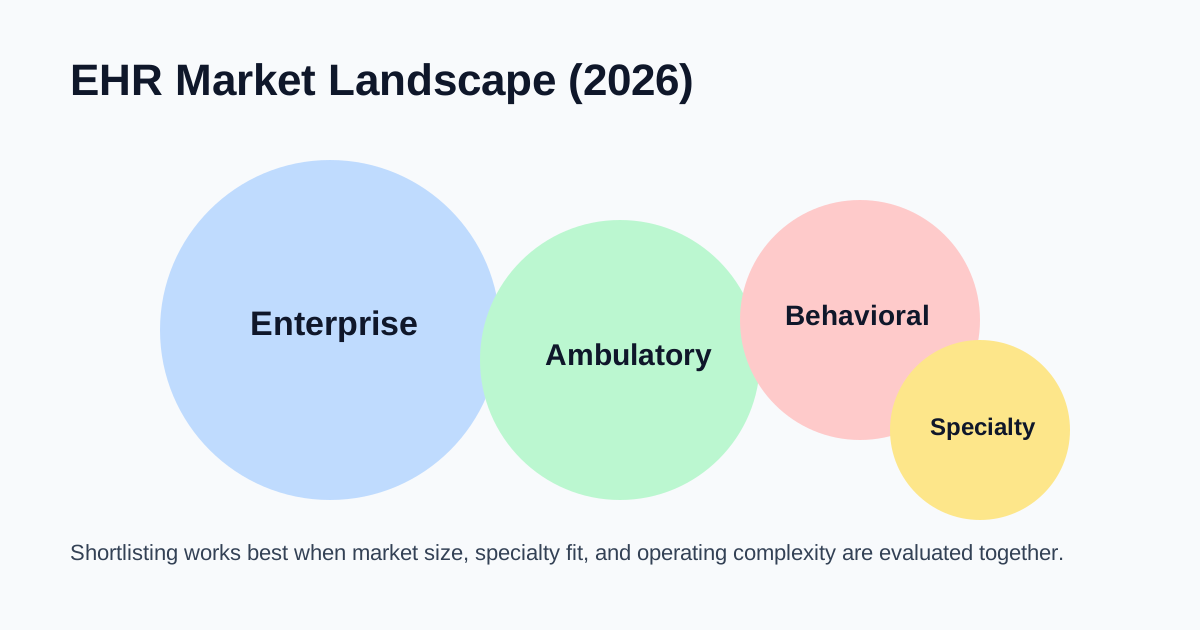
Key Takeaways
- Epic Systems dominates with 37-44% ambulatory market share and 250M+ patient records. It won ~70% of new hospital contracts in 2024 — but it's overkill (and unaffordable) for most independent practices.
- Oracle Health (Cerner) is the #2 hospital EHR but is losing ground post-acquisition — down 74 hospital sites in 2024 — as it migrates to Oracle Cloud Infrastructure.
- For ambulatory practices, athenahealth (cloud-native, strong RCM) and eClinicalWorks (largest cloud ambulatory install base, aggressive AI) are the two largest players.
- Pricing ranges from $10/month (Tebra entry tier) to $30M+ (Epic enterprise deployment). Most ambulatory cloud EHRs fall in the $150-$600/provider/month range.
- The market is consolidating through private equity: Thoma Bravo bought NextGen ($1.8B), Bain/Hellman & Friedman own athenahealth, Francisco Partners acquired AdvancedMD, and Vista Equity Partners backs Greenway Health.
The EHR Market in 2026: What You Need to Know
The U.S. electronic health record market is projected to exceed $19 billion by 2027, and it is more consolidated than ever. A handful of vendors control the vast majority of the hospital market, while the ambulatory space remains more fragmented — though private equity is rapidly rolling up mid-tier vendors.
This consolidation matters for your purchasing decision. Vendor stability, investment trajectory, and long-term viability should factor into your evaluation alongside features and price. A vendor losing market share may offer aggressive discounts today but underinvest in R&D tomorrow. A vendor gaining share may have leverage to raise prices — but also has the revenue to fund innovation.
We've ranked these 10 vendors by a combination of market share, installed base size, revenue, and market influence. For each, we provide the data you actually need: who they serve best, what they charge, what makes them different, and where they fall short. All pricing reflects 2025-2026 market data and should be used as a planning range — actual quotes will vary based on your specific requirements.
For a deeper look at how deployment model affects your total cost, see our cloud vs. on-premise EHR comparison. For a structured approach to running your evaluation, follow our EHR selection process guide.
Master Comparison Table
Before diving into each vendor, here is the landscape at a glance. This table summarizes the key differentiators across all 10 vendors to help you quickly identify which platforms are worth a closer look for your organization.
| Vendor | Best For | Deployment | Pricing | Market Share / Scale | KLAS / Awards |
|---|---|---|---|---|---|
| Epic Systems | Large health systems, AMCs | Cloud / On-prem / Hybrid | $10M-$30M+ (hospital) | 37-44% ambulatory; 250M+ records | Best in KLAS 15 consecutive years |
| Oracle Health (Cerner) | Hospitals, government/military | Cloud (OCI) / On-prem | $2M-$5M (mid-size hospital) | 21.7-22.9% hospital market | Declining satisfaction scores |
| athenahealth | Ambulatory practices (1-75 providers) | 100% cloud-native | $140+/provider/mo + % collections | 160,000+ providers | Best in KLAS 2025 (Indep. Practice) |
| eClinicalWorks | Ambulatory practices, FQHCs | Cloud / Client-server | $449-$599/provider/mo | 850,000+ physicians; ~$1B revenue | Polarized reviews; DOJ settlement history |
| NextGen Healthcare | Mid-large specialty practices | Cloud / On-prem | $150-$500/provider/mo | 100,000+ providers | Strong specialty content ratings |
| MEDITECH | Small-mid community hospitals | Cloud-hosted (Expanse) | Custom enterprise pricing | Strong in 1-150 bed hospitals | Best in KLAS (Community Hospital) |
| AdvancedMD | Independent practices (2-10 providers) | 100% cloud | $229-$729/provider/mo | Mid-tier ambulatory | Strong for independent practices |
| Greenway Health | Small-mid ambulatory practices | Cloud / On-prem | $100-$500/provider/mo | 55,000+ providers | KLAS Cybersecurity Transparent |
| DrChrono (EverHealth) | Small/solo tech-forward practices | 100% cloud, iPad-first | $299+/provider/mo | Small-practice focused | Strong mobile/UX ratings |
| Tebra (Kareo) | Very small/startup practices | 100% cloud | $10-$100+/mo | 107,000+ providers historically | Most affordable entry point |
1. Epic Systems
Overview
Epic Systems is the undisputed market leader in electronic health records. Founded in 1979 by Judy Faulkner — who still leads the company as CEO — Epic has grown from a small Wisconsin startup into the platform that holds medical records for over 250 million patients. The company is privately held with no outside investors, which gives it unusual long-term strategic freedom. Epic has never been acquired and has never acquired another company, preferring to build everything in-house.
Epic's dominance is not just historical — it is accelerating. The company won approximately 70% of new hospital EHR contracts awarded in 2024, a staggering win rate that is pulling further ahead of competitors. Epic has been named Best in KLAS for 15 consecutive years, a streak unmatched by any other health IT vendor.
Target Market
Large health systems, academic medical centers, integrated delivery networks, and major hospital chains. Epic also serves mid-size hospitals through its Community Connect program, which allows smaller facilities to access Epic through a larger health system's instance at a significantly reduced cost.
Deployment & Pricing
Epic offers cloud, on-premise, and hybrid deployment models. Historically on-premise, Epic has invested heavily in cloud-hosted and Azure-based deployments in recent years. Pricing for a full hospital implementation typically ranges from $10 million to $30 million or more, depending on the number of beds, modules, and customization required. Epic does not publish list pricing — every deal is custom-negotiated.
Key Differentiators
- Most comprehensive platform — Epic covers inpatient, outpatient, emergency, surgery, pharmacy, lab, radiology, revenue cycle, population health, and patient engagement in a single integrated system.
- Best interoperability — Epic's Care Everywhere network enables data exchange across Epic sites and non-Epic sites via CommonWell and Carequality. Its FHIR API implementation is among the most mature in the industry.
- MyChart patient portal — The most widely adopted patient portal in the U.S., with over 190 million activated accounts.
- AI investment — Epic has integrated generative AI for clinical documentation, inbox management, and decision support, partnering with Microsoft and Nuance.
Pros and Cons
Pros
- Most comprehensive feature set on the market
- Best interoperability and data exchange network
- Dominant market position ensures long-term viability
- Highest KLAS satisfaction scores among enterprise EHRs
- Private ownership means no quarterly earnings pressure
Cons
- Extremely expensive — prohibitive for small organizations
- Complex implementation (12-24+ months typical)
- Overkill for independent practices and small hospitals
- Requires significant internal IT and build resources
- Vendor lock-in once implemented
Best for: Large health systems, academic medical centers, and integrated delivery networks with the budget and IT infrastructure to support a comprehensive enterprise EHR platform.
2. Oracle Health (Cerner)
Overview
Oracle Health — formerly Cerner Corporation — has been a major EHR vendor since 1979. Oracle acquired Cerner in June 2022 for $28.3 billion, one of the largest health IT acquisitions in history. The acquisition was intended to combine Cerner's healthcare domain expertise with Oracle's cloud infrastructure and database technology to create a next-generation health platform.
The reality has been more turbulent. Oracle Health holds approximately 21.7-22.9% of the hospital EHR market, making it the clear #2 behind Epic. However, the company lost 74 hospital sites in 2024 as client satisfaction has declined during the post-acquisition integration. Oracle is actively migrating the Cerner platform to Oracle Cloud Infrastructure (OCI), a multi-year effort that has introduced uncertainty for existing clients.
Target Market
Mid-to-large hospitals, health systems, and government/military healthcare. Oracle Health is the EHR vendor for the U.S. Department of Veterans Affairs (VA) modernization program, though that project has faced significant delays, cost overruns, and Congressional scrutiny.
Deployment & Pricing
Oracle Health is transitioning from on-premise and hosted deployments to Oracle Cloud Infrastructure. For a mid-size hospital implementation, expect pricing in the $2 million to $5 million range. Pricing varies significantly based on modules, bed count, and whether you're a new customer or an existing Cerner site migrating to OCI.
Key Differentiators
- Oracle infrastructure investment — Oracle is pouring billions into building a healthcare-specific cloud platform, with promises of AI-driven clinical decision support, autonomous database management, and unified health data.
- Strong acute care foundation — Cerner's Millennium platform has deep inpatient, surgical, and emergency department functionality built over decades.
- Government and military presence — Oracle Health is the EHR of record for the VA and has FedRAMP authorization for government cloud deployments.
- Open platform strategy — Oracle Health has historically been more open to third-party integrations and custom development than some competitors.
Pros and Cons
Pros
- Strong acute care / inpatient functionality
- Massive Oracle investment in cloud and AI
- Government/military deployment experience
- More affordable than Epic for mid-size hospitals
- Open platform for third-party integration
Cons
- Losing market share — 74 hospital sites lost in 2024
- Post-acquisition disruption and leadership turnover
- Client satisfaction scores declining
- VA modernization project struggles hurt reputation
- Cloud migration timeline creates uncertainty
Best for: Mid-to-large hospitals, government and military healthcare facilities, and organizations willing to bet on Oracle's long-term cloud investment — particularly those that can negotiate favorable pricing during this competitive transition period.
3. athenahealth
Overview
athenahealth is the leading cloud-native EHR for ambulatory practices. Founded in 1997, the company was a cloud pioneer — building its platform for web-based delivery from the ground up, years before "cloud" became a buzzword in healthcare IT. Today, athenahealth serves over 160,000 providers and is backed by private equity firms Bain Capital and Hellman & Friedman.
athenahealth was named Best in KLAS 2025 for Independent Physician Practice for the second consecutive year, reflecting strong clinician satisfaction and robust functionality for the practices it serves best. The platform's core differentiator is its network model: athenahealth aggregates anonymized data across its entire client base to benchmark performance, identify billing optimization opportunities, and automatically update rules engines based on payer behavior changes.
Target Market
Independent ambulatory practices with 1-75 providers. athenahealth also serves some larger medical groups and health systems through its enterprise offering, but its sweet spot is the independent practice that wants a modern cloud platform with strong revenue cycle management.
Deployment & Pricing
100% cloud-native since inception — there is no on-premise option. Pricing starts at approximately $140+ per provider per month for the EHR, with additional fees for practice management and revenue cycle management services. athenahealth's RCM model charges a percentage of collections (typically 4-7% of net collections), which aligns the vendor's incentive with your practice's financial performance but can become expensive for high-revenue practices.
Key Differentiators
- Network intelligence — Rules engine continuously updated based on payer behavior across 160,000+ providers. If a payer changes a prior authorization requirement, athenahealth's system adapts for all clients.
- Revenue cycle management — One of the strongest integrated RCM offerings in ambulatory EHR, with claims scrubbing, denial management, and patient collections built in.
- Cloud-native architecture — No version upgrades, no patching, no downtime for updates. All clients are always on the latest version.
- Marketplace — App marketplace with 250+ third-party integrations via APIs.
Pros and Cons
Pros
- True cloud-native — always current, zero maintenance
- Best-in-class revenue cycle management
- Network benchmarking provides actionable insights
- Strong KLAS ratings for independent practices
- Active third-party app marketplace
Cons
- Percentage-of-collections RCM model gets expensive at scale
- Less suited for enterprise/hospital deployments
- PE ownership raises long-term strategic questions
- Customization options more limited than on-premise systems
- Some users report interface complexity for non-standard workflows
Best for: Independent ambulatory practices with 1-75 providers that want a modern cloud platform with strong integrated revenue cycle management and are willing to pay a premium for network-powered billing intelligence.
4. eClinicalWorks
Overview
eClinicalWorks (eCW) claims the title of the largest cloud-based ambulatory EHR by installed base, with over 850,000 physicians using the platform. The company is privately held and founder-owned, generating approximately $1 billion in annual revenue. eCW has been one of the most aggressive EHR vendors in embracing artificial intelligence, with over 125 AI-powered features and a ChatGPT integration for clinical documentation assistance.
eCW's history is not without controversy. In 2017, the company paid a $155 million settlement to the U.S. Department of Justice for allegedly falsely certifying that its EHR met Meaningful Use requirements. Since then, eCW has invested significantly in compliance and quality — but the settlement remains a factor that buyers should be aware of during due diligence.
Target Market
Ambulatory practices of all sizes, with particular strength in Federally Qualified Health Centers (FQHCs), multi-specialty groups, and primary care practices. eCW's pricing makes it competitive for mid-size practices that need comprehensive functionality without the athenahealth percentage-of-collections model.
Deployment & Pricing
eClinicalWorks offers both cloud and client-server deployment models. Pricing ranges from $449 to $599 per provider per month depending on the package selected, with the higher tiers including practice management, billing, patient engagement, and telehealth modules. This flat per-provider pricing is predictable and often more cost-effective than percentage-based models for practices with healthy collections.
Key Differentiators
- Aggressive AI innovation — 125+ AI features including ambient listening, clinical decision support, and ChatGPT-powered documentation assistance. eCW is moving faster than most competitors in AI adoption.
- Comprehensive platform — EHR, practice management, revenue cycle, telehealth (healow), patient engagement, and population health in one system.
- healow ecosystem — Integrated telehealth, patient self-scheduling, check-in, and health record sharing through the healow brand.
- FQHC strength — Deep functionality for community health centers including UDS reporting, sliding fee schedules, and grant management.
Pros and Cons
Pros
- Comprehensive feature set at predictable pricing
- Most aggressive AI innovation in ambulatory EHR
- Integrated telehealth (healow) platform
- Strong FQHC and community health center support
- Large installed base means extensive peer community
Cons
- $155M DOJ settlement raises compliance trust questions
- Polarized user reviews — some love it, some strongly dislike it
- Customer support quality is inconsistently reported
- Data migration out of eCW is notoriously difficult
- Interface can feel cluttered for simple workflows
Due diligence note: If you're evaluating eClinicalWorks, specifically ask about data export capabilities and contractual provisions for data portability. Multiple practices have reported difficulty extracting their data when switching vendors. Ensure your contract includes clear data export rights in a standard format (C-CDA, FHIR, or CSV) before signing.
Best for: Mid-size ambulatory practices and FQHCs that want comprehensive functionality at a predictable per-provider price, particularly those interested in early AI adoption and integrated telehealth.
5. NextGen Healthcare
Overview
NextGen Healthcare has been serving ambulatory practices since 1974, making it one of the longest-tenured vendors in the EHR space. The company was taken private by Thoma Bravo in a $1.8 billion acquisition in 2023. Under PE ownership, NextGen has accelerated investment in cloud migration, artificial intelligence, and specialty-specific content. The platform serves over 100,000 ambulatory providers.
NextGen's defining characteristic is its specialty depth. The platform offers 26 specialty-specific clinical content templates — covering everything from orthopedics to ophthalmology to cardiology — that provide pre-built workflows, order sets, and documentation templates tailored to how each specialty actually practices. This is a genuine differentiator vs. general-purpose EHRs that require extensive configuration to match specialty workflows.
Target Market
Mid-to-large specialty and multi-specialty ambulatory practices. NextGen is particularly strong in practices with 10-200+ providers where specialty-specific workflows are critical and the practice has outgrown simpler small-practice EHRs.
Deployment & Pricing
NextGen offers both cloud and on-premise deployment options. Pricing ranges from $150 to $500 per provider per month depending on modules selected. The base EHR starts at the lower end; adding practice management, patient engagement, analytics, and revenue cycle modules increases the price. NextGen also offers an enterprise version for larger organizations that need more advanced configuration and integration capabilities.
Key Differentiators
- 26 specialty-specific templates — Purpose-built clinical content for the most common ambulatory specialties, reducing configuration time and improving workflow fit.
- AI Ambient Assist — AI-powered ambient listening that converts patient-provider conversations into structured clinical documentation. NextGen reports this feature saves clinicians an average of 2.5 hours per day — a significant productivity and burnout-reduction claim.
- Strong mobile app — Well-regarded mobile experience for charting and order management on the go.
- Thoma Bravo investment — PE backing is funding accelerated product development, cloud migration, and strategic acquisitions.
Pros and Cons
Pros
- Best specialty-specific clinical content in the market
- Good value pricing for the functionality delivered
- AI Ambient Assist is a genuine productivity booster
- Strong mobile app for clinician flexibility
- Active PE investment fueling R&D
Cons
- Enterprise version needed for larger organizations (added cost/complexity)
- PE ownership creates uncertainty about long-term pricing strategy
- Cloud migration still in progress — not fully cloud-native
- Revenue cycle management less mature than athenahealth
- Some legacy interface elements remain in the platform
Best for: Mid-to-large specialty and multi-specialty ambulatory practices that need deep specialty-specific workflows out of the box and want a platform that balances functionality, mobile access, and AI-powered documentation at competitive pricing.
6. MEDITECH
Overview
MEDITECH is one of the oldest EHR vendors in the industry, founded in 1969 — a full decade before Epic and Cerner. The company has evolved through multiple platform generations, and its current flagship product, MEDITECH Expanse, represents a modern, cloud-hosted, web-based platform that has earned strong recognition in the community hospital segment.
MEDITECH's strength is the small-to-mid-size hospital market where Epic is often too expensive and too complex. MEDITECH Expanse has been recognized as Best in KLAS for Community Hospitals with 1-150 beds — a segment that represents hundreds of hospitals across the United States. The company is privately held and employee-owned, which gives it a culture more focused on long-term client relationships than quarterly revenue targets.
Target Market
Small-to-mid-size community hospitals (typically 1-300 beds), critical access hospitals, and community health systems. MEDITECH is particularly strong in rural hospitals and smaller organizations that need a full acute care EHR without the cost and complexity of Epic or Oracle Health.
Deployment & Pricing
MEDITECH Expanse is available as a cloud-hosted solution (MEDITECH as a Service) as well as traditional on-premise deployment. Pricing is custom-quoted based on bed count and modules but is generally positioned as significantly more affordable than Epic or Oracle Health for hospitals in the under-200-bed range. MEDITECH does not publish list pricing.
Key Differentiators
- Community hospital focus — Purpose-built for the operational realities of smaller hospitals where staff wear multiple hats and budgets are tighter.
- Expanse platform — Modern web-based interface that represents a significant upgrade from MEDITECH's earlier generations (MAGIC, Client/Server, 6.x).
- Google Cloud partnership — MEDITECH has partnered with Google for cloud hosting and AI capabilities, including Google Health's clinical AI tools.
- Lower total cost of ownership — For hospitals in its target market, MEDITECH typically offers a significantly lower TCO than Epic or Oracle Health.
Pros and Cons
Pros
- Best in KLAS for community hospitals (1-150 beds)
- Significantly more affordable than Epic/Oracle for small hospitals
- Employee-owned — aligned with long-term client success
- Expanse is a genuine modern platform upgrade
- Google Cloud partnership brings AI and infrastructure benefits
Cons
- Limited ambulatory/independent practice functionality
- Smaller app ecosystem and third-party integration options
- Less suitable for large, complex health systems
- Many existing clients still on legacy platforms (migration needed)
- Interoperability options less mature than Epic's Care Everywhere
Best for: Small-to-mid-size community hospitals and critical access hospitals (1-200 beds) that need a full acute care EHR at a price point significantly below Epic or Oracle Health, with vendor attention and support scaled to their organization's size.
7. AdvancedMD
Overview
AdvancedMD is a cloud-based EHR and practice management platform designed specifically for independent medical practices. Founded in 1999, the company was acquired by Global Payments in 2018, and subsequently purchased by Francisco Partners, a technology-focused private equity firm. AdvancedMD occupies an important niche: it's more feature-rich than entry-level platforms like Tebra but more accessible and affordable than enterprise systems like athenahealth at scale.
Target Market
Independent medical practices with 2-10 providers. AdvancedMD is well-suited for practices that want a comprehensive cloud platform — EHR, practice management, billing, patient engagement, and telemedicine — from a single vendor, without the complexity of enterprise-grade systems.
Deployment & Pricing
100% cloud-based. Pricing ranges from $229 to $729 per provider per month depending on the tier and modules selected. The base tier includes EHR and practice management, while higher tiers add advanced reporting, patient engagement, telemedicine, and revenue cycle management services. One-time implementation and training fees apply separately.
Pros and Cons
Pros
- Comprehensive all-in-one cloud platform
- Strong practice management and scheduling
- Good customization options for independent practices
- Integrated telemedicine and patient portal
- Responsive customer support for its target market
Cons
- Can be pricey at higher tiers ($729/provider/month)
- Less suited for practices above 15-20 providers
- Reporting capabilities lag behind larger platforms
- PE ownership cycle creates vendor stability questions
- Fewer specialty-specific templates than NextGen
Best for: Independent medical practices with 2-10 providers that want a comprehensive, all-in-one cloud platform without the complexity of enterprise systems or the revenue-share pricing model of athenahealth.
8. Greenway Health (Intergy)
Overview
Greenway Health, backed by Vista Equity Partners, serves over 55,000 providers with its Intergy EHR and practice management platform. The company has roots dating back to 1977 and has built a reputation as a reliable, no-frills EHR for small-to-mid-size ambulatory practices. Greenway earned the KLAS Cybersecurity Transparent designation, reflecting its commitment to security transparency — an increasingly important factor in vendor selection.
Target Market
Small-to-mid-size ambulatory practices, particularly those that prioritize reliable core EHR functionality, good customer support, and affordable pricing over cutting-edge features. Greenway is a solid choice for practices that want a dependable system without paying for functionality they won't use.
Deployment & Pricing
Greenway offers both cloud and on-premise deployment options. Pricing ranges from $100 to $500 per provider per month, making it one of the more affordable options in the mid-tier ambulatory EHR market. The lower end of the range covers basic EHR functionality, while the upper end includes practice management, analytics, and revenue cycle services.
Pros and Cons
Pros
- Affordable pricing for small-mid practices
- Good customer support reputation
- KLAS Cybersecurity Transparent designation
- Solid core EHR and practice management
- Both cloud and on-premise options available
Cons
- Interface can feel dated compared to newer platforms
- AI and advanced analytics lag behind competitors
- Smaller ecosystem of third-party integrations
- Less innovation velocity than eCW or athenahealth
- PE ownership may drive cost increases over time
Best for: Small-to-mid-size ambulatory practices that want reliable, affordable core EHR functionality with good customer support, and don't need cutting-edge AI or a large third-party app ecosystem.
9. DrChrono (EverHealth)
Overview
DrChrono was one of the first EHR platforms designed for the iPad, launching in 2009 with a mobile-first philosophy that was ahead of its time. Now part of EverCommerce's EverHealth division, DrChrono remains a cloud-native, mobile-first EHR that appeals to tech-forward small practices and solo practitioners who want a modern, intuitive interface.
DrChrono's iPad-first design means the clinical workflow was built from the ground up for touch interaction — not retrofitted from a desktop application. This gives it a distinctly different feel from legacy EHRs and is a genuine advantage for providers who chart at the point of care using a tablet.
Target Market
Solo practitioners and small practices (1-5 providers) who value modern design, mobile-first workflows, and a streamlined user experience. DrChrono is particularly popular in specialties like dermatology, urgent care, and direct primary care where iPad-based charting fits the clinical workflow naturally.
Deployment & Pricing
100% cloud-based with native iPad and iPhone apps. Pricing starts at $299+ per provider per month. Plans scale based on features — the base tier covers core EHR functionality, while premium tiers add advanced billing, custom forms, API access, and medical billing services.
Pros and Cons
Pros
- Best-in-class mobile/iPad experience
- Modern, intuitive user interface
- Cloud-native architecture — no maintenance burden
- Good API and developer documentation
- Quick implementation for small practices
Cons
- Limited scalability for practices above 10 providers
- Revenue cycle management less robust than athenahealth/eCW
- Smaller vendor — fewer resources than major competitors
- Reporting and analytics are basic
- EverCommerce ownership introduces corporate complexity
Best for: Tech-forward solo and small practices (1-5 providers) that want a modern, mobile-first EHR experience — particularly those in specialties where iPad-based point-of-care charting improves the clinical workflow.
10. Tebra (Kareo)
Overview
Tebra was formed in 2021 through the merger of Kareo (a popular budget-friendly EHR and billing platform) and PatientPop (a patient experience and marketing platform). The combined entity aims to be an all-in-one practice management and growth platform for independent practices. Kareo historically served 107,000+ providers, most of them very small practices or solo providers attracted by its low entry price.
Tebra occupies the budget end of the EHR market — it's the most affordable option on this list for practices that need basic EHR and billing functionality without the full feature depth of more expensive platforms. The merger with PatientPop added a unique angle: integrated online reputation management, patient marketing, and web presence tools that no other EHR vendor bundles natively.
Target Market
Very small practices (1-3 providers), solo practitioners, and startup practices that need the most affordable path to a compliant EHR with basic practice management. Also attractive to practices that value integrated patient marketing and online reputation tools.
Deployment & Pricing
100% cloud-based. Pricing starts as low as $10 to $100+ per month for basic EHR functionality, making Tebra the most affordable entry point on this list. However, pricing has increased since the Kareo/PatientPop merger, and add-on modules (billing, patient engagement, marketing) can significantly increase the total monthly cost. Be sure to get an all-in quote for the modules you actually need.
Pros and Cons
Pros
- Most affordable entry point in the EHR market
- Integrated patient marketing and reputation management (unique)
- Quick setup for simple practices
- Clean, simple interface for basic clinical workflows
- Good option for brand-new practices with limited budget
Cons
- Brand confusion post-merger (Kareo vs. Tebra vs. PatientPop)
- Prices have been rising since the merger
- Limited clinical depth for complex specialties
- Reporting and analytics are basic
- Not suitable for practices above 5-10 providers
Best for: Very small and startup practices (1-3 providers) that need the most affordable path to a functional EHR and billing system, and value integrated patient marketing tools that help grow the practice alongside managing it.
A Note on Behavioral Health EHR Vendors
The 10 vendors above dominate the general medical EHR market, but they are not the best choices for every specialty. Behavioral health, substance abuse treatment, and mental health practices have fundamentally different documentation, billing, and workflow requirements — and are often better served by specialty-specific EHR vendors that understand those differences.
If your practice focuses on behavioral health, we strongly recommend reading our dedicated behavioral health EHR comparison, which covers the leading vendors in this space:
- TherapyNotes — The most popular EHR for solo and small behavioral health practices, known for excellent documentation templates and a clean interface.
- SimplePractice — Cloud-native platform popular with private practice therapists, with strong telehealth and client engagement features.
- Valant — Purpose-built for psychiatric and behavioral health practices with a focus on measurement-based care and outcomes tracking.
- Netsmart — Enterprise-grade behavioral health platform serving larger organizations, community mental health centers, and addiction treatment facilities.
- AZZLY Rize — Cloud-native, purpose-built for substance abuse treatment and behavioral health, with integrated billing and treatment planning designed for the unique workflows of addiction treatment programs.
General-purpose EHRs can be configured for behavioral health, but the documentation workflows, progress note formats (DAP, SOAP, BIRP), treatment plan templates, and substance abuse-specific billing requirements (ASAM levels, authorization workflows) are significantly more mature in specialty platforms. See our full behavioral health EHR comparison for detailed vendor profiles.
How to Choose: A Framework by Practice Type
With 10 vendors and widely varying price points, the right choice depends entirely on your organization type, size, and strategic priorities. Here's a quick decision framework:
If You're a Solo or Startup Practice
Consider: Tebra, DrChrono, or athenahealth
Start with Tebra if budget is your primary constraint. Upgrade to DrChrono if you want a modern mobile-first experience, or athenahealth if revenue cycle management is a top priority and you can invest $140+/month/provider. See our EHR cost guide for full pricing details.
If You're a Small-Mid Ambulatory Practice (2-25 Providers)
Consider: athenahealth, eClinicalWorks, NextGen, or AdvancedMD
athenahealth for best-in-class RCM, eClinicalWorks for comprehensive features at flat pricing, NextGen if you're a specialty practice needing specialty-specific templates, or AdvancedMD if you want an all-in-one platform without the scale of the bigger vendors. For behavioral health practices in this range, look at specialty vendors in our behavioral health EHR comparison.
If You're a Large Ambulatory Practice or Multi-Specialty Group (25+ Providers)
Consider: athenahealth, NextGen Enterprise, or Epic (via Community Connect)
At this scale, evaluate total cost of ownership carefully. athenahealth's percentage-of-collections model can get expensive; NextGen Enterprise provides more configuration depth; and Epic Community Connect may be an option if a nearby health system offers it. Run the numbers — our cloud vs. on-premise analysis includes TCO comparisons at this practice size.
If You're a Hospital (Any Size)
Consider: MEDITECH (1-200 beds), Oracle Health (mid-size), or Epic (large systems)
The hospital market is a three-vendor race. MEDITECH Expanse is the value leader for community hospitals. Oracle Health is competitive for mid-size hospitals, especially if you can negotiate favorable pricing during their market share recovery effort. Epic dominates large health systems and academic medical centers. Budget accordingly — hospital EHR implementations are measured in millions, not monthly subscriptions.
Regardless of which vendor you're evaluating, follow a structured selection process. Our EHR selection process guide walks you through requirements gathering, vendor shortlisting, demonstrations, reference checks, and contract negotiation — step by step. And once you've chosen, use our EHR implementation checklist to plan a successful go-live.
Frequently Asked Questions
Who is the largest EHR vendor in the United States?
Epic Systems is the largest EHR vendor in the United States by market share. Epic holds approximately 37-44% of the ambulatory EHR market and an even larger share of the acute care hospital market. Over 250 million patients have a medical record in an Epic system. Epic won roughly 70% of new hospital EHR contracts awarded in 2024 and has been named Best in KLAS for 15 consecutive years. The company is privately held, founder-owned, and headquartered in Verona, Wisconsin.
What is the best EHR for small practices?
The best EHR for small practices depends on your size, specialty, and budget. For practices with 1-5 providers seeking strong revenue cycle management, athenahealth is consistently top-rated (Best in KLAS 2025 for Independent Physician Practice). For budget-conscious solo or startup practices, Tebra offers plans starting around $10-100/month. For tech-forward small practices wanting a modern mobile-first experience, DrChrono is a strong choice. For behavioral health practices, specialty-specific vendors like TherapyNotes or AZZLY Rize often outperform general-purpose EHRs.
How much does an EHR system cost?
EHR costs vary dramatically by practice size and deployment model. For ambulatory practices using cloud-based EHRs, expect to pay $100-$700 per provider per month plus one-time setup fees of $1,000-$10,000. Specific examples: Tebra starts at $10-100/month, Greenway Health runs $100-500/provider/month, eClinicalWorks charges $449-599/provider/month, and athenahealth starts at $140+/provider/month plus a percentage of collections. For hospitals, costs escalate significantly — a mid-size hospital Oracle Health implementation runs $2-5 million, while a large health system Epic deployment can cost $10-30 million or more. See our complete EHR cost guide for detailed pricing breakdowns.
Is Epic EHR worth the cost for a small hospital?
For most small hospitals (under 150 beds), Epic is likely overkill. Epic excels in large, complex health systems where its comprehensive functionality, deep interoperability, and integrated ecosystem justify the $10-30 million+ investment. Small hospitals typically get better value and more attentive support from MEDITECH (Best in KLAS for Community Hospitals 1-150 beds) or Oracle Health. However, Epic Community Connect — where a small hospital connects to a larger health system's Epic instance — can make Epic accessible to smaller organizations at a fraction of the standalone cost.
What EHR vendors are gaining or losing market share in 2026?
Epic Systems continues to gain market share aggressively, winning approximately 70% of new hospital contracts in 2024. Oracle Health (formerly Cerner) is losing market share — it lost 74 hospital sites in 2024 as the post-acquisition integration with Oracle has disrupted client relationships and satisfaction scores have declined. In the ambulatory space, athenahealth is gaining share among independent practices, while eClinicalWorks maintains its large installed base. NextGen Healthcare, now backed by Thoma Bravo, is investing in AI and specialty content to compete more effectively in the mid-market. For a detailed analysis of market trends and deployment shifts, see our cloud vs. on-premise comparison.
The Bottom Line
The EHR market in 2026 is dominated by a few giants at the top — Epic and Oracle Health in hospitals, athenahealth and eClinicalWorks in ambulatory care — with a competitive mid-tier of specialty and niche vendors serving specific practice types and sizes. Private equity is reshaping the landscape, with Thoma Bravo (NextGen), Bain/Hellman & Friedman (athenahealth), Francisco Partners (AdvancedMD), and Vista Equity Partners (Greenway) all investing aggressively in their portfolio companies.
The most important thing is not choosing the "best" vendor — it's choosing the right vendor for your specific organization. A solo practice doesn't need Epic. A 500-bed academic medical center shouldn't be running Tebra. Match the vendor's target market to your reality, validate pricing against your budget, check references from practices similar to yours, and plan your implementation carefully.
If you're in the process of evaluating EHR vendors, we recommend starting with our step-by-step EHR selection guide to structure your evaluation, then using the vendor profiles above to build your shortlist, and finally reading our cloud vs. on-premise comparison to decide on your deployment model. For specialty practices — particularly behavioral health — always evaluate specialty-specific vendors alongside the general-purpose platforms listed here.
Next Steps
- -> Follow our EHR Selection Process -- 5-step vendor evaluation framework
- -> Best EHR for Large Provider Groups -- Enterprise governance and operating-model fit guide
- -> Read the Complete EHR Cost Guide -- Detailed pricing by vendor and practice size
- -> Cloud vs. On-Premise EHR -- Choose the right deployment model
- -> Download our EHR Implementation Checklist -- Phase-by-phase planning guide
- -> Compare Behavioral Health EHRs -- Specialty-specific vendor comparison