How Much Does an EHR Cost? A Complete Pricing Guide for 2026
Real pricing data from eight major EHR vendors, a complete breakdown of hidden costs, and the budgeting framework you need to avoid surprises — whether you're a solo practitioner or a 50-provider group.
Key Takeaways
- Cloud EHR pricing ranges from $150 to $700+ per provider per month for general medical practices, with behavioral health platforms starting as low as $49/month.
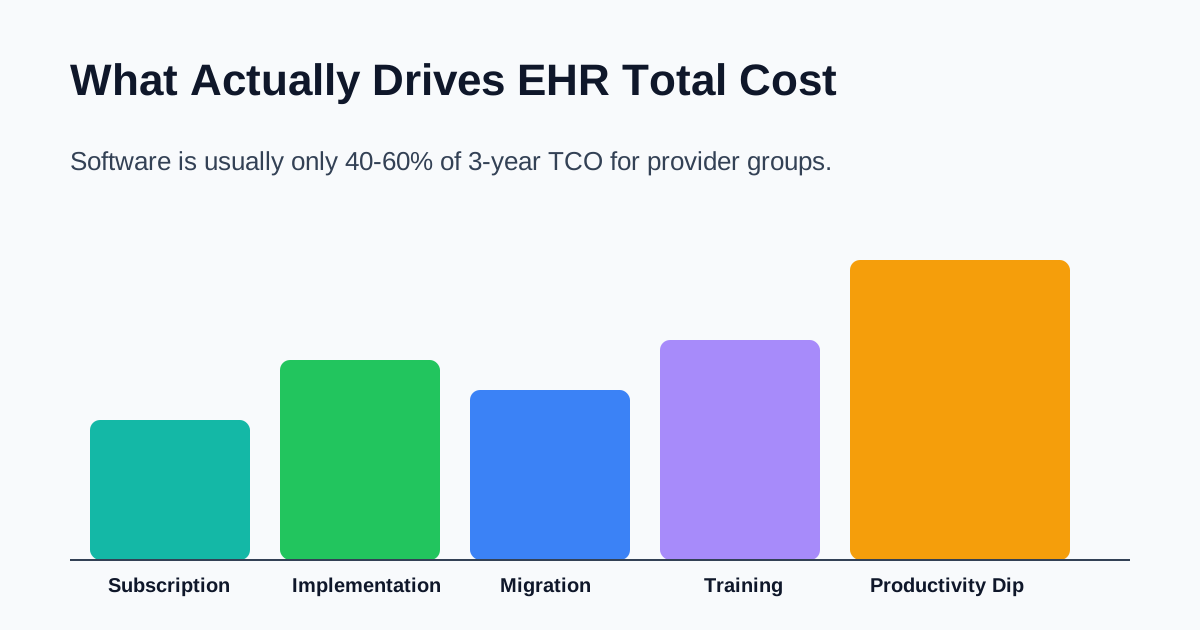
- The software subscription is only 40-60% of total cost. Hidden expenses — implementation, training, data migration, and productivity loss — can add $15,000-$50,000+ for a small practice.
- Over 5 years, cloud EHR costs a solo practice roughly $55,000-$60,000 vs. $75,000-$85,000 for on-premise when IT labor is honestly included.
- AHRQ data shows EHR systems generate an average net benefit of $86,400 per provider over 5 years, with most practices achieving payback within 10 months.
- Always budget a 15-20% contingency. Every EHR implementation has unexpected costs — the question is whether you've planned for them.
How to Calculate ROI for Your EHR Investment
EHR Pricing at a Glance
"How much does an EHR cost?" is the most common question we receive — and it's the hardest to answer with a single number. EHR pricing depends on your practice size, specialty, deployment model (cloud vs. on-premise), the modules you need, and the vendor you choose. A solo behavioral health therapist might pay $49/month. A 25-provider multi-specialty group could pay $12,000/month or more.
Making it harder: most EHR vendors don't publish transparent pricing. They want you on a sales call. This guide cuts through that opacity with real pricing data gathered from vendor websites, published rate cards, verified user reports, and our own research.
More importantly, the subscription or license fee is only part of the story. The total cost of owning an EHR includes implementation, data migration, training, hardware, interface fees, and the productivity dip during go-live. Practices that budget only for the monthly subscription are routinely blindsided by 30-50% in additional costs.
This guide covers everything: pricing models, vendor-specific numbers, hidden costs, a complete 5-year total cost of ownership comparison, how to budget properly, and the ROI data that justifies the investment.
EHR Pricing Models Explained
Before comparing specific vendors, you need to understand the three dominant pricing models in the EHR market. Each has different cash flow implications, risk profiles, and long-term cost trajectories.
1. SaaS / Subscription (Per Provider Per Month)
This is the dominant model in 2026, used by roughly 80% of cloud EHR vendors. You pay a recurring monthly or annual fee per provider (sometimes per user) for access to the software. The vendor handles hosting, maintenance, updates, backups, and security.
- Typical range: $150-$700/provider/month for general medical; $49-$150/month for behavioral health and solo platforms
- What's included: Software access, hosting, automatic updates, basic support, regulatory updates (ICD, CMS rule changes)
- What's extra: Implementation/setup, data migration, advanced training, premium support, add-on modules (telehealth, patient portal, advanced analytics)
- Vendors using this model: AdvancedMD, DrChrono, eClinicalWorks, NextGen, TherapyNotes, SimplePractice, Greenway Health
Pros: Low upfront cost, predictable monthly expense, vendor handles all infrastructure, always running the latest version.
Cons: Ongoing cost never ends (you're renting, not owning), potential price increases at renewal, vendor lock-in if data portability is limited.
2. Perpetual License (One-Time Purchase)
The traditional model, now primarily used by on-premise EHR systems. You purchase a perpetual software license upfront and own the right to use the software indefinitely. But you pay separately for hosting, support, and updates.
- Typical range: $3,000-$25,000+ per provider (one-time license), plus 15-20% of the license cost annually for maintenance and support
- What's included: Perpetual right to use the software version you purchased
- What's extra: Server hardware, IT staff/MSP, annual maintenance (bug fixes, regulatory updates), major version upgrades, hosting, backups
- Vendors historically using this model: Some legacy systems, on-premise Epic and Oracle Health (Cerner) deployments
Pros: You "own" the software, no recurring subscription, total control over update timing.
Cons: High upfront cost, annual maintenance still required, hardware and IT labor add significantly, version upgrades can cost as much as a new license.
3. Percentage-of-Collections
A less common but notable model where the vendor charges a percentage of the revenue collected through their billing/RCM platform. The most prominent example is athenahealth, which combines a base subscription with a collections-based fee.
- Typical range: 4-8% of collections, sometimes on top of a base subscription fee
- What's included: Full RCM service (claim submission, follow-up, denial management, payment posting) in addition to EHR access
- What's extra: Implementation, data migration, advanced modules
- Vendors using this model: athenahealth (hybrid: base + % of collections), some RCM-focused vendors
Pros: Aligns vendor incentives with yours (they earn more when you collect more), reduces risk for new practices, includes comprehensive billing services.
Cons: Can cost more than flat subscription for high-revenue practices, less predictable monthly expense, harder to comparison-shop.
Watch out: Some vendors quote a low per-provider price but charge separately for practice management, billing, patient portal, telehealth, e-prescribing, and reporting modules. Always ask for the "all-in" price that includes every module you need. A $200/month EHR that requires $150/month in add-ons is really a $350/month EHR.
What an EHR Actually Costs by Practice Size
Practice size is the single biggest determinant of total EHR cost. Here's what to expect across the spectrum, including both the software subscription and the implementation expenses that vendors don't always mention upfront.
Solo Practice (1 Provider)
| Cost Category | Low Estimate | High Estimate |
|---|---|---|
| Monthly subscription | $200/mo | $700/mo |
| Annual software cost | $2,400 | $8,400 |
| Implementation/setup | $1,000 | $5,000 |
| Data migration | $0 | $5,000 |
| Training | $500 | $3,000 |
| Productivity loss (go-live) | $3,000 | $8,000 |
| First-Year Total | $6,900 | $29,400 |
Note: Data migration cost is $0 if this is your first EHR (transitioning from paper). Productivity loss estimated at 10-25% of revenue for 2-4 weeks.
Small Practice (2-5 Providers)
| Cost Category | Low Estimate (3 providers) | High Estimate (5 providers) |
|---|---|---|
| Monthly subscription | $600/mo | $3,500/mo |
| Annual software cost | $7,200 | $42,000 |
| Implementation/setup | $3,000 | $15,000 |
| Data migration | $2,000 | $10,000 |
| Training ($1-3K per provider) | $3,000 | $15,000 |
| Productivity loss | $8,000 | $30,000 |
| First-Year Total | $23,200 | $112,000 |
Mid-Size Practice (6-25 Providers)
| Cost Category | Low Estimate (10 providers) | High Estimate (25 providers) |
|---|---|---|
| Monthly subscription | $2,000/mo | $15,000/mo |
| Annual software cost | $24,000 | $180,000 |
| Implementation/setup | $10,000 | $50,000 |
| Data migration | $5,000 | $25,000 |
| Training | $15,000 | $50,000 |
| Productivity loss | $25,000 | $100,000 |
| First-Year Total | $79,000 | $405,000 |
Large Practice (25+ Providers)
At 25+ providers, you're entering enterprise territory. Annual software costs alone range from $120,000 to $500,000+, and implementation projects regularly exceed $250,000 when you include training, data migration, and workflow redesign. Organizations at this scale should budget $500,000 to $2 million+ for the complete first-year cost, depending on the vendor and complexity. The implementation checklist becomes essential at this scale.
Vendor-by-Vendor Pricing Breakdown
Below is pricing data for eight major EHR vendors. These figures are based on published rate cards, verified user reports, and vendor disclosures as of early 2026. Actual pricing may vary based on contract negotiation, practice size, and bundled modules.
| Vendor | Monthly Price | Model | Best For |
|---|---|---|---|
| athenahealth | $140+/provider + % of collections | Subscription + RCM % | 5-100+ provider groups |
| AdvancedMD | $229-$729/provider/mo | Flat subscription | Independent practices, multi-specialty |
| DrChrono (Tebra) | $299+/provider/mo | Flat subscription | Small practices, iPad-first |
| eClinicalWorks | $449-$599/provider/mo | Flat subscription | Mid-large practices, FQHCs |
| NextGen Healthcare | $150-$500/provider/mo | Flat subscription | Specialty practices, mid-size groups |
| Greenway Health | $100-$500/provider/mo | Flat subscription | Primary care, small-mid groups |
| TherapyNotes | $69-$79/mo | Per-clinician subscription | Behavioral health solo/small |
| SimplePractice | $49+/mo | Per-clinician subscription | BH, wellness, solo practitioners |
athenahealth
athenahealth uses a hybrid pricing model: a base subscription starting around $140 per provider per month, plus a percentage of net collections processed through their integrated revenue cycle management (RCM) service. The collections percentage typically ranges from 4-8%, depending on contract terms and volume.
For a solo provider collecting $400,000/year, the RCM fee at 5% adds approximately $1,667/month on top of the base subscription — making the effective monthly cost roughly $1,800. That sounds expensive, but it includes full billing and collections management that you'd otherwise pay a billing staff member $40,000-$60,000/year to handle. For practices that want to outsource their entire revenue cycle, athenahealth's model is often cost-competitive. For practices with an efficient in-house billing team, the percentage-based fee can be more expensive than a flat-rate competitor.
AdvancedMD
AdvancedMD offers tiered pricing based on modules. EHR-only starts around $229/provider/month. Adding practice management pushes it to $329-$429/month. The full suite — EHR, PM, billing, patient portal, and telehealth — can reach $629-$729/provider/month. AdvancedMD targets independent practices and offers deep configurability for multi-specialty groups. They also offer an RCM-as-a-service option that adds to the base price.
DrChrono (Tebra)
DrChrono, now part of the Tebra platform after merging with Kareo, prices its EHR at $299/provider/month and up for the full-featured plan. They're known for their iPad-first design and appeal to small practices and solo practitioners. Tebra also offers a practice management and billing module. Implementation support is included in some plans, though advanced data migration is an additional cost.
eClinicalWorks
eClinicalWorks serves 150,000+ providers and prices its cloud offering between $449 and $599 per provider per month for the EHR and PM bundle. They offer strong population health, patient engagement, and telehealth capabilities. eClinicalWorks is popular with federally qualified health centers (FQHCs) and large multi-location groups. Implementation fees are separate and typically run $5,000-$20,000+ depending on complexity.
NextGen Healthcare
NextGen prices between $150 and $500 per provider per month, with the wide range reflecting their modular approach and specialty-specific editions. They have particularly strong offerings for specialty practices including cardiology, orthopedics, and dermatology. NextGen is a good fit for mid-size groups (10-50 providers) that need specialty workflows. Volume discounts are available for larger organizations.
Greenway Health
Greenway Health (Intergy and Prime Suite) prices between $100 and $500 per provider per month. They target primary care and small-to-mid-size groups. Greenway's lower-tier pricing makes them competitive for cost-conscious practices that need core EHR and PM functionality without extensive add-ons. Implementation and training fees vary but are generally in the $3,000-$15,000 range for small practices.
TherapyNotes
TherapyNotes is purpose-built for behavioral health — therapists, psychologists, psychiatrists, and social workers. Pricing is straightforward: $69/month for solo clinicians, $79/month per clinician for group practices, with a 30-day free trial. This includes EHR, scheduling, billing, telehealth, and a client portal. No implementation fee. No long-term contract. For BH solo practitioners, TherapyNotes represents one of the best value propositions in the market.
SimplePractice
SimplePractice targets behavioral health therapists, counselors, dietitians, and wellness practitioners. Plans start at $49/month (Starter) and go to $99/month (Professional) per clinician. The Starter plan includes basic scheduling and documentation; the Professional plan adds insurance claim filing, a client portal, and telehealth. Like TherapyNotes, there's no implementation fee and no contract, making it extremely accessible for solo practitioners launching a private practice.
Cloud vs. On-Premise: 5-Year Total Cost of Ownership
The cloud vs. on-premise cost debate is one of the most misunderstood comparisons in healthcare IT. Surface-level analyses that exclude IT labor consistently make on-premise look cheaper than it actually is. Here's a complete picture for a solo practice and a 10-provider group.
Solo Practice — 5-Year TCO
| Cost Category | Cloud | On-Premise |
|---|---|---|
| Software (subscription or license) | $48,000 | $15,000 |
| Setup & implementation | $3,000 | $8,000 |
| Server hardware | $0 | $8,000 |
| Annual maintenance & support | Included | $12,500 |
| IT support (MSP or part-time) | $2,500 | $30,000 |
| Hardware refresh (year 4) | $0 | $6,000 |
| Training | $2,000 | $2,000 |
| 5-Year Total | $55,500 | $81,500 |
Cloud subscription assumes $800/month average. On-premise IT support assumes $500/month MSP contract. On-premise annual maintenance assumes 15-20% of license cost.
Mid-Size Practice (10 Providers) — 5-Year TCO
| Cost Category | Cloud | On-Premise |
|---|---|---|
| Software | $300,000 | $75,000 |
| Setup & implementation | $15,000 | $35,000 |
| Server hardware & networking | $0 | $25,000 |
| Annual maintenance & support | Included | $50,000 |
| IT staff / MSP | $10,000 | $300,000 |
| Hardware refresh (year 4) | $0 | $18,000 |
| Training | $12,000 | $12,000 |
| 5-Year Total | $337,000 | $515,000 |
On-premise IT staff assumes a part-time system administrator at $60K/yr. Cloud subscription assumes $500/provider/month average.
The takeaway: When you honestly include IT labor — the expense most on-premise TCO analyses undercount — cloud EHR is less expensive at every practice size up to roughly 100 providers. Above that, on-premise can be cost-competitive if you have an existing IT department. For a detailed analysis of deployment models, see our cloud vs. on-premise EHR comparison.
How to Budget for an EHR: A Practical Framework
Based on the data above, here's a budgeting framework that accounts for both visible and hidden costs.
Step 1: Calculate Your Annual Software Cost
Multiply the per-provider monthly subscription by the number of providers and by 12. If you're evaluating athenahealth's percentage-of-collections model, estimate your annual collections and calculate the percentage fee. Add any required module add-ons (PM, billing, telehealth, patient portal) that aren't included in the base price.
Formula: (Monthly per-provider rate) x (# of providers) x 12 = Annual software cost
Step 2: Add One-Time Implementation Costs
Get explicit quotes from your vendor for: implementation/configuration fees, data migration, interface activation fees, and hardware (if on-premise or if workstations need replacing). Total these into a single "implementation budget" line item.
Step 3: Budget for Training
Plan for $1,000-$3,000 per provider for initial training. This includes vendor-led sessions, super-user advanced training, and ongoing education. Don't cut this line item — underfunding training is the single most reliable predictor of EHR implementation failure.
Step 4: Estimate Productivity Loss
Calculate your average weekly revenue, then multiply by 15% (a conservative mid-range estimate) and by the number of transition weeks (typically 2-4). This is money you won't collect during the go-live transition but still need to cover payroll, rent, and other fixed costs.
Formula: (Annual revenue / 52 weeks) x 15% x 3 weeks = Productivity loss reserve
Step 5: Add a 15-20% Contingency
Every EHR implementation surfaces unexpected costs: an interface that needs custom development, an additional training session, a hardware failure during go-live, or a longer-than-expected productivity dip. Adding 15-20% contingency to your total budget is not being pessimistic — it's being realistic. Practices that build in contingency have dramatically smoother implementations than those that budget to the dollar.
Sample Budget: 5-Provider Family Medicine Practice (Cloud EHR)
- Annual software subscription (5 x $350/mo x 12) $21,000
- Implementation and configuration $8,000
- Data migration (from previous EHR) $6,000
- Training (5 providers + 8 staff) $9,000
- Productivity loss (3 weeks at 15%) $12,000
- Hardware (2 new workstations, tablets) $3,500
- Subtotal $59,500
- 15% contingency $8,925
- Total First-Year Budget $68,425
EHR ROI: The Payback Math
An EHR is not just an expense — it's an investment that generates measurable financial returns. The question isn't whether an EHR pays for itself, but how quickly.
The Data on EHR ROI
Research from the Agency for Healthcare Research and Quality (AHRQ), the American Medical Association (AMA), and multiple academic studies provides a consistent picture:
- Average payback period: 10 months — A widely cited AHRQ-funded study of primary care practices found that the average time to recoup the initial EHR investment was approximately 10 months, with full ROI achieved within 2.5 years.
- Average annual savings: $33,000 per provider per year — Savings come from reduced transcription, fewer chart pulls, decreased claim denials, faster reimbursement, fewer duplicate tests, and improved coding accuracy.
- Net benefit over 5 years: $86,400 per provider — The same AHRQ research estimated a net benefit (savings minus total costs) of approximately $86,400 per provider over a 5-year period for primary care practices.
- Revenue cycle improvements — Practices using integrated EHR/PM billing report 5-10% increases in net collections from improved coding, reduced claim denials, and faster payment posting. For a provider generating $500,000/year, a 7% improvement adds $35,000 annually.
Where the ROI Comes From
| ROI Category | Estimated Annual Savings per Provider |
|---|---|
| Reduced transcription costs | $6,000-$12,000 |
| Reduced chart pull and filing labor | $3,000-$5,000 |
| Fewer claim denials (cleaner coding) | $8,000-$15,000 |
| Faster reimbursement (reduced days in A/R) | $2,000-$5,000 |
| Fewer duplicate tests and procedures | $3,000-$6,000 |
| Improved coding accuracy (upcoding capture) | $5,000-$10,000 |
| Reduced paper and supply costs | $1,000-$2,000 |
| Total Estimated Savings | $28,000-$55,000 |
Savings vary significantly by practice type, payer mix, starting efficiency, and how fully the EHR's features are utilized. Practices that use the EHR for clinical documentation only — without leveraging billing, e-prescribing, and patient engagement tools — realize substantially less ROI.
ROI Timeline
ROI doesn't happen on Day 1. Expect this trajectory:
- Months 1-3: Net negative. Productivity is down, implementation costs are hitting, and the system isn't yet optimized.
- Months 4-6: Approaching break-even. Staff is proficient, claim denials are stabilizing, and efficiency gains are emerging.
- Months 7-14: Payback period. For most primary care practices, the cumulative savings exceed the total investment by month 10-14.
- Year 2 onward: Net positive. Ongoing subscription costs are offset by sustained efficiency gains, and you're generating positive ROI each month.
Critical caveat: ROI figures assume you actually use the system's full capabilities. Practices that implement an EHR but continue using paper workarounds, manual billing processes, or don't activate e-prescribing and patient portal features will not achieve the savings documented in the research. The EHR is only as valuable as the workflows you build around it.
How to Reduce Your EHR Costs
EHR pricing is more negotiable than vendors want you to believe. Here are proven strategies to lower your total cost:
- Negotiate the contract term — Vendors offer significant discounts (10-25%) for 3-year vs. 1-year commitments. But balance the discount against the risk of being locked into a system you might want to leave. A 2-year initial term with a price cap on renewal is often the best compromise.
- Ask for implementation fee waivers — Many vendors will waive or reduce setup fees to win competitive deals. If you're evaluating multiple vendors, tell each one what the others are offering. This is standard practice in enterprise software negotiations.
- Bundle modules instead of adding them later — Buying EHR + PM + billing as a bundle at contract signing is almost always cheaper than adding modules à la carte later. Vendors have less leverage once you're already locked in.
- Time your purchase strategically — Like car dealerships, EHR vendors have quarterly and annual sales targets. Negotiating at the end of a quarter (March, June, September, December) often yields better pricing. Fiscal year-end (typically December or June) is especially productive.
- Use a behavioral health or specialty-specific platform — General-purpose EHRs like athenahealth and eClinicalWorks charge $300-$600/provider/month. Specialty platforms like TherapyNotes ($69/mo) or SimplePractice ($49/mo) serve behavioral health providers at a fraction of the cost because they don't need general-medical features.
- Leverage the selection process competitively — Get quotes from 3-5 vendors before making a decision. Share competitor pricing (tactfully) during negotiations. Most vendors have authorization to offer 10-20% discounts to win competitive situations but won't offer those rates unprompted.
- Cap annual price increases — Negotiate a clause that limits annual subscription increases to 3-5%. Without this protection, some vendors raise prices 7-10% at renewal, knowing the switching cost is high.
- Audit your user licenses annually — If a provider leaves and you don't remove their license, you're paying for a seat nobody uses. Review your active licenses quarterly and adjust.
Frequently Asked Questions
How much does an EHR system cost per month?
Cloud-based EHR systems typically cost $150 to $700 per provider per month for general medical practices. Behavioral health and solo-practice platforms like TherapyNotes ($69-$79/mo) and SimplePractice ($49+/mo) are significantly less expensive. The price depends on the vendor, included modules, number of providers, and contract length. Most vendors also charge one-time setup fees ranging from $1,000 to $10,000.
What are the hidden costs of EHR implementation?
The most commonly overlooked costs include: implementation and configuration fees ($5,000-$50,000), data migration ($2,000-$15,000+), staff training ($1,000-$3,000 per provider), productivity loss during go-live (10-25% revenue reduction for 2-4 weeks), hardware upgrades, interface fees for lab and pharmacy connections ($1,000-$5,000 per interface), and annual price increases at contract renewal. For a detailed implementation budget, see our EHR implementation checklist.
Is a cloud-based EHR cheaper than on-premise?
Over a 5-year period, cloud-based EHR is typically less expensive when you factor in all costs honestly — including IT labor. A solo practice might pay $55,000-$60,000 for cloud over 5 years vs. $75,000-$85,000 for on-premise. The cloud model has lower upfront costs and eliminates hardware and IT staffing expenses. On-premise can appear cheaper only if you exclude IT labor, which averages $500-$1,000/month even for small practices using a managed service provider. Read our full cloud vs. on-premise comparison for more.
What is the ROI of an EHR system?
According to AHRQ research, the average EHR generates a net benefit of approximately $86,400 per provider over five years for primary care practices, with most practices achieving payback within 10 months. ROI comes from reduced transcription costs, fewer denied claims, faster reimbursement, reduced chart pull labor, fewer duplicate tests, and improved coding accuracy. The average annual savings is approximately $33,000 per provider. Practices that fully utilize billing and revenue cycle management features see the fastest ROI.
Do EHR vendors charge percentage-of-collections fees?
Some vendors use a percentage-of-collections model. athenahealth is the most notable example, charging a base subscription plus a percentage (typically 4-8%) of collections processed through their RCM service. This model aligns the vendor's financial incentives with yours and includes comprehensive billing services. While it can cost more for high-revenue practices, it reduces upfront risk and may replace the need for in-house billing staff. Most other EHR vendors use flat per-provider monthly pricing.
The Bottom Line
EHR cost varies enormously — from $49/month for a solo behavioral health therapist to $500,000+ per year for a large multi-specialty group. But regardless of where you fall on that spectrum, the principles are the same:
- Look beyond the subscription. The monthly fee is only 40-60% of your true cost. Implementation, training, data migration, and productivity loss are real expenses that need real budget allocation.
- Compare total cost of ownership, not sticker price. A $200/month EHR with $25,000 in implementation fees isn't cheaper than a $350/month EHR with implementation included. Run the 3- or 5-year TCO before deciding.
- Budget a 15-20% contingency. Surprises are guaranteed. The only question is whether you've planned for them.
- The investment pays for itself. AHRQ data shows an average net benefit of $86,400 per provider over 5 years. The right EHR, properly implemented, is one of the best financial investments a practice can make.
- Don't cut training to save money. It's the most counterproductive cost reduction in healthcare IT. The practices that spend the least on training spend the most on rework, lost productivity, and staff turnover.
The right EHR at the right price with the right implementation strategy generates substantial positive ROI. The wrong EHR — or the right EHR with a botched implementation — becomes a years-long drain on your finances and staff morale. Use the data in this guide to make an informed decision, and don't hesitate to walk away from any vendor who won't provide transparent, all-in pricing.
Next Steps
- → Best EHR for Large Provider Groups — Enterprise economics and governance priorities
- → Cloud vs. On-Premise EHR — Understand deployment models before choosing a vendor
- → EHR Implementation Checklist — Phase-by-phase planning guide to avoid costly mistakes
- → The EHR Selection Process — 5-step vendor evaluation framework
- → Enterprise EHR RFP Template — Compare vendors with weighted scoring criteria
- → Denial Prevention Playbook — Reduce preventable write-offs with workflow controls
- → Behavioral Health EHR Comparison — Specialty-specific vendor comparison for BH practices